MCQ
Let $A$ be a $3 \times 3$ real matrix such that $A \left(\begin{array}{l}1 \\ 1 \\ 0\end{array}\right)=\left(\begin{array}{l}1 \\ 1 \\ 0\end{array}\right) ; A \left(\begin{array}{l}1 \\ 0 \\ 1\end{array}\right)=\left(\begin{array}{c}-1 \\ 0 \\ 1\end{array}\right)$ and $A \left(\begin{array}{l}0 \\ 0 \\ 1\end{array}\right)=\left(\begin{array}{l}1 \\ 1 \\ 2\end{array}\right)$. If $X =\left( x _{1}, x _{2}, x _{3}\right)^{ T }$ and $I$ is an identity matrix of order $3$ , then the system $( A -2 I ) X =\left(\begin{array}{l}4 \\ 1 \\ 1\end{array}\right)$ has
  • A
    no solution
  • infinitely many solutions
  • C
    unique solution
  • D
    exactly two solutions

Answer

Correct option: B.
infinitely many solutions
b
$A =\left[\begin{array}{lll} a _{1} & b _{1} & c _{1} \\ a _{2} & b _{2} & c _{2} \\ a _{3} & b _{3} & c _{3}\end{array}\right]$

$A \left[\begin{array}{l}0 \\ 0 \\ 1\end{array}\right]=\left[\begin{array}{l} c _{1} \\ c _{2} \\ c _{3}\end{array}\right]=\left[\begin{array}{l}1 \\ 1 \\ 2\end{array}\right]$

$\Rightarrow c _{1}=1, c _{2}=1, c _{3}=2$

$A \left[\begin{array}{l}1 \\ 0 \\ 1\end{array}\right]=\left[\begin{array}{l} c _{1}+ a _{1} \\ c _{2}+ a _{2} \\ c _{3}+ a _{3}\end{array}\right]=\left[\begin{array}{c}-1 \\ 0 \\ 1\end{array}\right]$

$\Rightarrow a _{1}=-2, a _{2}=-1, a _{3}=-1$

$A \left[\begin{array}{l}1 \\ 1 \\ 0\end{array}\right]=\left[\begin{array}{l} a _{1}+ b _{1} \\ a _{2}+ b _{2} \\ a _{3}+ b _{3}\end{array}\right]=\left[\begin{array}{l}1 \\ 1 \\ 0\end{array}\right]$

$\Rightarrow b _{1}=3, b _{2}=2, b _{3}=1$

$\Rightarrow \quad A =\left[\begin{array}{lll}-2 & 3 & 1 \\ -1 & 2 & 1 \\ -1 & 1 & 2\end{array}\right]$

$\Rightarrow A -2 I =\left[\begin{array}{ccc}-4 & 3 & 1 \\ -1 & 0 & 1 \\ -1 & 1 & 0\end{array}\right]$

$| A -2 I |=0$

Now, $\left[\begin{array}{lll}-4 & 3 & 1 \\ -1 & 0 & 1 \\ -1 & 1 & 0\end{array}\right]\left[\begin{array}{l} x _{1} \\ x _{2} \\ x _{3}\end{array}\right]=\left[\begin{array}{l}4 \\ 1 \\ 1\end{array}\right]$

$-4 x_{1}+3 x_{2}+x_{3}=4 \quad \ldots .$ ($1$)

$- x _{1}+ x _{3}=1 \ldots .$ ($2$)

$- x _{1}+ x _{2}=1 \ldots .$ ($2$)

(1) $-[(2)+3(3)]$

$0=0 \Rightarrow$ infinite solutions
Need a full question paper?

Generate a complete, print-ready paper with questions like this in minutes — across 16+ boards, with answer keys.

Start Generating Free

Similar questions

For $A=\left[\begin{array}{cc}3 & 1 \\ -1 & 2\end{array}\right]$, then $14 A^{-1}$ is given by
If $\vec a = 3\vec j + 4\vec k$ , $\vec b = 2\vec i + \vec k$ and $\vec c$ , $\vec d$ are respectively the component of $\vec a$ parallel & perpendicular to $\vec b$ ,then $\left[ {\left( {\vec a \times \vec c} \right) \times \left( {\vec c \times \vec d} \right)\,\left( {\vec c \times \vec d} \right) \times \left( {\vec d \times \vec a} \right)\left( {\vec d \times \vec a} \right) \times \left( {\vec a \times \vec c} \right)} \right]$ equals
If a curve $y = f ( x )$ passes through the point $(1,2)$ and satisfies $x \frac{d y}{d x}+y=b x^{4},$ then for what value of $b, \int_{1}^{2} f(x) d x=\frac{62}{5} ?$
A vector $r $ is equally inclined with the co-ordinate axes. If the tip of $ r $ is in the positive octant and $ |r| = 6,$  then $r$ is
Choose the correct answer from the given four options.
The value of $\lambda$ for which the vectors $3\hat{\text{i}}-6\hat{\text{j}}+\hat{\text{k}}$ and $2\hat{\text{i}}-4\hat{\text{j}}+\lambda\hat{\text{k}}$ are parallel, is:
Area of the ellipse $\frac{\text{x}^2}{\text{a}^2}+\frac{\text{y}^2}{\text{b}^2}=1$ is:
Consider the function $f$ in $\text{A}=\text{R}-\{\frac{2}{3}\}$ defiend as $\text{f(x)}=\frac{4\text{x}+3}{6\text{x}-4}.$ Find $f^{-1}$.
The integral value $\int_{ - 2}^0 {\left[ {{x^3} + 3{x^2} + 3x + 3 + (x + 1)\cos (x + 1)} \right]\;dx} $ is
 
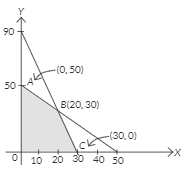
The maximum value of $Z=4 x+y$ for a $\text{L.P.P.}$ whose feasible region is given below is:
Image
If $f(x) f(y)=f(x+y)$ for all $x, y$; suppose $f(5)=2$ and $f^{\prime}(0)=3$, then $f^{\prime}(5)$ is equal to