MCQ
Let a function $f\left( x \right) = \left\{ \begin{gathered}
   - \ln \left( {3x - \left[ {3x} \right]} \right)\,;\,\,3x \ne n;n \in N \hfill \\
  \ln \left( {\operatorname{sgn} \left( {3x} \right)} \right)\,\,\,\,\,\,\,;\,\,3x = n;n \in N \hfill \\ 
\end{gathered}  \right.,$ (where [.] and sgn $(x)$ denotes greatest integer function and signum function respectively) then number of point $(s)$ , where $f(x)$ is minimum in $x  \in  (0, 5)$ , is 
  • A
    $0$
  • B
    $4$
  • C
    $5$
  • $14$

Answer

Correct option: D.
$14$
d
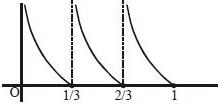
$f(\mathrm{x})=\left\{\begin{array}{ll}{-\ln \{3 \mathrm{x}\}} & {; 3 \mathrm{x} \neq \mathrm{n}} \\ {0} & {; 3 \mathrm{x}=\mathrm{n}}\end{array}\right.$

Graph of $f(\mathrm{x})$ will be

$\therefore \quad$ Local minima at $\mathrm{x}=\frac{1}{9}, \frac{2}{3}, \frac{3}{3}, \ldots \ldots, \frac{14}{3}$

$\Rightarrow 14$ points.

Need a full question paper?

Generate a complete, print-ready paper with questions like this in minutes — across 16+ boards, with answer keys.

Start Generating Free

Similar questions

A stick of length $10$ units rests against the floor $\&$ a wall of a room . If the stick begins to slide on the floor then the locus of its middle point is :
The equation of the normal to the ellipse $\frac{{{x^2}}}{{{a^2}}} + \frac{{{y^2}}}{{{b^2}}} = 1$ at the point $(a\cos \theta ,\;b\sin \theta )$ is
The solution of the inequallity $(cot^{-1}x)^2 -5cot^{-1}x + 6 > 0$ is :-
If $x, y, z \in R^+$ such that $x + y + z = 4$, then maximum possible value of $xyz^2$ is -
The curve $xy = c, (c > 0)$, and the circle $x^2 + y^2 = 1$ touch at two points. Then the distance between the points of contacts is
Let $R$ be the relation on the set $R$ of all real numbers defined by $a \ R \ b$ if $|a - b| \le 1$. Then $R$ is
The point of intersection of the lines $(a^3 + 3)x+ ay + a - 3 =0$ and $(a^5 + 2)x+ (a + 2)y+ 2a + 3 = 0$ ($a$ is a real) lies on the $y-$ axis for
An organization awarded $48$ medals in event '$A$',$25$ in event '$B$ ' and $18$ in event ' $C$ '. If these medals went to total $60$ men and only five men got medals in all the three events, then, how many received medals in exactly two of three events?
What is the sum of all two digit numbers which give a remainder of $4$ when divided by $6$ ?
Let $f$ be differentiable function such that $(x - y) f(x + y) - (x + y) f(x - y) = 4xy(x^2 - y^2)$ and $f(1) = 2$ . Then area enclosed by $\frac{{{\left| f(x)-x \right|}^{\frac{1}{3}}}}{17}+\frac{{{\left| f\left( y \right)-y \right|}^{\frac{1}{3}}}}{2}\le \frac{1}{4},$ is