Question
Let $A =\left[\begin{array}{ll}4 & -2 \\ 6 & -3\end{array}\right], B =\left[\begin{array}{cc}0 & 2 \\ 1 & -1\end{array}\right]$ and $C =\left[\begin{array}{cc}-2 & 3 \\ 1 & -1\end{array}\right]$. Find $A^2 - A + BC$.

Answer

$A=\left[\begin{array}{ll}4 & -2 \\ 6 & -3\end{array}\right], B=\left[\begin{array}{cc}0 & 2 \\ 1 & -1\end{array}\right] \text { and } C=\left[\begin{array}{cc}-2 & 3 \\ 1 & -1\end{array}\right] . $
$ \therefore A^2=\left[\begin{array}{ll}4 & -2 \\ 6 & -3\end{array}\right]\left[\begin{array}{ll}4 & -2 \\ 6 & -3\end{array}\right] $
$ =\left[\begin{array}{cc}16-12 & -8+6 \\ 24-18 & -12+9\end{array}\right]$
$BC =\left[\begin{array}{cc}0 & 2 \\ 1 & -1\end{array}\right]\left[\begin{array}{cc}-2 & 3 \\ 1 & -1\end{array}\right]=\left[\begin{array}{cc}0+2 & 0-2 \\ -2-1 & 3+1\end{array}\right] $
$ =\left[\begin{array}{cc}2 & -2 \\ -3 & 4\end{array}\right]$
Now $A ^2- A + BC$
$ =\left[\begin{array}{ll} 4 & -2 \\ 6 & -3 \end{array}\right]-\left[\begin{array}{cc} 4 & -2 \\ 6 & -3
\end{array}\right]+\left[\begin{array}{cc} 2 & -2 \\ -3 & 4 \end{array}\right] $
$=\left[\begin{array}{ll} 0 & 0 \\ 0 & 0 \end{array}\right]+\left[\begin{array}{cc} 2 & -2 \\ -3 & 4 \end{array}\right]=\left[\begin{array}{cc} 2 & -2 \\-3 & 4 \end{array}\right] $

Need a full question paper?

Generate a complete, print-ready paper with questions like this in minutes — across 16+ boards, with answer keys.
Start Generating Free

Similar questions

The perimeter of a rectangular field is $82\ m$ and its area is $400\ m^2,$ find the dimension of the rectangular field.
Solve the equation $x^4 + 2x^3- 13x^2 + 2x + 1 = 0.$
By using the distance formula prove that each of the following sets of points are the vertices of a right angled triangle.
(i) $(6, 2), (3, -1)$ and $(- 2, 4)$
(ii) $(-2, 2), (8, -2)$ and $(-4, -3).$
If the seventh term of an A.P. is $\frac{1}{9}$ and its ninth term is $\frac{1}{7}$, find its 63 rd term.
An observer, 1.5m tall, is 28.5m away from a tower 30m high. Determine the angle of elevation of the top of the tower from his eye.
An exhibition tent is in the form of a cylinder surmounted by a cone. The height of the tent above the ground is $85\ m$ and height of the cylindrical part of $50\ m.$ If the diameter of the base is $168\ m,$ find the quantity of canvas required to make the tent. Allow $20\%$ extra for fold and for stitching. Give your answer to the nearest $m^2.$
if x $=\frac{6 a b}{a+b}$ find the value of $\frac{x+3 a}{x-3 a}=\frac{x+3 b}{x-3 b}$
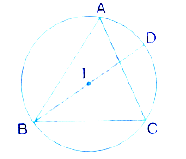
In the given figure, I is the incentre of ΔABC. BI when produced meets the circumcircle of
ΔABC at D. ∠BAC = 55° and ∠ACB = 65°; calculate:
(i) ∠DCA, (ii) ∠DAC, (iii) ∠DCI, (iv) AIC
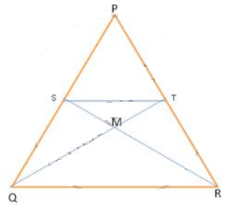
Figure shows $\triangle PQR$ in which $ST \| QR$ and $SR$ and $QT$ intersect each other at $M$. If $\frac{ PT }{ TR }=\frac{5}{3}$ find $\frac{\operatorname{Ar}(\triangle MTS )}{\operatorname{Ar}(\triangle MQR )}$
Image
Prove that $\sqrt{\frac{1+\cos A}{1-\cos A}}=\frac{\tan A+\sin A}{\tan A \cdot \sin A}$