MCQ
Let A = N × N and × be the binary operation on A defined by (a, b) × (c, d) = (a + c, b + d). Then × is:
  • A
    Commutative.
  • B
    Associative.
  • Both (a) and (b).
  • D
    None of these.l

Answer

Correct option: C.
Both (a) and (b).

Need a full question paper?

Generate a complete, print-ready paper with questions like this in minutes — across 16+ boards, with answer keys.
Start Generating Free

Similar questions

If the three points $A(1, 6), B(3, −4)$ and $C(x, y)$ are collinear, then the equation satisfying by $x$ and $y$ is:
Which of the following functions from $\text{A}=\{\text{x}\in\text{R}:-1\leq\text{x}\leq1\}$ to itself are bijections?
If $\int\limits^\alpha_0\frac{1}{1+4\text{x}^2}\text{ dx}=\frac{\pi}{8},$ then a equals:
The value of the determinant $\begin{vmatrix}\text{a}^2&\text{a}&1\\\cos\text{nx}&\cos(\text{n}+1)\text{x}&\cos(\text{n}+2)\text{x}\\\sin\text{nx}&\sin(\text{n}+1)\text{x}&\sin(\text{n}+2)\text{x}\end{vmatrix}$ is independent of:
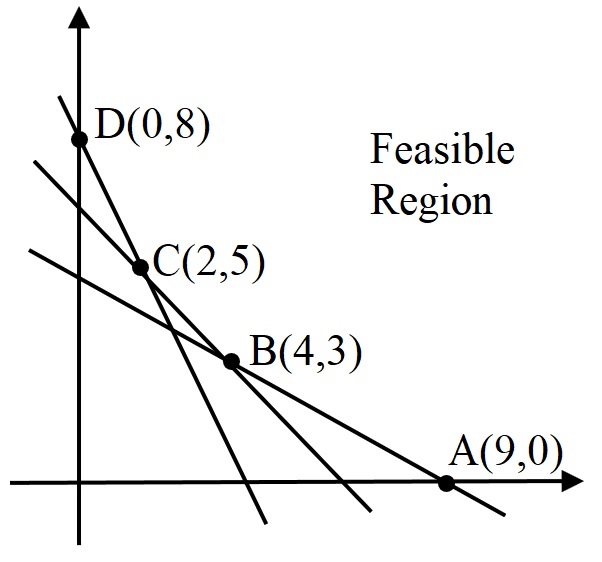
The feasible region for an LPP is shown shaded in the following figure. Minimum of Z = 4x + 3y occurs at the point.
If the length of the perpendicular drawn from the point $P ( a , 4,2), a >0$ on the line $\frac{x+1}{2}=\frac{y-3}{3}=\frac{z-1}{-1}$ is $2 \sqrt{6}$ units and $Q \left(\alpha_{1}, \alpha_{2}, \alpha_{3}\right)$ is the image of the point $P$ in this line, then $a+\sum_{i=1}^{3} \alpha_{i}$ is equal to.
$\overrightarrow a ,\overrightarrow b ,\overrightarrow c $ are non coplanar vectors such that $\overrightarrow P = \overrightarrow a + \overrightarrow b + \overrightarrow c, \overrightarrow Q = 4 \overrightarrow a + 3 \overrightarrow b + 4 \overrightarrow c$ and $ \overrightarrow R = \overrightarrow a + \alpha \overrightarrow b + \beta \overrightarrow c $ are linearly dependent vectors, then number of possible values of $\alpha$ is
A person writes $4$ letters and addresses $4$ envelopes. If the letters are placed in the envelopes at random, then the probability that all letters are not placed in the right envelopes, is
If $\cos^{-1}\text{x}>\sin^{-1}\text{x},$ then:
Difference between the greatest and the least values of the function$f (x) = x(ln x - 2)$ on $[1, e^2]$ is