Question
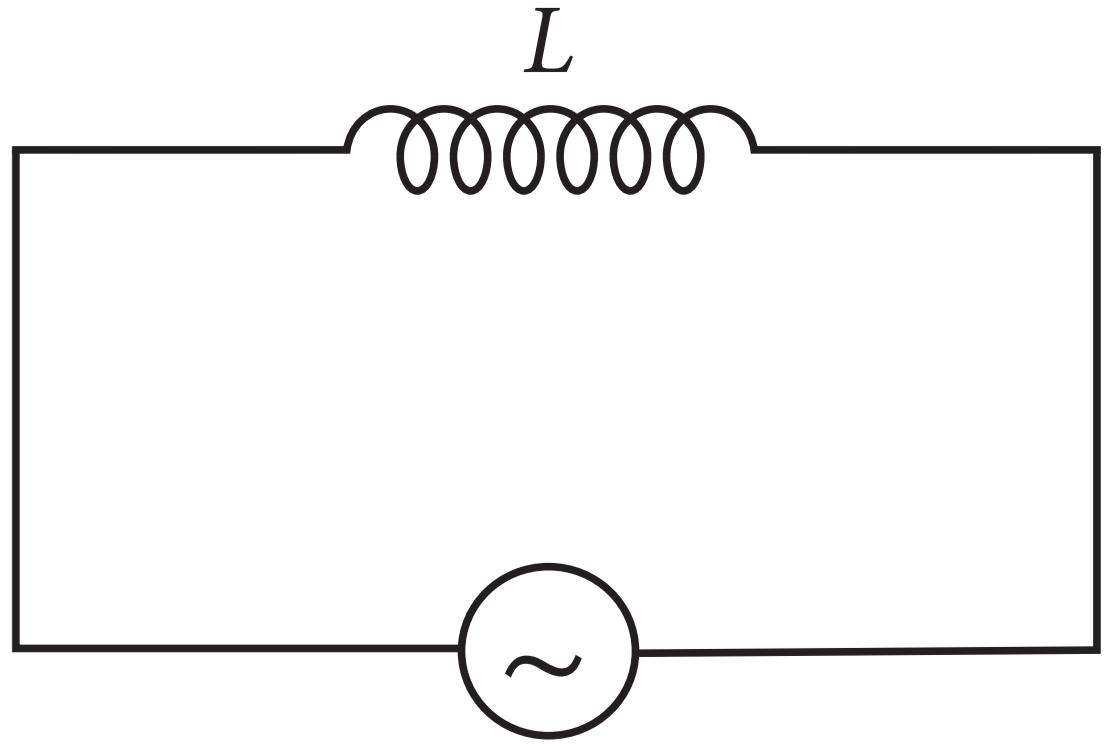
Let a source of alternating e.m.f. $\text{E} = \text{E}_\circ\sin\omega\text{t}$ be connected to a circuit containing a pure inductance L. If I is the value of instantaneous current in the circuit, then $\text{I}=\text{I}_\circ\sin\Big(\omega\text{t}-\frac{\pi}{2}\Big).$ The inductive reactance limits the current in a purely inductive circuit and is given by $\text{X}_\text{L}= \text{W}_\text{L}.$
  1. A 100 hertz a.c. is flowing in a 14mH coil. The reactance is:
  1. $15\Omega$
  2. $7.7\Omega$
  3. $8.8\Omega$
  4. $10\Omega$
  1. In a pure inductive circuit, resistance to the flow of current is offered by:
  1. Resistor
  2. Inductor
  3. Capacitor
  4. Resistor and inductor
  1. In a inductive circuit, by what value of phase angle does alternating current lags behind e.m.f.?
  1. 45º
  2. 90º
  3. 120º
  4. 75º
  1. How much inductance should be connected to 200V, 50Hz a.c. supply so that a maximum current of 0.9A flows through it?
  1. 5H
  2. 1H
  3. 10H
  4. 4.5H
  1. The maximum value of current when inductance of 2H is connected to 150V, 50Hz supply is:
  1. 0.337A
  2. 0.721A
  3. 1.521A
  4. 2.522A

Answer

  1. (c) $8.8\Omega$

Explanation:

Inductive reactance,

$\text{X}_\text{L}= \text{W}_\text{L}=2\pi\mu\text{L}$

$=2\pi\times100\times14\times10^{-3}$

$\text{X}_\text{L}=8.8\Omega$

  1. (b) Inductor
  2. (b) 90º

Explanation:

In an inductor vol tag: leads the current by $\frac{\pi}{2}$ or current lags the voltage by $\frac{\pi}{2}.$

  1. (b) 1H

Explanation:

The current in the inductor coil is given by,

$\text{I}_0=\frac{\text{E}_0}{\text{X}_\text{L}}=\frac{\sqrt{2}\text{E}_\text{V}}{2\pi\mu\text{L}}$

$\text{L}=\frac{\sqrt{2}\text{E}_\text{V}}{2\pi\mu\text{I}_0}=\frac{1.414\times200}{2\times3.14\times50\times0.9}=1\text{H}$

  1. (a) 0.337A

Explanation:

Inductive reactance,

$\text{X}_\text{L}= \text{W}_\text{L}=2\pi\mu\text{L}$

$=2\pi\times3.14\times50\times2=628\Omega$

$\text{I}_0=\frac{\text{E}_0}{\text{X}_\text{L}}$

$\Rightarrow\text{I}_0=\frac{\sqrt{2}\times\text{E}_\text{V}}{\text{X}_\text{L}}=\frac{\sqrt{2}\times150}{628}=0.337\text{A}$

Need a full question paper?

Generate a complete, print-ready paper with questions like this in minutes — across 16+ boards, with answer keys.

Start Generating Free

Similar questions

A magnetic field set up using Helmholtz coils (described in Exercise 4.16) is uniform in a small region and has a magnitude of 0.75 T. In the same region, a uniform electrostatic field is maintained in a direction normal to the common axis of the coils. A narrow beam of (single species) charged particles all accelerated through 15 kV enters this region in a direction perpendicular to both the axis of the coils and the electrostatic field. If the beam remains undeflected when the electrostatic field is 9.0 × 10–5 V m–1, make a simple guess as to what the beam contains. Why is the answer not unique?
Two point charges $+3.2 \times 10^{-19}$ Coulomb and $-3.2 \times 10^{-19}$ Coulomb are kept at a distance of 2.4 $\times 10^{-10}$ meters from each other. This dipole is placed at an angle of $30^{\circ}$ to the field direction in a uniform field of intensity of $3 \times 10^4$ Newton/Coulomb. Find the value of the moment of the couple acting on it. What will be the maximum value of this torque?
A police jeep is chasing a culprit going on a motorbike. The motorbike crosses a turning at a speed of 72km/h. The jeep follows it at a speed of 90km/h, crossing the turning ten seconds later than the bike. Assuming that they travel at constant speeds, how far from the turning will the jeep catch up with the bike?
Consider a coin of Example 1.20. It is electrically neutral and contains equal amounts of positive and negative charge of magnitude 34.8kC. Suppose that these equal charges were concentrated in two point charges seperated by,
  1. 1cm $\Big(\sim\frac{1}{2}\times\text{diagonalof theone paisa coin}\Big)$,
  2. 100m (~ length of a long building), and
  3. 106m (radius of the earth). Find the force on each such point charge in each of the three cases. What do you conclude from these results?
A player hits a baseball at some angle. The ball goes high up in space. The player runs and catches the ball before it hits the ground. Which of the two (the player or the ball) has greater displacement?
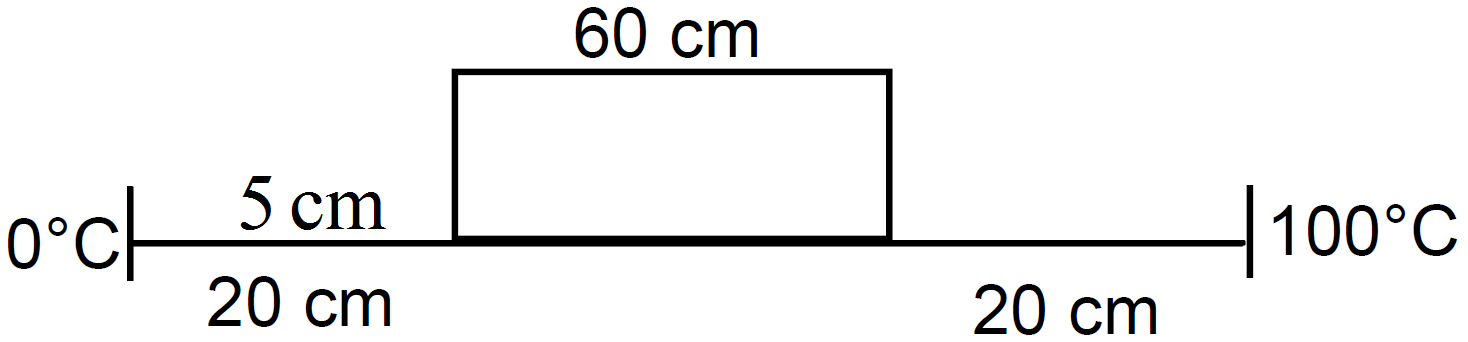
Consider the situation shown in figure. The frame is made of the same material and has a uniform cross-sectional area everywhere. Calculate the amount of heat flowing per second through a cross section of the bent part if the total heat taken out per second from the end at 100°C is 130J.

Two fat astronauts each of mass 120kg are travelling in a closed spaceship moving at a speed of 15km/s in the outer space far removed from all other material objects. The total mass of the spaceship and its contents including the astronauts is 660kg. If the astronauts do slimming exercise and thereby reduce their masses to 90kg each, with what velocity will the spaceship move?
A tangent galvanometer shows a deflection of 45° when 10mA of current is passed through it. If the horizontal component of the earth's magnetic field is BH = 3.6×10⁻⁵ T and radius of the coil is 10cm, find the number of turns in the coil.
Hydrogen spectrum consists of discrete bright lines in a dark background, and it is specifically known as hydrogen emission spectrum. There is one more type of hydrogen spectrum that exists where we get dark lines on the bright background, it is known as absorption spectrum. Balmer found an empirical formula by the observation of a small part of this spectrum, and it is represented by $\frac{1}{\lambda}=\text{R}\bigg(\frac{1}{2^2}-\frac{1}{\text{n}^2}\bigg)$ where n = 3, 4, 5 For Lyman series, the emission is from first state to nth state, for Paschen series, it is from third state to nth state, for Brackett series, it is from fourth state to nth state and for Pfund series, it is from fifth state to nth state.
  1. Number of spectral lines in hydrogen atom is:
  1. 8
  2. 6
  3. 15
  4. $\infty$
  1. Which series of hydrogen spectrum corresponds to ultraviolet region?
  1. Balmer series.
  2. Brackett series.
  3. Paschen series.
  4. Lyman series.
  1. Which of the following lines of the H-atom spectrum belongs to the Balmer series?
  1. 1025A
  2. 1218A
  3. 4861A
  4. 18751A
  1. Rydberg constant is.
  1. A universal constant.
  2. A universal constants.
  3. Different for different elements.
  4. None of these.
  1. Hydrogen atom is excited from ground state to another state with principal quantum number equal to 4. Then the number of spectral lines in the emission spectra will be.
  1. 3
  2. 5
  3. 6
  4. 2
The weight Mg of an extended body is generally shown in a diagram to act through the centre of mass. Does it mean that the earth does not attract other particles?