MCQ
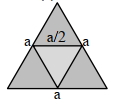
Let $\mathrm{ABC}$ be an equilateral triangle. A new triangle is formed by joining the middle points of all sides of the triangle $\mathrm{ABC}$ and the same process is repeated infinitely many times. If $\mathrm{P}$ is the sum of perimeters and $Q$ is be the sum of areas of all the triangles formed in this process, then:
  • $\mathrm{P}^2=36 \sqrt{3} \mathrm{Q}$
  • B
    $\mathrm{P}^2=6 \sqrt{3} \mathrm{Q}$
  • C
    $P=36 \sqrt{3} Q^2$
  • D
     $\mathrm{P}^2=72 \sqrt{3} \mathrm{Q}$

Answer

Correct option: A.
$\mathrm{P}^2=36 \sqrt{3} \mathrm{Q}$
a
Area of first $\Delta=\frac{\sqrt{3} \mathrm{a}^2}{4}$

Area of second $\Delta=\frac{\sqrt{3} a^2}{4} \frac{a^2}{4}=\frac{\sqrt{3} a^2}{16}$

Area of third $\Delta=\frac{\sqrt{3} \mathrm{a}^2}{64}$

sum of area $=\frac{\sqrt{3} a^2}{4}\left(1+\frac{1}{4}+\frac{1}{16} \ldots\right)$

$\mathrm{Q}=\frac{\sqrt{3} \mathrm{a}^2}{4} \frac{1}{\frac{3}{4}}=\frac{\mathrm{a}^2}{\sqrt{3}}$

perimeter of $1^{\text {st }} \Delta=3 \mathrm{a}$

perimeter of $2^{\text {nd }} \Delta=\frac{3 a}{2}$

perimeter of $3^{\text {rd }} \Delta=\frac{3 \mathrm{a}}{4}$

$ \mathrm{P}=3 \mathrm{a}\left(1+\frac{1}{2}+\frac{1}{4}+\ldots\right) $

$ \mathrm{P}=3 \mathrm{a} \cdot 2=6 \mathrm{a} $

$ \mathrm{a}=\frac{\mathrm{P}}{6} $

$ \mathrm{Q}=\frac{1}{\sqrt{3}} \cdot \frac{\mathrm{P}^2}{36} $

$ \mathrm{P}^2=36 \sqrt{3} \mathrm{Q}$

Need a full question paper?

Generate a complete, print-ready paper with questions like this in minutes — across 16+ boards, with answer keys.

Start Generating Free

Similar questions

Three vertices are chosen randomly from the seven vertices of a regular $7$ -sided polygon. The probability that they form the vertices of an isosceles triangle is
The equation of the pair of bisectors of the angles between two straight lines is,$12x^2 - 7xy - 12y^2 = 0$ . If the equation of one line is $2y - x = 0$ then the equation of the other line is :
Arrange the given words in the sequence in which they occur in the dictionary and then choose the correct sequence.
$1.$Page $2.$Pagan $3.$Palisade $4.$Pageant $5.$Palate
The sum to $n$ terms of the series ${2^2} + {4^2} + {6^2} + ...........$ is
The equation of a tangent to the parabola ${y^2} = 4ax$ making an angle $\theta $ with $x$ - axis is
A box contains $10$ good articles and $6$ defective articles. One item is drawn at random. The probability that it is either good or has a defect, is:
Let $H: \frac{-x^2}{a^2}+\frac{y^2}{b^2}=1$ be the hyperbola, whose eccentricity is $\sqrt{3}$ and the length of the latus rectum is $4 \sqrt{3}$. Suppose the point $(\alpha, 6), \alpha>0$ lies on $H$. If $\beta$ is the product of the focal distances of the point $(\alpha, 6)$, then $\alpha^2+\beta$ is equal to :
The product of the lengths of perpendiculars drawn from any point on the hyperbola $x^2 -2y^2 -2=0$  to its asymptotes is 
One vertex of the equilateral triangle with centroid at the origin and one side as $x + y - 2 = 0$ is:
$[$​​​​​​​Hint: Let $\text{ABC}$ be the equilateral triangle with vertex $A (h, k)$ and let $\text{D}(\alpha,\beta)$ be the point on $\text{BC.}$ Then $\frac{2\alpha+\text{h}}{3}=0=\frac{2\beta+\text{k}}{3}.$ Also $\alpha+\beta-2=0$ and $\frac{\text{k}-0}{\text{h}-0}\times(-1)=-1\Big].$
Any circle through the point of intersection of the lines $x + \sqrt 3 y = 1$ and $\sqrt 3 x - y = 2 $ if intersects these lines at points $P$ and $Q$, then the angle subtended by the arc $PQ$ at its centre is ............ $^o$