MCQ
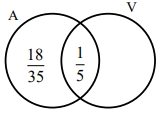
Let Ajay will not appear in $\ce{JEE}$ exam with probability $p =\frac{2}{7}$, while both Ajay and Vijay will appear in the exam with probability $q =\frac{1}{5}$. Then the probability, that Ajay will appear in the exam and Vijay will not appear is :
  • A
    $\frac{9}{35}$
  • B
    $\frac{18}{35}$
  • C
    $\frac{24}{35}$
  • D
    $\frac{3}{35}$

Answer

Image
$P(\overline{A})=\frac{2}{7}=p$
$P(A \cap V)=\frac{1}{5}=q$
$P(A)=\frac{5}{7}$
Ans. $P ( A \cap \overline{ V })=\frac{18}{35}$

Need a full question paper?

Generate a complete, print-ready paper with questions like this in minutes — across 16+ boards, with answer keys.

Start Generating Free

Similar questions

If in an examination different weights are assigned to different subjects. Physics $(2)$, Chemistry $(1)$, English $(1) $ Mathematics $(2)$. If a student scored $60$ in Physics, $70$ in Chemistry, $70$ in English and $80$ in Mathematics, then his weighted $A.M.$ is :-
Let $\alpha $, $\beta$ $\gamma$, $\delta$ are distinct imaginary roots of

$z^5=1$ then value of $\left| {\begin{array}{*{20}{c}}
  {{e^\alpha }}&{{e^{2\alpha }}}&{{e^{3\alpha  + 1}}}&{ - {e^{ - \delta }}} \\ 
  {{e^\beta }}&{{e^{2\beta }}}&{{e^{3\beta  + 1}}}&{ - {e^{ - \delta }}} \\ 
  {{e^\gamma }}&{{e^{2\gamma }}}&{{e^{3\gamma  + 1}}}&{ - {e^{ - \delta }}} 
\end{array}} \right|$

Let $S$ be a set containing n elements and we select $2$ subsets $A$ and $B$ of $S$ at random then the probability that $A \cup B = S$ and $A \cap B = \phi $ is
If $^n{C_r} = 84,{\;^n}{C_{r - 1}} = 36$ and $^n{C_{r + 1}} = 126$, then $n$ equals
If the circles ${x^2}\, + {y^2}\, - 16x\, - 20y\, + \,164\,\, = \,\,{r^2}$ and ${(x - 4)^2} + {(y - 7)^2} = 36$ intersect at two distinct points, then
${2^{1/4}}{.4^{1/8}}{.8^{1/16}}{.16^{1/32}}..........$ is equal to
The solution of the differential equation $\sqrt {a + x} \frac{{dy}}{{dx}} + xy = 0$is
If $\sum_{k=1}^{10} \frac{k}{k^{4}+k^{2}+1}=\frac{m}{n}$, where $m$ and $n$ are coprime, then $m+n$ is equal to.
If $x$  takes non-positive permissible value, then ${\sin ^{ - 1}}x =$
If both the roots of the quadratic equation $x^2 - mx + 4 = 0$ are real and distinct and they lie in the interval $[1, 5],$ then $m$ lies in the interval.