Question
Let $A=\left[\begin{array}{cc}2 & -1 \\ 3 & 4\end{array}\right], B=\left[\begin{array}{ll}5 & 2 \\ 7 & 4\end{array}\right], C=\left[\begin{array}{ll}2 & 5 \\ 3 & 8\end{array}\right]$. Find a matrix D such that $\mathrm{CD}-\mathrm{AB}=0$

Answer

Let $D = \left[ {\begin{array}{*{20}{c}} a&b \\ c&d \end{array}} \right]$
Given that CD - AB = O
$\left[ {\begin{array}{*{20}{c}} 2&5 \\ 3&8 \end{array}} \right]\left[ {\begin{array}{*{20}{c}} a&b \\ c&d \end{array}} \right] - \left[ {\begin{array}{*{20}{c}} 2&{ - 1} \\ 3&4 \end{array}} \right]\left[ {\begin{array}{*{20}{c}} 5&2 \\ 7&4 \end{array}} \right] = 0$
$\left[ {\begin{array}{*{20}{c}} {2a + 5c}&{2b + 5d} \\ {3a + 8c}&{3b + 8d} \end{array}} \right] - \left[ {\begin{array}{*{20}{c}} 3&0 \\ {43}&{22} \end{array}} \right] = 0$
$\left[ {\begin{array}{*{20}{c}} {2a + 5c - 3}&{2b + 5d} \\ {3a + 8c - 43}&{3b + 8d - 22} \end{array}} \right] = \left[ {\begin{array}{*{20}{c}} 0&0 \\ 0&0 \end{array}} \right]$
2a + 5c – 3 = 0........(1)
2b + 5d = 0.........(2)
3a + 8c – 43 = 0..........(3)
3b + 8d – 22 = 0..........(4)
Solving (1) and (3), we get, a = -191, c = 77.
Solving (2) and (4), we get, b = -110, d = 44
$D = \left[ {\begin{array}{*{20}{c}} { - 191}&{ - 110} \\ {77}&{44} \end{array}} \right]$

Need a full question paper?

Generate a complete, print-ready paper with questions like this in minutes — across 16+ boards, with answer keys.
Start Generating Free

Similar questions

If `$\text{y}=(\cos\text{x})^{(\cos\text{x})^{(\cos\text{x})\dots\infty}},$ show that $\frac{\text{dy}}{\text{dx}}=\frac{\text{y}^2\tan\text{x}}{\text{y}\log\cos\text{x}-1}.$
Find the equation of a curve passing through the point $(0, 0)$ and whose differential equation is $y\ ' = e^x \sin x.$
Five defective bolts are acciedently mixed with twenty good ones. If four bolts are drawn at random from this lot, find the probability distribution of the number of defective bolts.
Two numbers are selected at random (without replacement) from the first six positive integers. Let X denote the larger of the two numbers obtained. Find E(X).
Classify the following functions as injection, surjection or bijection : $f : R \rightarrow R,$ defined by $f(x) = 1 + x^2$
Evalute the following integrals:
$\int\frac{1}{\sqrt{1-\cos2\text{x}}}\text{dx}$
$\int\frac{1}{\sqrt{\text{x+a}}+\sqrt{\text{x+b}}}\text{dx}$
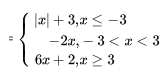
Find all points of discontinuity of $f$ where $f$ is defined as follows$, f(x)$
Image
If $\Big(\sin^{-1}\text{x}\Big)^2+\Big(\cos^{-1}\text{x}\Big)^2=\frac{175\pi^2}{36},$ find x.
Of the students in a college, it is known that $60\%$ reside in hostel and $40\%$ are day scholars $($not residing in hostel$)$. Previous year results report that $30\%$ of all students who reside in hostel attain. $A$ grade and $20\%$ of day scholars attain $A$ grade in their annual examination. At the end of year, one student is chosen at random from the college and he has an $A$ grade, what is the probability that the student is a hostlier?