MCQ
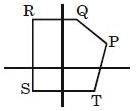
Let $\alpha $ and $\beta $ be integers satisfying $0 < \beta < \alpha $ .Let $P\left( {\alpha ,\beta } \right),Q$ be the reflection of $P$ in the line $y = x, R$ be the reflection of $Q$ in the $y-$ axis, $S$ be the reflection of $R$ in the $x-$ axis and $T$ be the reflection of $S$ in the $y-$ axis. If the area of convex pentagon $PQRST$ is $187\ sq. units$ , then value of $\alpha  + {\beta ^2}$ is
  • A
    $20$
  • B
    $34$
  • C
    $27$
  • $15$

Answer

Correct option: D.
$15$
d
$\mathrm{P}(\alpha, \beta), Q(\beta, \alpha), R(-\beta, \alpha), S(-\beta,-\alpha), T(\beta,-\alpha)$

$187=4 \alpha \beta+\frac{1}{2} \cdot 2 \alpha(\alpha-\beta)$

$187=\alpha(\alpha+3 \beta)$

$\alpha=11,3 \beta+\alpha=17$

$\alpha=11$ and $\beta=2$

Need a full question paper?

Generate a complete, print-ready paper with questions like this in minutes — across 16+ boards, with answer keys.

Start Generating Free

Similar questions

The probability of a man hitting a target is $\frac{1}{10}$. The least number of shots required, so that the probability of his hitting the target at least once is greater than $\frac{1}{4},$ is
The length of chord of contact of the tangents drawn from the point $(2, 5)$ to the parabola ${y^2} = 8x$, is
If $y = {\sec ^{ - 1}}{{2x} \over {1 + {x^2}}} + {\sin ^{ - 1}}{{x - 1} \over {x + 1}}$, then ${{dy} \over {dx}}$ is equal to
The sum $\frac{3}{{{1^2}}} + \frac{5}{{{1^2} + {2^2}}} + \frac{7}{{{1^2} + {2^2} + {3^2}}} + ....$ upto $11-$ terms is
Two distinct polynomials $f(x)$ and $g(x)$ are defined as follows:

$f(x)=x^2+a x+2 ; g(x)=x^2+2 x+a$.If the equations $f(x)=0$ and $g(x)=0$ have a common root, then the sum of the roots of the equation $f(x)+g(x)=0$ is

Let the line $x+y=1$ meet the axes of $x$ and $y$ at $A$ and $B$, respectively. A right angled triangle AMN is inscribed in the triangle OAB , where O is the origin and the points M and N lie on the lines OB and $A B$, respectively. If the area of the triangle AMN is $\frac{4}{9}$ of the area of the triangle OAB and $AN : NB =\lambda: 1$, then the sum of all possible value(s) of is $\lambda$ :
In the expansion of ${(1 + x)^5}$, the sum of the coefficient of the terms is
The value of $\left(\sin 70^{\circ}\right)\left(\cot 10^{\circ} \cot 70^{\circ}-1\right)$ is
The number of solutions of ${\log _4}(x - 1) = {\log _2}(x - 3)$
If $a, b, c$ be any three non-coplanar vectors, then $[a + b\,\,\,b + c\,\,\,c + a] = $