MCQ
Let $\alpha ,\beta $ be the roots of ${x^2} + (3 - \lambda )x - \lambda = 0.$ The value of $\lambda $ for which ${\alpha ^2} + {\beta ^2}$ is minimum, is
  • A
    $0$
  • B
    $1$
  • $2$
  • D
    $3$

Answer

Correct option: C.
$2$
c
(c) $\alpha + \beta = \lambda - 3\,\,\,\,{\rm{and }}\,\,\, \alpha \beta = - \lambda $

${\alpha ^2} + {\beta ^2} = {(\alpha + \beta )^2} - 2\alpha \beta $ = ${(\lambda - 3)^2} + 2\lambda = {\lambda ^2} - 4\lambda + 9$

from options,

for $\lambda = 0,\,{({\alpha ^2} + {\beta ^2})_{\lambda = 0}} = 9$

for $\lambda = 1,\,{({\alpha ^2} + {\beta ^2})_{\lambda = 1}} = 1 - 4 + 9 = 6$

for $\lambda = 2,\,{({\alpha ^2} + {\beta ^2})_{\lambda = 2}} = 4 - 8 + 9 = 5$

for $\lambda = 3,\,{({\alpha ^2} + {\beta ^2})_{\lambda = 3}} = 9 - 12 + 9 = 6$

${\alpha ^2} + {\beta ^2}$ is minimum for $\lambda = 2$.

Need a full question paper?

Generate a complete, print-ready paper with questions like this in minutes — across 16+ boards, with answer keys.
Start Generating Free

Similar questions

A jar contains $7$ white marbles and $3$ blue marbles. Given that the $4$ marbles are chosen from the jar at the same time, then the standard deviation of the number of the blue marbles choosen is $\frac {\sqrt a}{b}$  where $a$ and $b$ are co-prime numbers and $a$ is square free then $a + b$ is
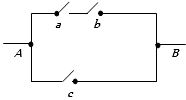
Consider the circuit,If the probability that each switch is closed is $p$, then find the probability of current flowing through $AB$
The equation of straight line passing through point of intersection of the straight lines $3x - y + 2 = 0$ and $5x - 2y + 7 = 0$ and having infinite slope is
A circle is drawn with $y- $ axis as a tangent and its centre at the point which is the reflection of $(3, 4)$ in the line $y = x$. The equation of the circle is
If $\int {x{e^{2x}}\,\,dx} $ is equal to ${e^{2x}}f(x) + C$ where  $C$ is constant of integration, then $ f(x)$  is
Let the lines $3 x-4 y-=0,8 x-11 y-33=0$, and $2 x-3 y+\lambda=0$ be concurrent. If the image of the point $(1,2)$ in the line $2 \mathrm{x}-3 \mathrm{y}+\lambda=0$ is $\left(\frac{57}{13}, \frac{-40}{13}\right)$, then $|\alpha \lambda|$ is equal to :
If $\frac{{dy}}{{dx}} = 1 + x + y + xy$ and $y( - 1) = 0,$ then function $y$ is
If a straight line $y - x = 2$ divides the region ${x^2} + {y^2} \le 4$ into two parts , then the ratio of the area of the smaller part to the area of the greater part is
The roots of the equation ${3^{2x}} - {10.3^x} + 9=0$ are
Let $S = \{\lambda ,\mu \} \in R \times R:f\left( t \right) = \left( {\left| \lambda \right|{e^{\left| t \right|}} - \mu } \right). sin \left( {2\left| t \right|} \right),t \in R$ , is a differentiable function . Then $S$ is a subest of?