MCQ
Let

$\alpha=\sum_{ k =1}^{\infty} \sin ^{2 k}\left(\frac{\pi}{6}\right)$

Let $g:[0,1] \rightarrow R$ be the function defined by

$g( x )=2^{\alpha x }+2^{\alpha(1- x )}$

Then, which of the following statements is/are $TRUE$?

$(A)$ The minimum value of $g( x )$ is $2^{\frac{7}{6}}$

$(B)$ The maximum value of $g( x )$ is $1+2^{\frac{1}{3}}$

$(C)$ The function $g( x )$ attains its maximum at more than one point

$(D)$ The function $g( x )$ attains its minimum at more than one point

  • A
    $A,B$
  • B
    $A,B,D$
  • C
    $A,C$
  • $A,B,C$

Answer

Correct option: D.
$A,B,C$
d
$\alpha=\left(\frac{1}{2}\right)^2+\left(\frac{1}{2}\right)^4+\left(\frac{1}{2}\right)^6+\ldots$

$\alpha=\frac{\frac{1}{4}}{1-\frac{1}{4}}=\frac{1}{3}$

$\therefore g(x)=2^{x / 3}+2^{1 / 3(1-x)}$

$\therefore g(x)=2^{x / 3}+\frac{2^{1 / 3}}{2^{x / 3}}$

$\text { where } g(0)=1+2^{1 / 3} \& g(1)=1+2^{1 / 3}$

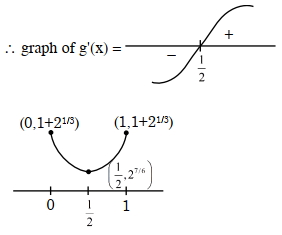
$\therefore g^{\prime}(x)=\frac{1}{3}\left(2^{x / 3}-\frac{2^{1 / 3}}{2^{\pi / 3}}\right)=0$

$\Rightarrow 2^{2 x / 3}=2^{1 / 3} \Rightarrow x=\frac{1}{2}=\text { critical point }$

(image)

& $g\left(\frac{1}{2}\right)=2^{\frac{7}{6}}$

$\therefore \text { graph of } g(x) \text { in }[0,1]$

(image)

Need a full question paper?

Generate a complete, print-ready paper with questions like this in minutes — across 16+ boards, with answer keys.

Start Generating Free

Similar questions

$\begin{vmatrix}\log_3512&\log_43\\\log_38&\log_49\end{vmatrix}\times\begin{vmatrix}\log_23&\log_83\\\log_34&\log_34\end{vmatrix}$
Choose the correct answer from the given four options. If $\cos^{-1}\alpha+\cos^{-1}\beta+\cos^{-1}\gamma=3\pi,$ then $\alpha(\beta+\gamma)+\beta(\gamma+\alpha)+\gamma(\alpha+\beta)$ equals:
Let $\overrightarrow{\mathrm{a}}=2 \hat{\mathrm{i}}-3 \hat{\mathrm{j}}+4 \hat{\mathrm{k}}, \overrightarrow{\mathrm{b}}=3 \hat{\mathrm{i}}+4 \hat{\mathrm{j}}-5 \hat{\mathrm{k}}$, and a vector $\vec{c}$ be such that $\vec{a} \times(\vec{b}+\vec{c})+\vec{b} \times \vec{c}=\hat{i}+8 \hat{j}+13 \hat{k}$. If $\vec{a} \cdot \vec{c}=13$, then $(24-\vec{b} \cdot \vec{c})$ is equal to ...........
Find the order of differential equations$:\ 2\text{x}^2\frac{\text{d}^2\text{y}}{\text{d}\text{y}^2}-3\frac{\text{dx}}{\text{dx}}+\text{y}=0$
If $f(x)=$  $7{e^{{{\sin }^2}x}} - {e^{{{\cos }^2}x}} + 2$, then,$\sqrt {7{f_{\min }} + {f_{\max }}}$ is equal to
The coordinates of the midpoints of the line segment joining the points $(2, 3, 4)$ and $(8, -3, 8)$ are:
Integrating factor of the differential equation $\left(1-x^2\right) \frac{d y}{d x}-x y=1$ is
The value of $p$ for which $p(\hat{i}+\hat{j}+\hat{k})$ is a unit vector is
The total revenue in Rupees received from the sale of $x$ units of a product is given by $R(x) 2 = 3x^2+ 36x + 5.$ The marginal revenue, when $x = 15$ is:
If integrating factor of $x(1 - {x^2})dy + (2{x^2}y - y - a{x^3})dx = 0$ is ${e^{\int_{}^{} {Pdx} }},$ then $P$ is equal to