MCQ
Let $D_1 =$ $\left| {\,\begin{array}{*{20}{c}}a&b&{a + b}\\c&d&{c + d}\\a&b&{a - b}\end{array}\,} \right|$ and $D_2 =$ $\left| {\,\begin{array}{*{20}{c}}a&c&{a + c}\\b&d&{b + d}\\a&c&{a + b + c}\end{array}\,} \right|$ then the value of $\frac{{{D_1}}}{{{D_2}}}$ where $b \ne 0$ and $ad \ne bc$, is
  • $-2$
  • B
    $0$
  • C
    $- 2b$
  • D
    $2b$

Answer

Correct option: A.
$-2$
a
Using $\rightarrow C_3 \rightarrow C_3 - (C_1 + C_2),$ $D_1 =$ $\left|{\,\begin{array}{*{20}{c}}a&b&{a + b}\\c&d&{c + d}\\a&b&{a - b}\end{array}\,} \right|$ and $D_2 = $ $\left| {\,\begin{array}{*{20}{c}}a&c&{a + c}\\b&d&{b + d}\\ a&c&{a + b + c}\end{array}\,} \right|$

$\therefore$ $\frac{{{D_1}}}{{{D_2}}}$ $=$ $\frac{{ - 2b(ad - bc)}}{{b(ad - bc)}}$ $=$ $- 2$ 

Need a full question paper?

Generate a complete, print-ready paper with questions like this in minutes — across 16+ boards, with answer keys.

Start Generating Free

Similar questions

If for $n \geq 1$ , ${P_n} = \int\limits_1^e {{{\left( {\log \,x} \right)}^n}\,dx} $ , then $P_{10} - 90P_8$ is equal to
If $\frac{d}{{dx}}\,G\left( x \right) = \frac{{{e^{\tan \,x}}}}{x},\,x \in \left( {0,\pi /2} \right)$, then $\int\limits_{1/4}^{1/2} {\frac{2}{x}} .{e^{\tan \,\left( {\pi \,{x^2}} \right)}}dx$ is equal to
Find adjoint of each of the matrices : $\left[\begin{array}{ll}1 & 2 \\ 3 & 4\end{array}\right]$
Let $a_{1}, a_{2}, a_{3}, \ldots$ be a G.P. such that $a_{1}<0$; $a_{1}+a_{2}=4$ and $a_{3}+a_{4}=16 .$ If $\sum\limits_{i=1}^{9} a_{i}=4 \lambda,$ then $\lambda$ is equal to 
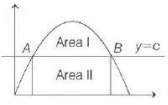
The figure shows a portion of the graph $y=2 x-4 x^3$.The line $y=c$ is such that the areas of the regions marked $I$ and $II$ are equal. If $a, b$ are the $x$-coordinates of $A, B$ respectively, then $a+b$ equals
If ${\sin ^{ - 1}}\frac{1}{3} + {\sin ^{ - 1}}\frac{2}{3} = {\sin ^{ - 1}}x,$ then $ x$  is equal to
Let ${T_n}$ denote the number of triangles which can be formed using the vertices of a regular polygon of $n$ sides. If ${T_{n + 1}} - {T_n} = 21,$ then $n$ equals
If $f"(x) < 0\, \forall \,x\, \in \,(0, 2)$ then $f(1 -x) + 2f(x/2)$ is :-
The position of a moving point in the $XY$ -plane at time $t$ is given by $\left( {(u\cos \alpha )t,(u\sin \alpha )t - \frac{1}{2}g{t^2}} \right),$ where $u,\,\alpha ,\,g$ are constants. The locus of the moving point is
If the value of $\frac{3 \cos 36^{\circ}+5 \sin 18^{\circ}}{5 \cos 36^{\circ}-3 \sin 18^{\circ}}$ is $\frac{a \sqrt{5}-b}{c}, $ where $a, b, c$ are natural numbers and $\text{gcd} (a, c) = 1,$ then $a + b + c$ is equal to: