MCQ
Let $E ^{ C }$ denote the complement of an event $E$. Let $E _{1}, E _{2}$ and $E _{3}$ be any pairwise independent events with $P \left( E _{1}\right) > 0$ and $P \left( E _{1} \cap E _{2} \cap E _{3}\right)=0$ Then $P \left( E _{2}^{ C } \cap E _{3}^{ C } / E _{1}\right)$ is equal to
  • $\mathrm{P}\left(\mathrm{E}_{3}^{\mathrm{C}}\right)-\mathrm{P}\left(\mathrm{E}_{2}\right)$
  • B
    $\mathrm{P}\left(\mathrm{E}_{2}^{\mathrm{C}}\right)+\mathrm{P}\left(\mathrm{E}_{3}\right)$
  • C
    $\mathrm{P}\left(\mathrm{E}_{3}^{\mathrm{C}}\right)-\mathrm{P}\left(\mathrm{E}_{2}^{\mathrm{C}}\right)$
  • D
    $\mathrm{P}\left(\mathrm{E}_{3}\right)-\mathrm{P}\left(\mathrm{E}_{2}^{\mathrm{C}}\right)$

Answer

Correct option: A.
$\mathrm{P}\left(\mathrm{E}_{3}^{\mathrm{C}}\right)-\mathrm{P}\left(\mathrm{E}_{2}\right)$
a
Given $\mathrm{E}_{1}, \mathrm{E}_{2}, \mathrm{E}_{3}$ are pairwise indepedent events $\operatorname{soP}\left(\mathrm{E}_{1} \cap \mathrm{E}_{2}\right)=\mathrm{P}\left(\mathrm{E}_{1}\right) \cdot \mathrm{P}\left(\mathrm{E}_{2}\right)$

and $\mathrm{P}\left(\mathrm{E}_{2} \cap \mathrm{E}_{3}\right)=\mathrm{P}\left(\mathrm{E}_{2}\right) \cdot \mathrm{P}\left(\mathrm{E}_{3}\right)$

and $\mathrm{P}\left(\mathrm{E}_{3} \cap \mathrm{E}_{1}\right)=\mathrm{P}\left(\mathrm{E}_{3}\right) \cdot \mathrm{P}\left(\mathrm{E}_{1}\right)$

$\& \mathrm{P}\left(\mathrm{E}_{1} \cap \mathrm{E}_{2} \cap \mathrm{E}_{3}\right)=0$

Now $\mathrm{P}\left(\frac{\overline{\mathrm{E}}_{2} \cap \overline{\mathrm{E}}_{3}}{\mathrm{E}_{1}}\right)=\frac{\mathrm{P}\left[\mathrm{E}_{1} \cap\left(\overline{\mathrm{E}}_{2} \cap \overline{\mathrm{E}}_{3}\right)\right]}{\mathrm{P}\left(\mathrm{E}_{1}\right)}$

$=\frac{\mathrm{P}\left(\mathrm{E}_{1}\right)-\left[\mathrm{P}\left(\mathrm{E}_{1} \cap \mathrm{E}_{2}\right)+\mathrm{P}\left(\mathrm{E}_{1} \cap \mathrm{E}_{3}\right)-\mathrm{P}\left(\mathrm{E}_{1} \cap \mathrm{E}_{2} \cap \mathrm{E}_{3}\right)\right]}{\mathrm{P}\left(\mathrm{E}_{1}\right)}$

$=\frac{\mathrm{P}\left(\mathrm{E}_{1}\right)-\mathrm{P}\left(\mathrm{E}_{1}\right) \cdot \mathrm{P}\left(\mathrm{E}_{2}\right)-\mathrm{P}\left(\mathrm{E}_{1}\right) \mathrm{P}\left(\mathrm{E}_{3}\right)-0}{\mathrm{P}\left(\mathrm{E}_{1}\right)}$

$=1-\mathrm{P}\left(\mathrm{E}_{2}\right)-\mathrm{P}\left(\mathrm{E}_{3}\right)$

$=\left[1-\mathrm{P}\left(\mathrm{E}_{3}\right)\right]-\mathrm{P}\left(\mathrm{E}_{2}\right)$

$=\mathrm{P}\left(\mathrm{E}_{3}^{\mathrm{c}}\right)-\mathrm{P}\left(\mathrm{E}_{2}\right)$
Need a full question paper?

Generate a complete, print-ready paper with questions like this in minutes — across 16+ boards, with answer keys.

Start Generating Free

Similar questions

The area of region $\{ \,(x,\,y):{x^2} + {y^2} \le 1 \le x + y\} $ is
$\int\text{e}^{\text{x}}\{\text{f(x)}+\text{f}'(\text{x})\}\text{dx}=$
  1. $\text{e}^{\text{x}}\text{f(x)}+\text{C}$
  2. $\text{e}^{\text{x}}+\text{f(x)}$
  3. $2\text{e}^{\text{x}}\text{f(x)}$
  4. $\text{e}^{\text{x}}-\text{f(x)}$
An urn contains 9 balls two of which are red, three blue and four black. Three balls are drawn at random. The probability that they are of the same colour is,
  1. $\frac{5}{84}$
  2. $\frac{3}{9}$
  3. $\frac{3}{7}$
  4. $\frac{7}{17}$
The differential equation of the ellipse $\frac{\text{x}^{2}}{\text{a}^{2}}+\frac{\text{y}^{2}}{\text{b}^{2}}=\text{C}$ is:
  1. $\frac{\text{y}''}{\text{y}'}+\frac{\text{y}'}{\text{y}}-\frac{1}{\text{x}}=0$
  2. $\frac{\text{y}''}{\text{y}'}+\frac{\text{y}'}{\text{y}}+\frac{1}{\text{x}}=0$
  3. $\frac{\text{y}''}{\text{y}'}-\frac{\text{y}'}{\text{y}}-\frac{1}{\text{x}}=0$
  4. None of these.
If $\left|\begin{array}{cc}x & 2 \\ 15 & x\end{array}\right|=\left|\begin{array}{ll}6 & 6 \\ 3 & 4\end{array}\right|$ then $x=$ _________.
The probability that an automobile will be stolen and found within one week is 0.0006. The probability that an automobile will be stolen is 0.0015. The probability that a stolen automobile will be found in one week is:
  1. 0.3
  2. 0.4
  3. 0.5
  4. 0.6
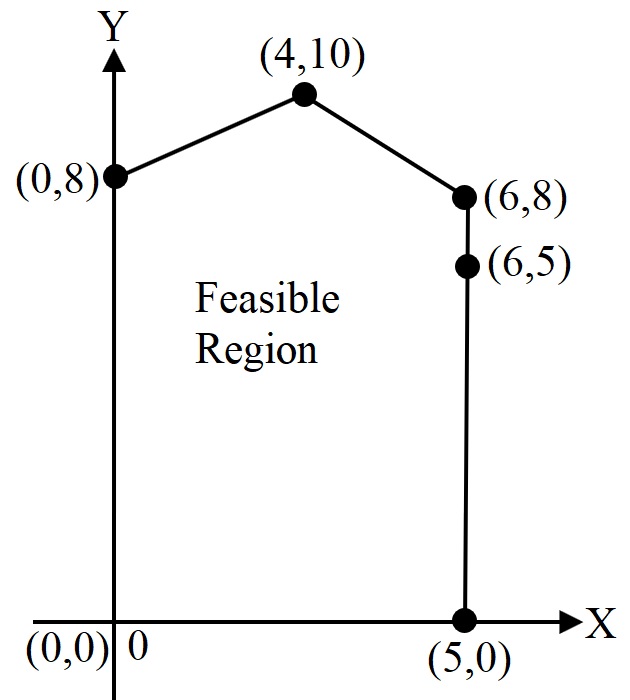
The feasible region for a LPP is shown shaded in the figure. Let Z = 3x - 4y be the objective function. Minimum of Z occurs at.

  1. (0, 0)
  2. (0, 8)
  3. (5, 0)
  4. (4, 10)
$\int_{}^{} {{e^{2x}}\left( {\frac{{\sin 4x - 2}}{{1 - \cos 4x}}} \right)\;dx = } $
Let the slope of the tangent to a curve $y=f(x)$ at $(x, y)$ be given by $2 \tan x(\cos x-y)$. if the curve passes through the point $(\frac{\pi}{4},0)$, then the value of $\int \limits_{0}^{\pi / 2} y d x$ is equal to
If $\int\text{x}\sin\text{x dx}=-\text{x}\cos\text{x}+\text{a},$ then a is equal to:
  1. $\sin\text{x}+\text{C}$
  2. $\cos\text{x}+\text{C}$
  3. $\text{C}$
  4. none of these.