MCQ
Let $f:[-1,2] \rightarrow[0, \infty)$ be a continuous function such that $f(x)=f(1-x)$ for all $x \in[-1,2]$. Let $R_1=\int_{-1}^2 x f(x) d x$, and $R_2$ be the area of the region bounded by $y=f(x), x=-1, x=2$, and the $x$-axis. Then
  • A
    $R_1=2 R_2$
  • B
    $R_1=3 R_2$
  • $2 R_1=R_2$
  • D
    $3 R_1=R_2$

Answer

Correct option: C.
$2 R_1=R_2$
c
$R_1=\int_{-1}^2 x f(x) d x=\int_{-1}^2(2-1-x) f(2-1-x) d x$

$=\int_{-1}^2(1-x) f(1-x) d x$

$=\int_{-1}^2(1-x) f(x) d x$

Hence $2 R_1=\int_{-1}^2 f(x) d x=R_2$.

Need a full question paper?

Generate a complete, print-ready paper with questions like this in minutes — across 16+ boards, with answer keys.

Start Generating Free

Similar questions

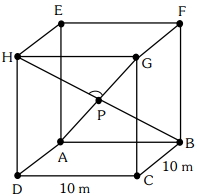
A hall has a square floor of dimension $10\, \mathrm{~m} \times 10\, \mathrm{~m}$ (see the figure) and vertical walls. If the angle $GPH$ between the diagonals $\mathrm{AG}$ and $\mathrm{BH}$ is $\cos ^{-1} \frac{1}{5}$, then the height of the hall (in $meters$) is :
Let $X Y$ be the diameter of a semi-circle with centre $O$. Let $A$ be a variable point on the semi-circle and $B$ another point on the semi-circle such that $A B$ is parallel to $X Y$.The value of $\angle B O Y$ for which the inradius of $\triangle A O B$ is maximum, is
Any circle through the points of intersection of the lines $x + \sqrt 3\, y = 1$ and $\sqrt 3\, x -y = 2$ if intersects these lines at points $P$ and $Q$, then the angle subtended by the arc $PQ$ at its centre is- ............. $^o$
Which one of the following statement is True ?
In what direction a line be drawn through the point $(1, 2)$ so that its points of intersection with the line $x + y = 4$ is at a distance $\frac{{\sqrt 6 }}{3}$ from the given point
Find the principal value of $\cos ^{-1}\left(-\frac{1}{\sqrt{2}}\right)$
The length of the chord joining the points in which the straight line $\frac{x}{3} + \frac{y}{4} = 1$ cuts the circle ${x^2} + {y^2} = \frac{{169}}{{25}}$ is 
The number of common tangent$(s)$ to the circles $x^2 + y^2 + 2x + 8y - 23 = 0$ and $x^2 + y^2 - 4x - 10y + 19 = 0$ is :
A bag contains $2$ white and $4$ black balls. A ball is drawn $5$ times with replacement. The probability that at least $4$ of the balls drawn are white is
${d \over {dx}}\left( {{x^2}\sin {1 \over x}} \right) = $