MCQ
Let $f$ be a differentiable function in $\left(0, \frac{\pi}{2}\right)$ If $\int\limits_{\cos x}^{1} t^{2} f(t) d t=\sin ^{3} x+\cos x-1$ then $\frac{1}{\sqrt{3}} f^{\prime}\left(\frac{1}{\sqrt{3}}\right)$ is equal to
  • A
    $6-9 \sqrt{2}$
  • B
    $\frac{9}{\sqrt{2}}-6$
  • C
    $\frac{9}{2}-6 \sqrt{2}$
  • $6-\frac{9}{\sqrt{2}}$

Answer

Correct option: D.
$6-\frac{9}{\sqrt{2}}$
d
$\int\limits_{\cos x}^{1} t^{2} f(t) d t=\sin ^{3} x+\cos x-1$

Calculation for option

differentiating both sides

$-\cos ^{2} x f(\cos x) \cdot(-\sin x)=3 \sin ^{2} x \cdot \cos x-\sin x$

$\Rightarrow f (\cos x )=3 \tan x -\sec ^{2} x$

$\Rightarrow f^{\prime}(\cos x)(-\sin x)=3 \sec ^{2} x-2 \sec ^{2} x \tan x$

$\Rightarrow f^{\prime}(\cos x) \cos x=\frac{2}{\cos ^{2} x}-\frac{3}{\sin x \cdot \cos x}$

When $\cos x=\frac{1}{\sqrt{3}} ; \sin x=\frac{\sqrt{2}}{\sqrt{3}}$

$\therefore f^{\prime}\left(\frac{1}{\sqrt{3}}\right) \frac{1}{\sqrt{3}}=6-\frac{9}{\sqrt{2}}$

Need a full question paper?

Generate a complete, print-ready paper with questions like this in minutes — across 16+ boards, with answer keys.

Start Generating Free

Similar questions

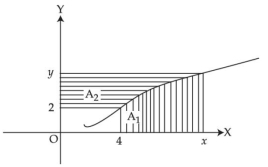
Consider a curve $y=y(x)$ in the first quadrant as shown in the figure. Let the area $A_{1}$ is twice the area $A _{2}$. Then the normal to the curve perpendicular to the line $2 x -12 y =15$ does NOT pass through the point.
A bag contains 5 red and 3 blue balls. If 3 balls are drawn at random without replacement, then the probability that exactly two of the three balls were red, the first ball being red, is
  1. $\frac{1}{3}$
  2. $\frac{4}{7}$
  3. $\frac{15}{28}$
  4. $\frac{5}{28}$
The projection of the vector $\hat{\text{i}}+\hat{\text{j}}+\hat{\text{k}}$ along the vector of $\hat{\text{j}}$ is:
  1. 1
  2. 0
  3. 2
  4. -1
  5. -2
The general solution of the differential equation $y d x-x d y=0$; (Given $x, y>0)$, is of the form
Each side of equilateral is increasing at the rate of 8cm/hr. The rate of increase of its area when side 2cm, is:
  1. $8\sqrt{3}\text{cm}^{2}/\text{hr}$  
  2. $4\sqrt{3}\text{cm}^{2}/\text{hr}$
  3. $\frac{\sqrt{3}}{8}\text{cm}^{2}/\text{hr}$
  4. $\text{None of these.}$
If $\Delta=\left|\begin{array}{lll}5 & 3 & 8 \\ 2 & 0 & 1 \\ 1 & 2 & 3\end{array}\right|$, then write the minor of the element $a_{22}$.
Area bounded by the ellipse $\frac{\text{x}^2}{4}+\frac{\text{y}^2}{9}=1$
  1. $6\pi\text{ sq}.\text{units}$
  2. $3\pi\text{ sq}.\text{units}$
  3. $12\pi\text{ sq}.\text{units}$
  4. $\text{None of these}$
If the ordinate $x = a$ divides the area bounded by the curve $y = \left( {1 + \frac{8}{{{x^2}}}} \right)\,,$ $x - $ axis and the ordinates $x = 2,$ $x = 4$ into two equal parts, then $a = $
$\int_0^{\pi /4} {[\sqrt {\tan x} + \sqrt {\cot x} ]\,dx} $ equals
The value of $\int\limits_{\frac{{ - \pi }}{2}}^{\frac{\pi }{2}} {\frac{{{{\sin }^2}x}}{{1 + {{\left( {2017} \right)}^x}}}\,dx} $ is