MCQ
Let $f: R \rightarrow R$ be a function defined by $f(x)=\left\{\begin{array}{cc}{[x],} & x \leq 2 \\ 0, & x>2\end{array}\right.$, where $[x]$ is the greatest integer less than or equal to $x$. If $I=\int_{-1}^2 \frac{x f\left(x^2\right)}{2+f(x+1)} d x$, then the value of $(4 I-1)$ is
  • $0$
  • B
    $1$
  • C
    $2$
  • D
    $3$

Answer

Correct option: A.
$0$
a
$I =\int_{-1}^0 \frac{ x \cdot 0}{2+0} dx +\int_0^1 \frac{ x \cdot 0}{2+1} dx +\int_1^{\sqrt{2}} \frac{ x \cdot 1}{2+0} dx +0=\frac{1}{4}$

$\Rightarrow 4 I -1=0$

Need a full question paper?

Generate a complete, print-ready paper with questions like this in minutes — across 16+ boards, with answer keys.

Start Generating Free

Similar questions

If a $3-$digit number is randomly chosen. What is the probability that either the number itself or some permutation of the number (which is a $3-$digit number) is divisible by $4$ and $5$ ?
A coin is tossed $2n$ times. The chance that the number of times one gets head is not equal to the number of times one gets tail is
Consider the matrices : $\mathrm{A}=\left[\begin{array}{cc}2 & -5 \\ 3 & \mathrm{~m}\end{array}\right], \mathrm{B}=\left[\begin{array}{l}20 \\ \mathrm{~m}\end{array}\right]$ and $X=\left[\begin{array}{l}x \\ y\end{array}\right]$. Let the set of all $m$, for which the system of equations $\mathrm{AX}=\mathrm{B}$ has a negative solution (i.e., $\mathrm{x}<0$ and $\mathrm{y}<0$ ), be the interval ( $\mathrm{a}, \mathrm{b}$ ). Then $8 \int_a^b|\mathrm{~A}| \mathrm{dm}$ is equal to.............
Solution of the differential equation $\frac{{dy}}{{dx}}\tan y = \sin (x + y) + \sin (x - y)$ is
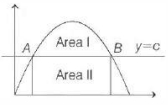
The figure shows a portion of the graph $y=2 x-4 x^3$.The line $y=c$ is such that the areas of the regions marked $I$ and $II$ are equal. If $a, b$ are the $x$-coordinates of $A, B$ respectively, then $a+b$ equals
If $f: R \rightarrow R, f(x)=2 x+1$, then the value of $f^{-1}(5)$ is
If $\text{P(A)}=\frac{7}{13},\text{P(B)}=\frac{9}{13}$ and $\text{P}(\text{A}\cap\text{B})=\frac{4}{13}.$ then, $\text{P}(\overline{\text{A}}|\text{B})=$
  1. $\frac{5}{9}$
  2. $\frac{4}{9}$
  3. $\frac{4}{13}$
  4. $\frac{6}{13}$
Solution of the differential equation, $\frac{{dy}}{{dx}} = \frac{{1 - 2y - 4x}}{{1 + y + 2x}}$ is
The value of b for which the function $\text{f(x)}=\begin{cases}5\text{x}-4,&0<\text{x}\leq1\\4\text{x}^2+3\text{bx},&1<\text{x}<2\end{cases}$ is continuous at every point of its domain, is:
  1. -1
  2. 0
  3. $\frac{13}{3}$
  4. 1
The angle between the lines $\frac{\text{x}-1}{1}=\frac{\text{y}-1}{1}=\frac{\text{z}-1}{2}$ and $\frac{\text{x}-1}{-\sqrt{3}-1}=\frac{\text{y}-1}{\sqrt{3}-1}=\frac{\text{z}-1}{4}$ is: