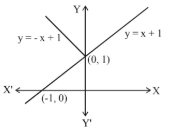
MCQ
Let $f:R \to R$ be a function defined by $f\left( x \right) = Min\left\{ {x + 1,\left| x \right| + 1} \right\}$ Then which of the following is true $?$
  • A
    $f\left( x \right) \ge 1$ for all $x \in R$
  • B
    $f(x)$ is not differentiable$x=1$ 
  • $f\left( x \right)$ is differentiable everywhere
  • D
    $f(x)$ is not differentiable at $x=0$ 

Answer

Correct option: C.
$f\left( x \right)$ is differentiable everywhere
c

Need a full question paper?

Generate a complete, print-ready paper with questions like this in minutes — across 16+ boards, with answer keys.

Start Generating Free

Similar questions

If an antiderivative of $f(x)$ is ${e^x}$ and that of $g(x)$ is $\cos x,$then $\int {f(x)\cos x\,dx} + \int {g(x){e^x}dx = } $
The value of the integral $\int_0^{\log 5} {\frac{{{e^x}\sqrt {{e^x} - 1} }}{{{e^x} + 3}}} \,dx = $
A circle touches the parabola $y^2=4 x$ at $(1,2)$ and also touches its directrix. The $y$-coordinate of the point of contact of the circle and the directrix is
If the coordinates of the points $A, B, C, D$, be $(a,\;b),$ $(a',\;b'),$ $( - a,\;b)$ and $(a',\; - b')$ respectively, then the equation of the line bisecting the line segments $AB$ and $CD$ is
Consider the piecewise defined functionf $f(x) = \left[ \begin{gathered}   \hfill \\   \hfill \\   \hfill \\   \hfill \\ \end{gathered}  \right.$$\begin{gathered}  \sqrt { - x}  & if\,\,\,\,\,\,\,\,\,\,x < 0 \hfill \\    \hfill \\  \,\,\,\,\,\,0 & if\,\,0 \leqslant x \leqslant 4 \hfill \\   \hfill \\  x - 4 & if\,\,\,\,\,\,\,\,\,\,x > 4 \hfill \\  \end{gathered} $ choose the answer which best describes the continuity of this function
The locus of a point $P\left( {\alpha ,\beta } \right)$ moving under the condition that the line $y = \alpha x + \beta $ is a tangent to the hyperbola $\frac{{{x^2}}}{{{a^2}}} - \frac{{{y^2}}}{{{b^2}}} = 1$ is
The number of real values of $x$ satisfying $\left| {\,\begin{array}{*{20}{c}} x&{3x + 2}&{2x - 1}\\{2x - 1}&{4x}&{3x + 1}\\{7x - 2}&{17x + 6}&{12x - 1}\end{array}\,} \right|$ $= 0$ is
The ellipse $E_1: \frac{x^2}{9}+\frac{y^2}{4}=1$ is inscribed in a rectangle $R$ whose sides are parallel to the coordinate axes.

Another ellipse $E _2$ passing through the point $(0,4)$ circumscribes the rectangle $R$.. The eccentricity of the ellipse $E _2$ is

If $P$ lies in the first quadrant on the ellipse $\frac{{{x^2}}}{{{a^2}}} + \frac{{{y^2}}}{{{b^2}}} = 1$ (where $a > b$ ), and tangent & normal drawn at $P$ meets major axis at the points $T$ & $N$ respectively, then the value of $\frac{{\left( {\left| {{F_2}N} \right| + \left| {{F_1}N} \right|} \right)\left( {\left| {{F_2}T} \right| - \left| {{F_1}T} \right|} \right)}}{{\left( {\left| {{F_2}N} \right| - \left| {{F_1}N} \right|} \right)\left( {\left| {{F_2}T} \right| + \left| {{F_1}T} \right|} \right)}}$ is equal to (where $F_1$ & $F_2$ are the foci $(ae, 0)$ & $(-ae, 0)$ respectively)
Let $y=y(x)$ be the solution of the differential equation $x^3 d y+(x y-1) d x=0, x>0$, $y\left(\frac{1}{2}\right)=3-e$. Then $y(1)$ is equal to