MCQ
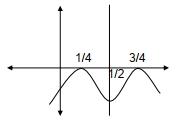
Let $f(x)$ be a non-constant twice differentiable function defined on $(-\infty, \infty)$ such that $f(x)=f(1-x)$ and $f^{\prime}\left(\frac{1}{4}\right)=0$. Then

$(A)$ $f^{\prime \prime}(x)$ vanishes at least twice on $[0,1]$

$(B)$ $f^{\prime}\left(\frac{1}{2}\right)=0$

$(C)$ $\int_{-1 / 2}^{1 / 2} f\left(x+\frac{1}{2}\right) \sin x d x=0$

$(D)$ $\int_0^{1 / 2} f(t) e^{\sin \pi t} d t=\int_{1 / 2}^1 f(1-t) e^{\sin \pi t} d t$

  • A
    $A,C,D,B$
  • $A,B,C,D$
  • C
    $D,B,C,A$
  • D
    $A,C,D,B$

Answer

Correct option: B.
$A,B,C,D$
b
$ f(x)=f(1-x) $

$ \text { Put } x=1 / 2+x $

$ f\left(\frac{1}{2}+x\right)=f\left(\frac{1}{2}-x\right)$

Hence $f(x+1 / 2)$ is an even function or $f(x+1 / 2) \sin x$ is an odd function.

Also, $f^{\prime}(x)=-f^{\prime}(1-x)$ and for $x=1 / 2$, we have $f^{\prime}(1 / 2)=0$.

Also, $\int_{1 / 2}^1 f(1-t) e^{\sin \pi t} d t=-\int_{1 / 2}^0 f(y) e^{\sin \pi y} d y$ (obtained by putting, $1-t=y$ ).

Since $f^{\prime}(1 / 4)=0, f^{\prime}(3 / 4)=0$. Also $f^{\prime}(1 / 2)=0$

$\Rightarrow f^{\prime \prime}(x)=0$ atleast twice in $[0,1]$ (Rolle's Theorem)

Need a full question paper?

Generate a complete, print-ready paper with questions like this in minutes — across 16+ boards, with answer keys.

Start Generating Free

Similar questions

If $A$ and $B$ are two independent events such that $P\,(A) = \frac{1}{2},\,\,P(B) = \frac{1}{5},$ then
A ladder is resting with the wall at an angle of ${30^o}$. A man is ascending the ladder at the rate of $ 3 \,ft/sec$. His rate of approaching the wall is
The equation of pair of tangents to the circle ${x^2} + {y^2} - 2x + 4y + 3 = 0$ from $(6, - 5)$, is
$ABC $ is an isosceles triangle right angled at $ A$. Forces of magnitude $2\sqrt {2,} \,5$ and $6$  act along $\overrightarrow {BC} ,\,\,\overrightarrow {CA} $ and $\overrightarrow {AB} $ respectively. The magnitude of their resultant force is
If $I _{1}=\int \limits_{0}^{1}\left(1- x ^{50}\right)^{100} dx$ and $I _{2}=\int \limits_{0}^{1}\left(1- x ^{50}\right)^{101} dx$ such that $I_{2}=\alpha I_{1}$ then $\alpha$ equals to
Let $g(t)=\int \limits_{-\pi / 2}^{\pi / 2} \cos \left(\frac{\pi}{4} t+f(x)\right) \,d x$, where $f(x)=\log _{e}\left(x+\sqrt{x^{2}+1}\right), x \in R$. Then which one of the following is correct?
If the roots of the equation $b{x^2} + cx + a = 0$ be imaginary, then for all real values of $x,$ the expression $3{b^2}{x^2} + 6bcx + 2{c^2} $ is :
If $\int {\frac{{x + 1}}{{\sqrt {2x - 1} }}} dx = f\left( x \right)\,\sqrt {2x - 1}  + C$ , where $C$ is a constant of integration of integration, then $f(x)$ is equal to
Let $A =\left(\begin{array}{cc} m & n \\ p & q \end{array}\right), d =| A | \neq 0| A - d (\operatorname{Adj} A )|=0$. Then
The line parallel to the $x$- axis and passing through the intersection of the lines $ax + 2by + 3b = 0$ and $bx - 2ay - 3a = 0$, where $(a,\,b) \ne (0,\,0)$ is