Question
Let f(x) be a real valued function, then its
  • Left Hand Derivative (L.H.D.) : $\text{Lf}'(\text{a})=\lim_\limits{\text{h}\rightarrow0}\frac{\text{f}(\text{a}-\text{h})-\text{f}(\text{a})}{-\text{h}}$
  • Right Hand Derivative (R.H.D.) : $\text{Rf}'(\text{a})=\lim_\limits{\text{h}\rightarrow0}\frac{\text{f}(\text{a}+\text{h})-\text{f}(\text{a})}{\text{h}}$
Also, a function f(x) is said to be differentiable at x = a if its L.H.D. and R.H.D. at x = a exist and are equal.
For the function $\text{f}(\text{x})=\begin{cases}|\text{x}-3|,\text{x}\geq1\\\\\frac{\text{x}^2}{4}-\frac{3\text{x}}{2}+\frac{13}{4},\text{x}<1\end{cases},$ answer the following questions.
  1. R.H.D. of f(x) at x = 1 is:
  1. 1
  2. -1
  3. 0
  4. 2
  1. L.H.D. of f(x) at x = 1 is:
  1. 1
  2. -1
  3. 0
  4. 2
  1. f(x) is non-differentiable at:
  1. x = 1
  2. x = 2
  3. x = 3
  4. x = 4
  1. Find the value of f'(2).
  1. 1
  2. 2
  3. 3
  4. -1
  1. The value of f'(-1) is:
  1. 2
  2. 1
  3. -2
  4. -1

Answer

We have, $\text{f}(\text{x})=\begin{cases}\text{x}-3&,\text{x}\geq3\\3-\text{x}&,1\leq\text{x}<3\\\\\frac{\text{x}^2}{4}-\frac{3\text{x}}{2}+\frac{13}{4}&,\text{x}<1\end{cases}$
  1. (b) -1
Solution:
$\text{Rf}'(1)=\lim\limits_{\text{h}\rightarrow0}\frac{\text{f}(1+\text{h})-\text{f}(1)}{\text{h}}$
$\lim\limits_{\text{h}\rightarrow0}\frac{3-(1+\text{h})-2}{\text{h}}=\lim\limits_{\text{h}\rightarrow0}-\frac{\text{h}}{\text{h}}=-1$
  1. (b) -1
Solution:
$\text{Lf}'(1)=\lim\limits_{\text{h}\rightarrow0}\frac{\text{f}(1-\text{h})-\text{f}(1)}{-\text{h}}$
$=\lim\limits_{\text{h}\rightarrow0}\frac{-1}{\text{h}}\Big[\frac{(1-\text{h})^2}{4}-\frac{3(1-\text{h})}{2}+\frac{13}{4}-2\Big]$
$=\lim\limits_{\text{h}\rightarrow0}\frac{-1}{\text{h}}\Big(\frac{1+\text{h}^2-2\text{h}-6+6\text{h}+13-8}{-4\text{h}}\Big)$
$=\lim\limits_{\text{h}\rightarrow0}\Big(\frac{\text{h}^2+4\text{h}}{-4\text{h}}\Big)=-1$
  1. (c) x = 3
Solution:
Since, R.H.D. at x = 3 is 1
and L.H.D. at x = 3 is - 1
$\therefore$ f(x) is non-differentiable at x = 3.
  1. (d) -1
  1. (c) -2
Solution:
From above, we have
$\text{f}'(\text{x})=\frac{\text{x}}{2}-\frac{3}{2},\text{x}<1$
$\therefore\text{f}'(-1)=\frac{-1}{2}-\frac{3}{2}=-2$

Need a full question paper?

Generate a complete, print-ready paper with questions like this in minutes — across 16+ boards, with answer keys.

Start Generating Free

Similar questions

If the equation is of the form $\frac{\text{dy}}{\text{dx}}=\frac{\text{f(x, y)}}{\text{g(x, y)}}$or $\frac{\text{dy}}{\text{dx}}=\text{F}\Big(\frac{\text{y}}{\text{x}}\Big),$
where $f\ (x, y), g\ (x, y)$ are homogeneous functions of the same degree in $x$ and $y,$ then put $y = vx$ and $\frac{\text{dy}}{\text{dx}}=\text{v+x}\Big(\frac{\text{dv}}{\text{dx}}\Big),$
so that the dependent variable y is changed to another variable $v$ and then apply variable separable method.
Based on the above information, answer the following questions.
  1. The general solution of $\text{x}^2\frac{\text{dy}}{\text{dx}}=\text{x}^2+\text{xy}+\text{y}^2$ is:
  1. $\tan^{-1}\frac{\text{x}}{\text{y}}=\log|\text{x}|+\text{c}$
  2. $\tan^{-1}\frac{\text{y}}{\text{x}}=\log|\text{x}|+\text{c}$
  3. $\text{y}=\text{x}\log|\text{x}|+\text{c}$
  4. $\text{x}=\text{y}\log|\text{y}|+\text{c}$
  1. Solution of the differential equation $2\text{xy}\frac{\text{dy}}{\text{dx}}=\text{x}^2+3\text{y}^2$ is:
  1. $x^3 + y^2 = cx^2$
  2. $\frac{\text{x}^2}{2}+\frac{\text{y}^3}{3}=\text{y}^2+\text{c}$
  3. $x^2 + y^3 = cx^2$
  4. $x^2 + y^2 = cx^3$
  1. General solution of the differential equation $(x^2 + 3xy + y^2) dx - x^2 dy = 0$ is:
  1. $\frac{\text{x+y}}{\text{y}}-\log\text{x = c}$
  2. $\frac{\text{x+y}}{\text{y}}+\log\text{x = c}$
  3. $\frac{\text{x}}{\text{x+y}}-\log\text{x = c}$
  4. $\frac{\text{x}}{\text{x+y}}+\log\text{x = c}$
  1. General solution of the differential equation $\frac{\text{dy}}{\text{dx}}=\frac{\text{y}}{\text{x}}\bigg\{\log\Big(\frac{\text{y}}{\text{x}}\Big)+1\bigg\}$ is:
  1. $\log(\text{xy})=\text{c}$
  2. $\log\text{y}=\text{cx}$
  3. $\log\frac{\text{y}}{\text{x}}=\text{cx}$
  4. $\log\text{x}=\text{cy}$
  1. Solution of the differential equation $\Big(\text{x}\frac{\text{dy}}{\text{dx}}-\text{y}\Big)\text{e}^\frac{\text{y}}{\text{x}}=\text{x}^2\ \cos\text{x}$ is:
  1. $\text{e}^\frac{\text{y}}{\text{x}}-\sin\text{x = c}$
  2. $\text{e}^\frac{\text{y}}{\text{x}}+\sin\text{x = c}$
  3. $\text{e}^\frac{\text{-y}}{\text{x}}-\sin\text{x = c}$
  4. $\text{e}^\frac{\text{-y}}{\text{x}}+\sin\text{x = c}$
Two schools $A$ and $B$ want to award their selected students on the values of Honesty, Hard work and Punctuality. The school $A$ wants to award $₹\ x$ each, $₹\ y$ each and $₹\ z$ each for the three respective values to its $3, 2$ and $1$ students respectively with a total award money of $₹\ 2200.$ School $B$ wants to spend $₹\ 3100$ to award its $4, 1$ and $3$ students on the respective values $($by giving the same award money to the three values as school $A).$ The total amount of award for one prize on each value is $₹\ 1200.$

Using the concept of matrices and determinants, answer the following questions.
  1. What is the award money for Honesty?
  1. $₹\ 350$
  2. $₹\ 300$
  3. $₹\ 500$
  4. $₹\ 400$
  1. What is the award money for Punctuality?
  1. $₹\ 300$
  2. $₹\ 280$
  3. $₹\ 450$
  4. $₹\ 500$
  1. What is the award money for Hard work?
  1. $₹\ 500$
  2. $₹\ 400$
  3. $₹\ 300$
  4. $₹\ 550$
  1. If a matrix $P$ is both symmetric and skew$-$symmetric, then $|P|$ is equal to:
  1. $1$
  2. $-1$
  3. $0$
  4. None of these.
  1. If P and Qare two matrices such that $PQ = Q$ and $QP = P,$ then $|Q^2|$ is equal to:
  1. $|Q|$
  2. $|P|$
  3. $1$
  4. $0$
If $\text{A}=[\text{a}_\text{ij}]_{\text{m}\times\text{n}}$ and $\text{B}=[\text{b}_\text{ij}]_{\text{m}\times\text{n}}$ are two matrices, then A ± B is of order m × n and is defined as:
$(\text{A}\pm\text{B})_\text{ij}=\text{a}_\text{ij}\pm\text{b}_\text{ij},$ where i = 1, 2, ............. , m and j = 1, 2, .......... , n
If $\text{A}=[\text{a}_\text{ij}]_{\text{m}\times\text{n}}$ and $\text{B}=[\text{b}_\text{ij}]_{\text{n}\times\text{p}}$ are two matrices, then AB is of order m × p and is defined as:
$(\text{A}\text{B})_\text{ik}=\sum\limits_\text{r=1}^\text{n}\text{a}_\text{ir}\text{b}_\text{rk}=\text{a}_\text{i1}\text{b}_\text{1k}+\text{a}_\text{i2}\text{b}_\text{2k}+.....+\text{a}_\text{in}\text{b}_\text{nk}$
Consider $\text{A}=\begin{bmatrix}2&-1\\3&4\end{bmatrix},\ \text{B}=\begin{bmatrix}5&2\\7&4\end{bmatrix},\ \text{B}=\begin{bmatrix}2&5\\3&8\end{bmatrix} \text{And}\ \text{D}=\begin{bmatrix}\text{a}&\text{b}\\\text{c}&\text{d}\end{bmatrix}$
Using the concept of matrices answer the following questions.
  1. Find the product AB.
  1. $\begin{bmatrix}3&0\\43&22\end{bmatrix}$
  2. $\begin{bmatrix}0&3\\22&43\end{bmatrix}$
  3. $\begin{bmatrix}43&22\\0&3\end{bmatrix}$
  4. $\begin{bmatrix}22&43\\3&0\end{bmatrix}$
  1. If A and Bare any other two matrices such that AB exists, then
  1. BA does not exist.
  2. BA will be equal to AB.
  3. BA may or may not exist.
  4. None of these.
  1. Find the values of a and c in the matrix D such than CD - AB = 0.
  1. a = 77, c = -191
  2. a = -191, c = 77
  3. a = 191, c = 77
  4. a = 91, c = 70
  1. Find the values of band din the matrix D such that CD - AB = 0.
  1. b = 44, d = -110
  2. b = 110, d = 44
  3. b = -110, d = 44
  4. b = -44, d = 110
  1. Find B + D.
  1. $\begin{bmatrix}80&200\\115&105\end{bmatrix}$
  2. $\begin{bmatrix}84&48\\180&181\end{bmatrix}$
  3. $\begin{bmatrix}186&108\\-84&-48\end{bmatrix}$
  4. $\begin{bmatrix}-186&-108\\84&48\end{bmatrix}$
In a play zone, Aastha is playing crane game. It has 12 blue balls, 8 red balls, 10 yellow balls and 5 green balls. If Aastha draws two balls one after the other without replacement, then answer the following questions.
  1. What is the probability that the first ball is blue and the second ball is green?
  1. $\frac{5}{119}$
  2. $\frac{12}{119}$
  3. $\frac{6}{119}$
  4. $\frac{15}{119}$
  1. What is the probability that the first ball is yellow and the second ball is red?
  1. $\frac{16}{119}$
  2. $\frac{8}{119}$
  3. $\frac{24}{119}$
  4. None of these.
  1. What is the probability that both the balls are red?
  1. $\frac{4}{85}$
  2. $\frac{24}{595}$
  3. $\frac{12}{119}$
  4. $\frac{64}{119}$
  1. What is the probability that the first ball is green and the second ball is not yellow?
  1. $\frac{10}{119}$
  2. $\frac{6}{85}$
  3. $\frac{12}{119}$
  4. None of these.
  1. What is the probability that both the balls are not blue?
  1. $\frac{6}{595}$
  2. $\frac{12}{85}$
  3. $\frac{15}{17}$
  4. $\frac{253}{595}$
In an office three employees Vinay, Sonia and Iqbal process incoming copies of a certain form. Vinay process $50\%$ of the forms, Sonia processes $20\%$ and Iqbal the remaining $30\%$ of the forms. Vinay has an error rate of $0.06,$ Sonia has an error rate of $0.04$ and Iqbal has an error rate of $0.03.$ Based on the above information, answer the following questions.
  1. The conditional probability that an error is committed in processing given that Sonia processed the form is:
  1. $0.0210$
  2. $0.04$
  3. $0.47$
  4. $0.06$
  1. The probability that Sonia processed the form and committed an error is:
  1. $0.005$
  2. $0.006$
  3. $0.008$
  4. $0.68$
  1. The total probability of committing an error in processing the form is:
  1. $0$
  2. $0.047$
  3. $0.234$
  4. $1$
  1. The manager of the company wants to do a quality check. During inspection he selects a form at random from the days output of processed forms. If the form selected at random has an error, the probability that the form is $\ce{NOT}$ processed by Vinay is:
  1. $1$
  2. $\frac{30}{47}$
  3. $\frac{20}{47}$
  4. $\frac{17}{47}$
  1. Let $A$ be the event of committing an error in processing the form and let $E_1, E_2$ and $E_3$ be the events that Vinay, Sonia and Iqbal processed the form. The value of $\sum\limits^3_\text{i=1}\ \text{P}(\text{E}_\text{i}\ |\ \text{A})$ is:
  1. $0$
  2. $0.03$
  3. $0.06$
  4. $1$
Area of a triangle whose vertices are $(x_1, y_1), (x_2, y_2)$ and $(x_3, y_3)$ is given by the determinant:
$\Delta=\frac{1}{2}\begin{vmatrix}\text{x}_1&\text{y}_1&1\\\text{x}_2&\text{y}_2&1\\\text{x}_3&\text{y}_3&1\end{vmatrix}$
Since, area is a positive quantity,
so we always take the absolute value of the determinant $\Delta.$ Also, the area of the triangle formed by three collinear points is zero.
Based on the above information, answer the following questions.
  1. Find the area of the triangle whose vertices are $(-2, 6), (3, -6)$ and $(1, 5).$
  1. $30\ \text{sq. units}$
  2. $35\ \text{sq. units}$
  3. $40\ \text{sq. units}$
  4. $15.5\ \text{sq. units}$
  1. If the points $(2, -3), (k, -1)$ and $(0, 4)$ are collinear, then find the value of 4k.
  1. $4$
  2. $\frac{7}{140}$
  3. $47$
  4. $\frac{40}{7}$
  1. If the area of a triangle $\text{ABC},$ with vertices $A(1, 3), B(0, 0)$ and $C(k, 0)$ is $3$ sq. units, then a value of $k$ is:
  1. $2$
  2. $3$
  3. $4$
  4. $5$
  1. Using determinants, find the equation of the tine joining the points $A(1, 2)$ and $B(3, 6).$
  1. $y = 2x$
  2. $x = 3y$
  3. $y = x$
  4. $4x - y = 5$
  1. If $\text{A}\equiv(11,7),\text{B}\equiv(5,5)$ and $\text{C}\equiv(-1,3),$ then:
  1. $\Delta\text{ABC}$ is scalene triangle.
  2. $\Delta\text{ABC}$ is equilateral triangle.
  3. $A, B$ and $C$ are collinear.
  4. None of these.
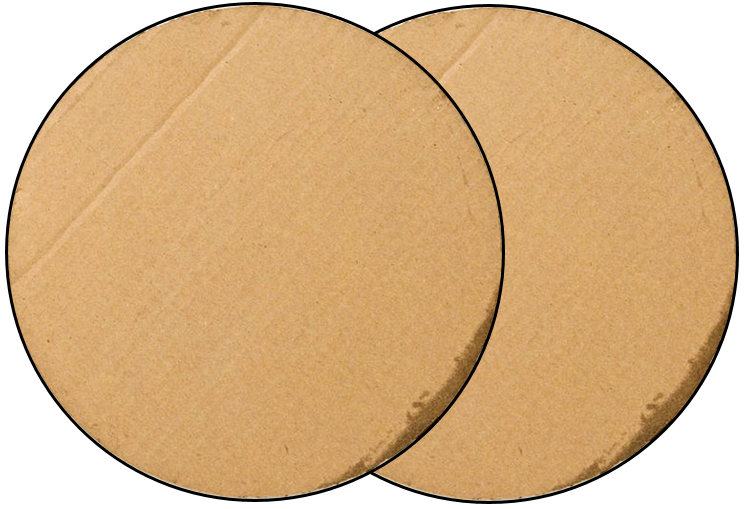
Ajay cut two circular pieces of cardboard and placed one upon other as shown in figure. One of the circle represents the equation $(x - 1)^2 + y^2 = 1,$ while other circle represents the equation $x^2 + y^2 = 1.$​​​​​​​

Based on the above information, answer the following questions.
  1. Both the circular pieces of cardboard meet each other at
  1. $\text{x}=1$
  2. $\text{x}=\frac{1}{2}$
  3. $\text{x}=\frac{1}{3}$
  4. $\text{x}=\frac{1}{4}$
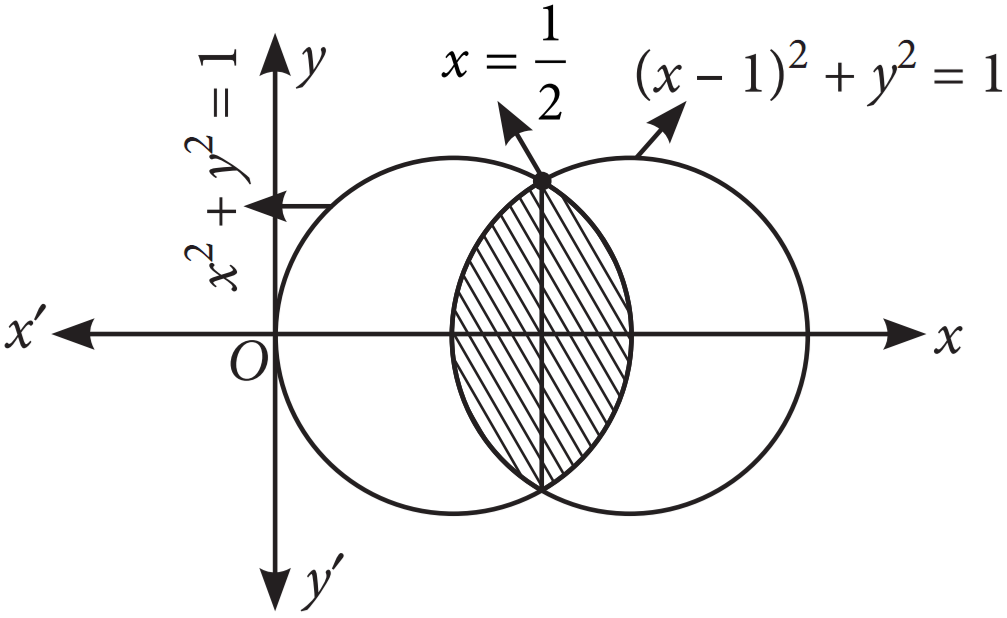
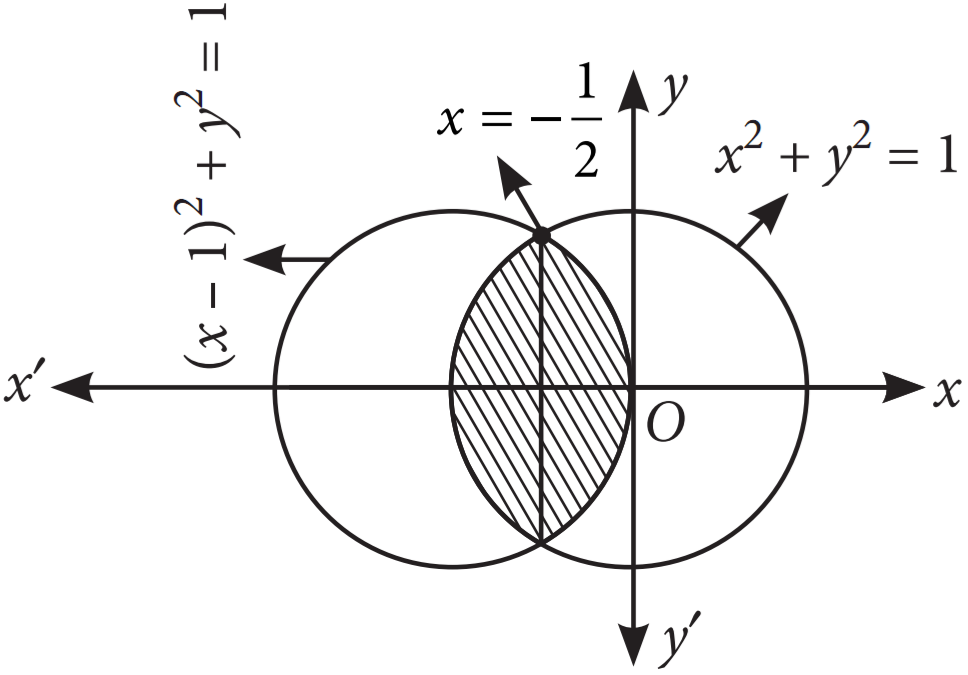
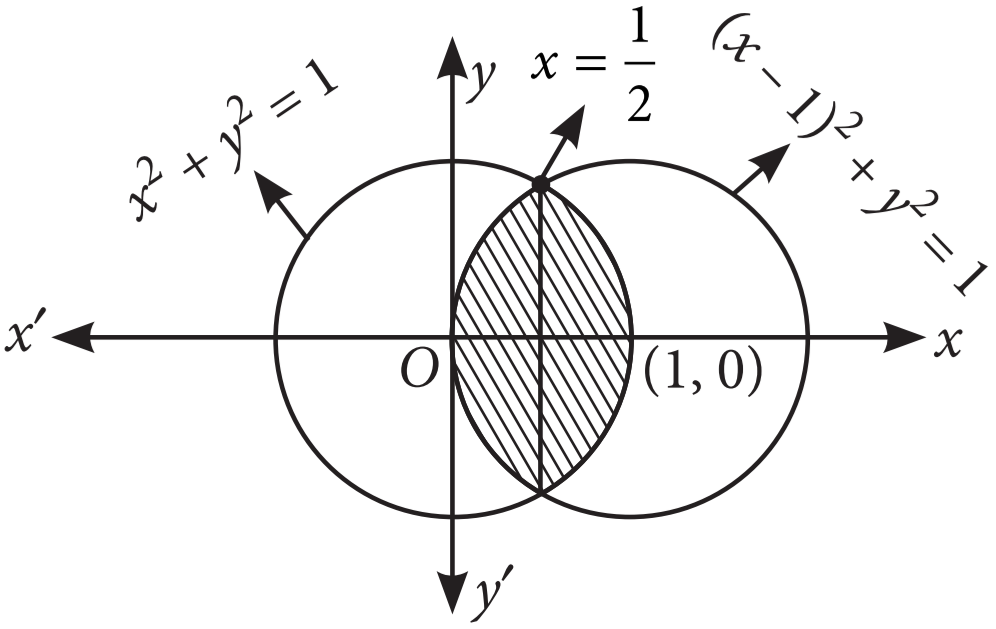
  1. Graph of given two curves can be drawn as.
  1. None of these
  1. Value of $\int\limits_{0}^{\frac{1}{2}}\sqrt{1-(\text{x}-1)^2}\text{dx}$ is.
  1. $\frac{\pi}{6}-\frac{\sqrt{3}}{8}$
  2. $\frac{\pi}{6}+\frac{\sqrt{3}}{8}$
  3. $\frac{\pi}{2}+\frac{\sqrt{3}}{4}$
  4. $\frac{\pi}{2}-\frac{\sqrt{3}}{4}$
  1. Value of $\int\limits_{\frac{1}{2}}^{1}\sqrt{1-\text{x}^2}\text{dx}$ is.
  1. $\frac{\pi}{6}+\frac{\sqrt{3}}{4}$
  2. $\frac{\pi}{6}+\frac{\sqrt{3}}{8}$
  3. $\frac{\pi}{6}-\frac{\sqrt{3}}{8}$
  4. $\frac{\pi}{2}-\frac{\sqrt{3}}{4}$
  1. Area of hidden portion of lower circle is.
  1. $\bigg(\frac{2\pi}{3}+\frac{\sqrt{3}}{2}\bigg)\text{ sq.units}$
  2. $\bigg(\frac{\pi}{3}-\frac{\sqrt{3}}{8}\bigg)\text{ sq.units}$
  3. $\bigg(\frac{\pi}{3}+\frac{\sqrt{3}}{8}\bigg)\text{ sq.units}$
  4. $\bigg(\frac{2\pi}{3}-\frac{\sqrt{3}}{2}\bigg)\text{ sq.units}$
Read the following text carefully and answer the questions that follow:
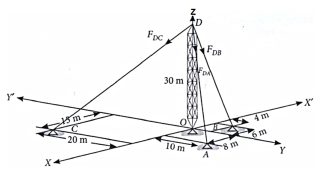
Consider the following diagram, where the forces in the cable are given.
Image
i. What is the equation of the line along cable $AD$ ? $(1)$
ii. What is length of cable $DC$ ? $(1)$
iii. Find vector $DB\ (2)$
OR
What is sum of vectors along the cable? $(2)$
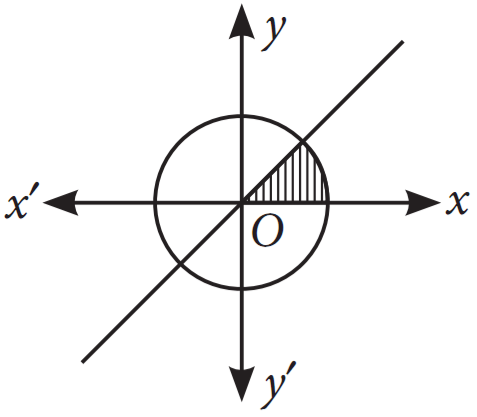
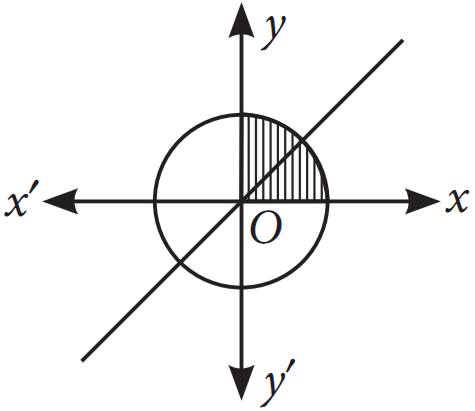
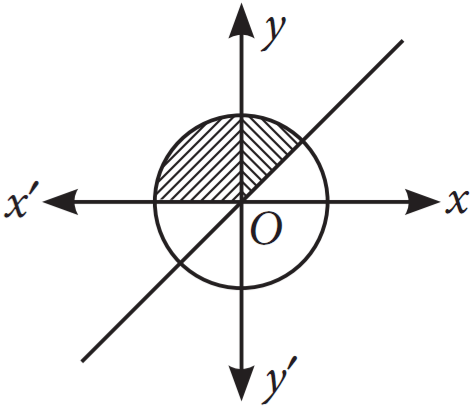
Consider the curve $x^2 + y^2 = 16$ and line $y = x$ in the first quadrant.
Based on the above information, answer the following questions.
  1. Point of intersection of both the given curves is.
  1. $(0, 4)$
  2. $(0, 2\sqrt{2})$
  3. $(2\sqrt{ 2},2\sqrt{2})$
  4. $(2,\sqrt{2},4)$
  1. Which of the following shaded portion represent the area bounded by given two curves?
  1. None of these
  1. The value of the integral $\int\limits_{0}^{2\sqrt{2}}\text{x}\text{dx}$ is.
  1. $0$
  2. $1$
  3. $2$
  4. $4$
  1. The value of the integral $\int\limits_{2\sqrt{2}}^{0}\sqrt{16-\text{x}^2}\text{ dx}$ is.
  1. $2(\pi-2)$
  2. $2(\pi-8)$
  3. $4(\pi-2)$
  4. $4(\pi+2)$
  1. Area bounded by the two given curves is.
  1. $3\pi\ \text{ sq.units}$
  2. $\frac{\pi}{2}\ \text{ sq.units}$
  3. $\pi\ \text{ sq.units}$
  4. $2\pi\ \text{ sq.units}$
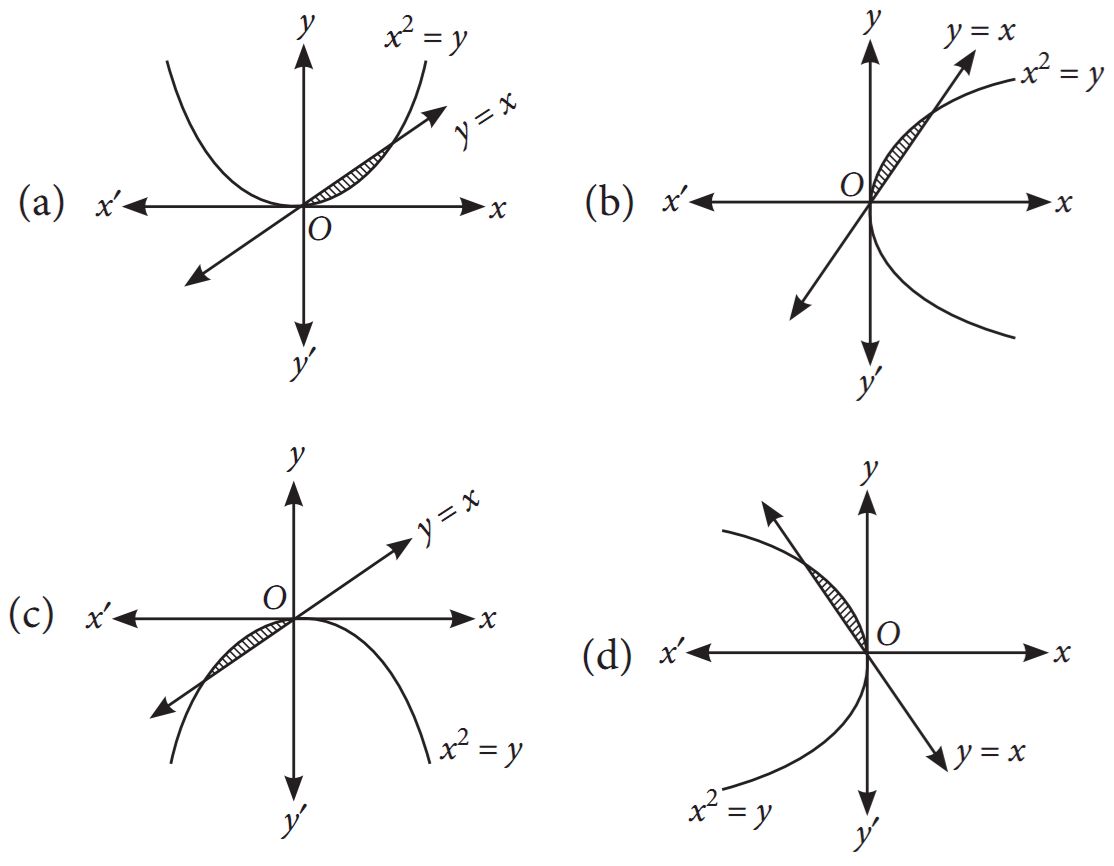
Consider the following equations of curves $x^2 = y$ and $y = x.$ On the basis of above information, answer the following questions.
  1. The point$(s)$ of intersection of both the curves is $($are$).$
  1. $(0, 0)(2, 2)$
  2. $(0, 0)(1, 1)$
  3. $(0, 0)(-1, -1)$
  4. $(0, 0)(-2, -2)$
  1. Area bounded by the curves is represented by which of the following graph?
  1. The value of the integral $\int\limits_{1}^{0}\text{x}\ \text{dx}$ is.
  1. $\frac{1}{4}$
  2. $\frac{1}{3}$
  3. $\frac{1}{2}$
  4. $1$
  1. The value of the integral $\int\limits_{0}^{1}\text{x}^2\ \text{dx}$ is.
  1. $\frac{1}{4}$
  2. $\frac{1}{3}$
  3. $\frac{1}{2}$
  4. $1$
  1. The value of area bounded by the curves $x^2 = y$ and $x = y$ is.
  1. $\frac{1}{6}\text{ sq}.\text{unit}$
  2. $\frac{1}{3}\text{ sq}.\text{unit}$
  3. $\frac{1}{2}\text{ sq}.\text{unit}$
  4. ${1}\text{ sq}.\text{unit}$