MCQ
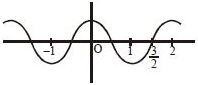
Let $f(x)$ = $\cos \left( {\pi \left( {\left| x \right| + 2\left[ x \right]} \right)} \right)$ where $[.]$ represents greatest integer function, then 
  • A
    $f(x)$ is neither odd nor even
  • B
    $f(x)$ is non periodic function
  • C
    Range of $f(x)$ is $[-1,1]$
  • $f(x)$ = $|f(x)|$ for all $x$ .

Answer

Correct option: D.
$f(x)$ = $|f(x)|$ for all $x$ .
d
$f(x)=\cos (2 \pi[x]+\pi|x|)=\cos (\pi|x|)$

$f(-x)=f(x)$ hence function is even.

It is a periodic function

form graph $f\left( x \right) = f\left| {\left( x \right)} \right|$ is not possible for all $x$.

Need a full question paper?

Generate a complete, print-ready paper with questions like this in minutes — across 16+ boards, with answer keys.

Start Generating Free

Similar questions

If $f'(x) = \frac{1}{x} + x$ and $f(1) = \frac{5}{2}$, then $f(x) = $
Let $A=\left[\begin{array}{cc}0 & -2 \\ 2 & 0\end{array}\right]$. If $M$ and $N$ are two matrices given by $M =\sum \limits_{ k =1}^{10} A ^{2 k }$ and $N =\sum \limits_{ k =1}^{10} A ^{2 k -1}$ then $MN ^{2}$ is
If $\displaystyle \text{a}_{\text{ij}}=0\left (\text{i}\neq \text{j} \right )$ and $\displaystyle \text{a}_{\text{ij}}=1\left (\text{i}= \text{j} \right )$  then the matrix $\text{A}=\displaystyle \left [\text{a}_{\text{ij}} \right ]_{\text{n}\times\text{n}}$ is a _____ matrix:
  1. Null
  2. Identity
  3. Scalar
  4. Triangular
The maximum value of $f(x) = {x \over {4 + x + {x^2}}}$ on $[ - 1,\,1]$ is
If ${ \sin }^{ -1 }\frac { \text{x} }{ 5 } +{ \text{cosec} }^{ -1 }\frac { 5 }{ 4 } $ then x is equal to:
  1. 1
  2. 4
  3. 3
  4. 5
For the function $ f (x) =$ $\mathop {Lim}\limits_{n \to \infty } \,\,\frac{1}{{1 + n{{\sin }^2}(\pi x)}}$ , which of the following holds ?
Let $f(\alpha ) = \int\limits_0^\alpha  {{x^2}{{\left( {1 - \frac{x}{\alpha }} \right)}^\alpha }} dx$ (where $\alpha > 0)$, then $\sum\limits_{\alpha  = 1}^5 {\frac{{f(\alpha )}}{{{\alpha ^3}}}} $  is equal to-
If $y =\frac{1}{{1\,\, + \,\,{x^{n\, - \,m\,}}\, + \,\,{x^{p - \,m}}}} +\frac{1}{{1\,\, + \,\,{x^{m\, - \,n\,}}\, + \,\,{x^{p - \,n}}}} +\frac{1}{{1\,\, + \,\,{x^{m\, - \,p\,}}\, + \,\,{x^{n - \,p}}}}$ then $\frac{{dy}}{{dx}}$ at  ${e^{{m^{{n^p}}}}}$ is equal to:
Let $\text{f}:[2,\infty)\rightarrow\ \text{X}$ be defined by f(x) = 4x - x2. Then, f is invertible if X =
  1. $[2,\infty)$
  2. $(-\infty,2]$
  3. $(-\infty,4]$
  4. $[4,\infty)$
If $f(x) = 2{x^3} - 21{x^2} + 36x - 30$, then which one of the following is correct