MCQ
Let $f(x) = e^x - e^{-x} + cosx$, then $f(x)$ is 
  • always increasing
  • B
    always decreasing
  • C
    non differentiable at $x = 0$
  • D
    local maxima at $x = 1.$

Answer

Correct option: A.
always increasing
a
$f'(x) = (e^x - e^{-x}) - sinx$
alwasys positive and three an increasing function.

Need a full question paper?

Generate a complete, print-ready paper with questions like this in minutes — across 16+ boards, with answer keys.
Start Generating Free

Similar questions

$\int_{\,0}^{\,\pi /2} {\{ x - [\sin x]\} \,dx} $ is equal to
The point which does not lie in the half plane $2 x+3 y-12 \leq 0$ is
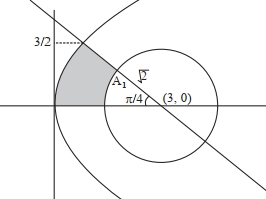
If the area bounded by the curve $2 y^2=3 x$, lines $x+y=3, y=0$ and outside the circle $(x-3)^2+y^2=2$ is $A$, then $4(\pi+4 A )$ is equal to $.........$.
Solution of the differential equation $\frac{\text{dy}}{\text{dx}}+\frac{\text{y}}{\text{x}}=\sin\text{x}$ is:
The angle between two lines $\frac{{x + 1}}{2} = $$\frac{{y + 3}}{2} = \frac{{z - 4}}{{ - 1}}$ and $\frac{{x - 4}}{1} = \frac{{y + 4}}{2} = \frac{{z + 1}}{2}$ is
Evaluate: $\int\frac{1}{\sqrt{1-\text{e}^{\text{2x}}}}\text{dx}.$
Let $f(x) = \left\{ {\begin{array}{*{20}{c}}
  {x,x < 0} \\ 
  {1 + {x^2},x \geqslant 0} 
\end{array}} \right.$ and $g(x) = 1 + x - [x],$ then range of $fog\ (x)$ is (where [.] denotes greatest integer function)
If $\beta$ is perpendicular to both $\alpha$ and $\gamma$, where $\alpha=\hat{k}$ and $\gamma=\gamma=2 \hat{i}+3 \hat{j}+4 \hat{k},$ then what is $\beta$ equal to?
Choose the correct answer from the given four options. If $\begin{bmatrix}2\text{x}+\text{y}&4\text{x}\\5\text{x}-7&4\text{x}\end{bmatrix}=\begin{bmatrix}7&7\text{y}-13\\\text{y}&\text{x}+6\end{bmatrix},$ then the value of $x + y$ is :
Let $O$ be the origin, and $\mathrm{M}$ and $\mathrm{N}$ be the points on the lines $\frac{x-5}{4}=\frac{y-4}{1}=\frac{z-5}{3}$ and $\frac{\mathrm{x}+8}{12}=\frac{\mathrm{y}+2}{5}=\frac{\mathrm{z}+11}{9}$ respectively such that $\mathrm{MN}$ is the shortest distance between the given lines. Then $\overrightarrow{\mathrm{OM}} \cdot \overrightarrow{\mathrm{ON}}$ is equal to ..................