MCQ
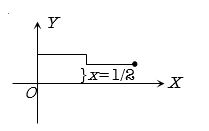
Let $f(x) = \left\{ \begin{array}{l}\frac{1}{2},\;if\;0 \le x \le \frac{1}{2}\\\frac{1}{3},\;if\;\frac{1}{2} < x \le 1\end{array} \right.$, then $f$ is
  • A
    A rational function
  • B
    A trigonometric function
  • A step function
  • D
    An exponential function

Answer

Correct option: C.
A step function
Which is step function.

Need a full question paper?

Generate a complete, print-ready paper with questions like this in minutes — across 16+ boards, with answer keys.

Start Generating Free

Similar questions

Let $\alpha$ and $\beta$ be the roots of $x^{2}-3 x+p=0$ and $\gamma$ and $\delta$ be the roots of $x^{2}-6 x+q=0 .$ If $\alpha$ $\beta, \gamma, \delta$ form a geometric progression. Then ratio $(2 q+p):(2 q-p)$ is 
${11^3} + {12^3} + .... + {20^3}$
True statement for $\mathop {\lim }\limits_{x \to 0} \frac{{\sqrt {1 + x} - \sqrt {1 - x} }}{{\sqrt {2 + 3x} - \sqrt {2 - 3x} }}$ is
If the chord $y = mx + 1$ of the circle ${x^2} + {y^2} = 1$ subtends an angle of measure ${45^o}$ at the major segment of the circle then value of $m$ is
$\mathop {Limit}\limits_{h\,\, \to \,\,0} \frac{{\int\limits_a^{x\, + \,h} {\,\ell {n^2}t\,\,\,dt} \,\, - \,\,\int\limits_a^x {\,\ell {n^2}t\,\,\,dt} }}{h}$ =
Let $B _{i}(i=1,2,3)$ be three independent events in a sample space. The probability that only $B _{1}$ occur is $\alpha,$ only $B _{2}$ occurs is $\beta$ and only $B _{3}$ occurs is $\gamma$. Let $p$ be the probability that none of the events $B _{i}$ occurs and these $4$ probabilities satisfy the equations $(\alpha-2 \beta) p =\alpha \beta$ and $(\beta-3 \gamma) p =2 \beta \gamma$ (All the probabilities are assumed to lie in the interval $(0,1))$. Then $\frac{ P \left( B _{1}\right)}{ P \left( B _{3}\right)}$ is equal to ..........
If the system of equations

$ x+(\sqrt{2} \sin \alpha) y+(\sqrt{2} \cos \alpha) z=0 $

$ x+(\cos \alpha) y+(\sin \alpha) z=0 $

$ x+(\sin \alpha) y-(\cos \alpha) z=0$

has a non-trivial solution, then $\alpha \in\left(0, \frac{\pi}{2}\right)$ is equal to :

Consider the matrices $:\mathrm{A}=\left[\begin{array}{cc}2 & -5 \\ 3 & \mathrm{~m}\end{array}\right], \mathrm{B}=\left[\begin{array}{l}20 \\ \mathrm{~m}\end{array}\right]$ and $X=\left[\begin{array}{l}x \\ y\end{array}\right]$. Let the set of all $m$, for which the system of equations $\mathrm{AX}=\mathrm{B}$ has a negative solution $($i.e., $\mathrm{x}<0$ and $\mathrm{y}<0 ),$ be the interval $($ $\mathrm{a}, \mathrm{b} ).$ Then $8 \int_a^b|\mathrm{~A}| \mathrm{dm}$ is equal to$.............$
$\text { If } \int \frac{1}{\sqrt[5]{(x-1)^4(x+3)^6}} d x=A\left(\frac{\alpha x-1}{\beta x+3}\right)^B+C,$ where $\mathrm{C}$ is the constant of integration, then the value of $\alpha+\beta+20 \mathrm{AB}$ is...........
If the ratio of the sum of $n$ terms of two $A.P.'s$ be $(7n + 1):(4n + 27)$, then the ratio of their ${11^{th}}$ terms will be