MCQ
Let $f(x) = (x-4)(x-5)(x-6)(x-7)$ then -
  • A
    $f'(x) = 0$ has four roots
  • Three roots of $f'(x) = 0$ lie in $(4, 5)  \cup  (5, 6)  \cup  (6, 7)$
  • C
    The equation $f'(x) = 0$ has only one root
  • D
    Three roots of $f'(x) = 0$ lie in $(3, 4)  \cup  (4, 5)  \cup  (5, 6)$
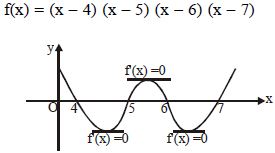
Answer

Correct option: B.
Three roots of $f'(x) = 0$ lie in $(4, 5)  \cup  (5, 6)  \cup  (6, 7)$
b

Need a full question paper?

Generate a complete, print-ready paper with questions like this in minutes — across 16+ boards, with answer keys.

Start Generating Free

Similar questions

Let $m_1$ and $m_2$ be the slopes of the tangents drawn from the point $P (4,1)$ to the hyperbola $H: \frac{y^2}{25}-\frac{x^2}{16}=1$. If $Q$ is the point from which the tangents drawn to $H$ have slopes $\left| m _1\right|$ and $\left| m _2\right|$ and they make positive intercepts $\alpha$ and $\beta$ on the $x$ axis, then $\frac{(P Q)^2}{\alpha \beta}$ is equal to $............$
The evaluation of $\int {\frac{{p\,{x^{p + 2q - 1}} - q\,{x^{q - 1}}}}{{{x^{2p + 2q}} + 2{x^{p + q}} + 1}}} \,\,dx$ is
Let $f(x)=\frac{2^{x+2}+16}{2^{2 x+1}+2^{x+4}+32}$. Then the value of $8\left(\mathrm{f}\left(\frac{1}{15}\right)+\mathrm{f}\left(\frac{2}{15}\right)+\ldots+\mathrm{f}\left(\frac{59}{15}\right)\right)$ is equal to
$\mathop {\lim }\limits_{x \to \infty } \frac{{\sqrt {{x^2} - \sqrt {{x^2} - \sqrt {{x^2} - .....} } } }}{x}$ is equal to-
If the variable line $y = kx + 2h$ is tangent to an ellipse $2x^2 + 3y^2 = 6$ , then locus of $P(h, k)$ is a conic $C$ whose eccentricity equals
If ${(1 + x)^{15}} = {C_0} + {C_1}x + {C_2}{x^2} + ...... + {C_{15}}{x^{15}},$ then ${C_2} + 2{C_3} + 3{C_4} + .... + 14{C_{15}} = $
The angle between the lines $2x - y + 3 = 0$ and $x + 2y + 3 = 0$ is ...........  $^\circ$
Let $N$ be the least positive integer such that whenever a non-zero digit $c$ is written after the last digit of $N$, the resulting number is divisible by $c$. The sum of the digits of $N$ is
$\int_0^{\pi /2} {\frac{{\sin x\cos x}}{{1 + {{\sin }^4}x}}\,dx = } $
If $\alpha ,\beta $ are the roots of the equation ${x^2} - px + q = 0$ then the quadratic equation whose roots are $({\alpha ^2} - {\beta ^2})({\alpha ^3} - {\beta ^3})$ and ${\alpha ^3}{\beta ^2} + {\alpha ^2}{\beta ^3}$ is 

(where $S = p[{p^4} - 5{p^2}q + 5{q^2}],\;P = {p^2}{q^2}$$({p^4} - 5{p^2}q + 4{q^2})$