MCQ
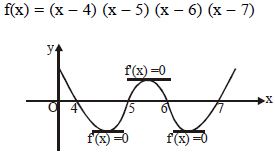
Let $f(x) = (x-4)(x-5)(x-6)(x-7)$ then -
  • A
    $f'(x) = 0$ has four roots
  • Three roots of $f'(x) = 0$ lie in $(4, 5)  \cup  (5, 6)  \cup  (6, 7)$
  • C
    The equation $f'(x) = 0$ has only one root
  • D
    Three roots of $f'(x) = 0$ lie in $(3, 4)  \cup  (4, 5)  \cup  (5, 6)$
Answer

Correct option: B.
Three roots of $f'(x) = 0$ lie in $(4, 5)  \cup  (5, 6)  \cup  (6, 7)$
b

Need a full question paper?

Generate a complete, print-ready paper with questions like this in minutes — across 16+ boards, with answer keys.

Start Generating Free

Similar questions

Choose the correct answer from the given four options:
The curve $\text{y}=\text{x}^{\frac{1}{5}}$ has at (0, 0)
Consider all rectangles lying in the region

$\left\{( x , y ) \in R \times R : 0 \leq x \leq \frac{\pi}{2} \text { and } 0 \leq y \leq 2 \sin (2 x )\right\}$

and having one side on the $x$-axis. The area of the rectangle which has the maximum perimeter among all such rectangles, is

The line $L$ given by  $\frac{{x - 2}}{2} = \frac{{y - 1}}{b} = \frac{{z + 1}}{c}$ passes through the point $(1, 2, 3)$ . Another line $K$ is parallel to line $L$ and has the equation $\frac{{x + 2}}{a} = \frac{{y - 3}}{2} = \frac{{z + 4}}{d}$ . Then the distance between line $L$ and $K$ is
Let $[\mathrm{x}]$ denote the greatest integer less than or equal to $\mathrm{x}$. Then, the values of $x \in R$ satisfying the equation $\left[e^{x}\right]^{2}+\left[e^{x}+1\right]-3=0$ lie in the interval:
If $p = \frac{{b \times c}}{{[a\,b\,c]}},\,\,q = \frac{{c \times a}}{{[a\,b\,c]}},\,\,r = \frac{{a \times b}}{{[a\,b\,c]}},\,\,$where $a, b, c $ are three non-coplanar vectors, then the value of $(a + b + c)\,.\,(p + q + r)$ is given by
The area of the region bounded by the curve $\text{y}=\sqrt{16-\text{x}^2}$ and $x-$ axis is :
If $\text{f(x)}=(\text{x+1})^{\cot\text{x}}$ be continuous at x = 0, then f(0) is equal to:
If $(a+\sqrt{2} b \cos x)(a-\sqrt{2} b \cos y)=a^{2}-b^{2}$ where $a>b>0,$ then $\frac{d x}{d y}$ at $\left(\frac{\pi}{4}, \frac{\pi}{4}\right)$ is
The value of $k$ for which $f(x)=\left\{\begin{array}{cc}3 x+5, & x \geq 2 \\ k x^2, & x<2\end{array}\right.$ is a continuous functions, is:
If $y=y(x)$ is the solution curve of the differential equation $\frac{d y}{d x}+y \tan x=x \sec x, \quad 0 \leq x \leq \frac{\pi}{3}$, $y (0)=1$, then $y \left(\frac{\pi}{6}\right)$ is equal to