MCQ
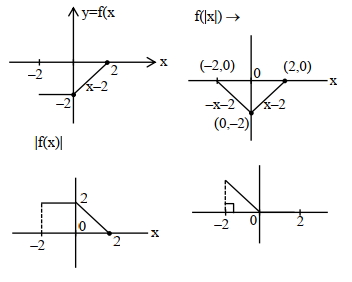
Let $f(x)=\left\{\begin{array}{cc}-2, & -2 \leq x \leq 0 \\ x-2, & 0 < x \leq 2\end{array}\right.$ and $h(x)=f(|x|)+|f(x)|$. Then $\int_{-2}^2 \mathrm{~h}(\mathrm{x}) \mathrm{dx}$ is equal to :
  • $2$
  • B
    $4$
  • C
    $1$
  • D
    $6$

Answer

Correct option: A.
$2$
a
$Image$

$h(x)=\left\{\begin{array}{cc}x-2+2-x=0, & 0 \leq x \leq 2 \\ -x-2+2=-x & -2 \leq x<0\end{array}\right.$

$Image$
Need a full question paper?

Generate a complete, print-ready paper with questions like this in minutes — across 16+ boards, with answer keys.

Start Generating Free

Similar questions

The volume of a sphere is increasing at $3\ cm^3/ \sec$. The rate at which the radius increases when radius is $2\ cm$, is :
Direction ratios of the line represented by the equation $x = ay + b,$ $z = cy + d$ are
If a dice is thrown $7$ times, then the probability of obtaining $5$ exactly $4$ times is
Find the value of $a, \,b,\, c,$ and $d$ from the equation: $\left[\begin{array}{cc}a-b & 2 a+c \\ 2 a-b & 3 c+d\end{array}\right]=\left[\begin{array}{cc}-1 & 5 \\ 0 & 13\end{array}\right]$
The value of $\left| {\begin{array}{*{20}{c}}
1&x&y\\
2&{\sin x + 2x}&{\sin y + 2y}\\
3&{\cos x + 3x}&{\cos y + 3y}
\end{array}} \right|$ is
Let $\gamma \in R$ be such that the lines $L_1: \frac{x+11}{1}=\frac{y+21}{2}=\frac{z+29}{3}$ and $L_2: \frac{x+16}{3}=\frac{y+11}{2}=\frac{z+4}{\gamma}$ intersect. Let $R_1$ be the point of intersection of $L_1$ and $L_2$. Let $O=(0,0,0)$, and $\hat{n}$ denote a unit normal vector to the plane containing both the lines $L_1$ and $L_2$.

Match each entry in $List-I$ to the correct entry in $List-II$.

$List-I$ $List-II$
($P$) $\gamma$ equals ($1$) $-\hat{i}-\hat{j}+\hat{k}$
($Q$) A possible choice for $\hat{n}$ is ($2$) $\sqrt{\frac{3}{2}}$
($R$) $\overline{O R_1}$ equals ($3$) $1$
($S$) A possible value of $\overline{O R_1} \cdot \hat{n}$ is ($4$) $\frac{1}{\sqrt{6}} \hat{i}-\frac{2}{\sqrt{6}} \hat{j}+\frac{1}{\sqrt{6}} \hat{k}$
  ($5$) $\sqrt{\frac{2}{3}}$

The correct option is

The value of $I = \int_0^{\pi /2} {\frac{{{{(\sin x + \cos x)}^2}}}{{\sqrt {1 + \sin 2x} }}{\rm{ }}} dx$ is
If $u = {\tan ^{ - 1}}{y \over x}$, then by Euler’s Theorem the value of $x$ ${{\partial u} \over {\partial x}} + y{{\partial u} \over {\partial y}} = $
A random variable X has the following probability distribution:
X: 1 2 3 4 5 6 7 8
P(X): 0.15 0.23 0.12 0.10 0.20 0.08 0.07 0.05
Find the events E = {X : X is a prime number}, F{X : X < 4}, the probability $\text{P}(\text{E}\cup\text{F})$ is:
If $\overline{\text{a}},\overline{\text{b}},\overline{\text{c}}$ are unit vectors such that $\overline{\text{a}}+\overline{\text{b}}+\overline{\text{c}}+\overline{\text{c.a}}=$