MCQ
Let $g ( x )=\left\{\begin{array}{ll}e^{2 x}, & x<0 \\ e^{-2 x}, & x \geq 0\end{array}\right.$ then $g ( x )$ does not satisfy the condition
  • A
    differentiable at $x = 0$
  • B
    continuous $\forall x \in R$
  • continuous $\forall x \in R$ and non differentiable at $x= \pm 1$
  • D
    not differentiable at $x = 0$

Answer

Correct option: C.
continuous $\forall x \in R$ and non differentiable at $x= \pm 1$
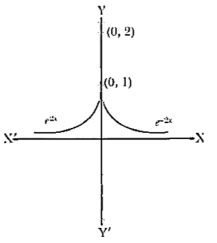
Image
Given $g ( x )=\left\{\begin{array}{ll}e^{2 x}, & x<0 \\ e^{-2 x}, & x \geq 0\end{array}\right. g ^{\prime}( x )=\left\{\begin{aligned} 2 e^{2 x}, & x<0 \\ -2 e^{-2 x}, & x \geq 0\end{aligned}\right.$
$\therefore \text{LHD}$ at $x =0, g^{\prime}(0)=2 e ^{2 \times 0}=2 e ^0=2$
$\text{RHD}$ at $x=0, g^{\prime}(0)=-2 e^0=-2 \times 1=-2$
As $\text{LHD} \neq \text{RHD}$ at $x=0$
$\therefore g ( x )$ is not differentiable at $x =0$
Again $\text { RHL }=\lim _{x \rightarrow 0^{+}} g(x)$
$=\lim _{x \rightarrow 0^{+}} e^{-2 x}=e^0=1$
$\text { LHL }=\lim _{x \rightarrow 0^{-}} g(x)$
$=\lim _{x \rightarrow 0^{-}} e^{2 x}=e^0=1$
$g(0)=e^0=1$
As $\text { LHL }=\text { RHL }=f(0)$
$\therefore g ( x )$ is continuous $\forall x \in R$

Need a full question paper?

Generate a complete, print-ready paper with questions like this in minutes — across 16+ boards, with answer keys.

Start Generating Free