Question
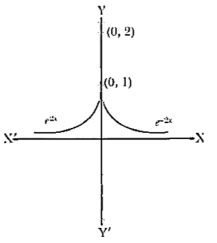
Let $g ( x )=\left\{\begin{array}{ll}e^{2 x}, & x<0 \\ e^{-2 x}, & x \geq 0\end{array}\right.$ then $g ( x )$ does not satisfy the condition
Answer

Image
Given $g ( x )=\left\{\begin{array}{ll}e^{2 x}, & x<0 \\ e^{-2 x}, & x \geq 0\end{array}\right.$
$g ^{\prime}( x )=\left\{\begin{aligned} 2 e^{2 x}, & x<0 \\ -2 e^{-2 x}, & x \geq 0\end{aligned}\right.$
$\therefore \ce{LHD}$ at $x =0, g^{\prime}(0)=2 e ^{2 \times 0}=2 e ^0=2$
$\ce{RHD}$ at $x=0, g^{\prime}(0)=-2 e^0=-2 \times 1=-2$
As $\ce{LHD} \neq \ce{RHD}$ at $x=0$
$\therefore g ( x )$ is not differentiable at $x =0$
$\text { Again RHL }=\lim _{x \rightarrow 0^{+}} g(x)$
$=\lim _{x \rightarrow 0^{+}} e^{-2 x}=e^0=1$
$\text { LHL }=\lim _{x \rightarrow 0^{-}} g(x)$
$=\lim _{x \rightarrow 0^{-}} e^{2 x}=e^0=1$
$g(0)=e^0=1$
$\text { As LHL }=\text { RHL }=f(0)$
$\therefore g ( x )$ is continuous $\forall x \in R$

Need a full question paper?

Generate a complete, print-ready paper with questions like this in minutes — across 16+ boards, with answer keys.

Start Generating Free

Similar questions

The corner points of the feasible region determined by the system of linear constraints are $(0,0),(0,40),(20,40),(60,20),(60,0)$. The objective function is $Z=4 x+3 y$.
Compare the quantity in Column A and Column B
Column AColumn B
Maximum of Z325
Find area bounded by curves $\{(\text{x},\text{y}):\text{y}\geq\text{x}^2\text{ andy}=\text{x}\}$ :
Determine the value of $k$ for which the function $f(x)$ is continuous at $x=4$.
$f(x)=\left\{\begin{array}{ll} \frac{x^2-16}{x-4}, & x \neq 4 \\ k, & x=4 \end{array}\right. $
The straight line $\frac{\text{x}-3}{3}=\frac{\text{y}-2}{1}=\frac{\text{z}-1}{0}$ is:
If $\left|\begin{array}{lll}<\text{br}> &1 &\text{amp; } 0 &\text{amp; } 0\\ <\text{br}>&2 &\text{amp; } 3 &\text{amp; } 4\\ <\text{br}>&5 &\text{amp; } -6 &\text{amp; x}<\text{br}> \end{array}\right|=45$ then $\text{x}=$
  1. 4
  2. 7
  3. -5
  4. -7
The value of $\int_0^{\pi / 6} \sin 3 x\ d x$ is:
The area of the region bounded by the parabola $y=\sin ^2 x$, lines $x=\frac{\pi}{2}, x=\pi$ and $x$-axis is :
If a line makes angle $\frac{\pi}{3}$ and $\frac{\pi}{4}$ with x-axis and y-axis respectively, then the angle made by the line with z-axis is:
  1. $\frac{\pi}{2}$
  2. $\frac{\pi}{3}$
  3. $\frac{\pi}{4}$
  4. $\frac{5\pi}{12}$
Let A and B be two events such that P(A) = 0.6, P(B) = 0.2, P(A|B) = 0.5. Then $\text{P}(\overline{\text{A}}|\overline{\text{B}})$ equals.
  1. $\frac{1}{10}$
  2. $\frac{3}{10}$
  3. $\frac{3}{8}$
  4. $\frac{6}{7}$
Let $\text{U}=\sin^{-1}\Big(\frac{2\text{x}}{1+\text{x}^2}\Big)$ and $\text{V}=\tan^{-1}\Big(\frac{2\text{x}}{1-\text{x}^2}\Big),$ then $\frac{\text{dU}}{\text{dV}}=$
  1. $\frac{1}{2}$
  2. $\text{x}$
  3. $\frac{1-\text{x}^2}{\text{x}^2-4}$
  4. $1$