a
(1) We have
$\frac{1}{2}\,\left\| \begin{array}{l}
\,k\,\,\, - 3k\,\,\,1\\
\,5\,\,\,\,\,\,\,\,k\,\,\,\,\,1\\
- k\,\,\,\,\,2\,\,\,\,\,1
\end{array} \right\| = 28$
$ \Rightarrow 5{k^2} + 13k - 46 = 0$
or $5{k^2} + 13k - 66 = 0$
Now, $5{k^2} + 13k - 46 = 0$
$ \Rightarrow k = \frac{{ - 13 \pm \sqrt {1089} }}{{10}}$
$\therefore k = \frac{{ - 23}}{5};k = 2$
since $k$ is an integer, $\therefore k = 2$
Also $5{k^2} + 13k + 66 = 0$
$ \Rightarrow k = \frac{{ - 13 \pm \sqrt { - 1151} }}{{10}}$
So no real solution exist
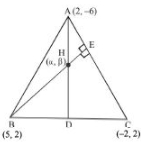
For cothocentre
$BH \bot AC$
$\therefore \left( {\frac{{\beta - 2}}{{\alpha - 5}}} \right)\left( {\frac{8}{{ - 4}}} \right) = - 1$
$ \Rightarrow \,\,\alpha - 2\beta = 1\,\,\,\,\,\,\,\,\,\,.......\left( 1 \right)$
Also $CH \bot AB$
$\therefore \left( {\frac{{\beta - 2}}{{\alpha + 2}}} \right)\left( {\frac{8}{3}} \right) = - 1$
$ \Rightarrow \,\,3\alpha - 8\beta = 1\,0\,\,\,\,\,\,\,\,\,.......\left( 2 \right)$
Solving $(1)$ and $(2)$ , we get
$\alpha = 2,\beta = \frac{1}{2}$
orthocentre is $\left( {2,\frac{1}{2}} \right)$