MCQ
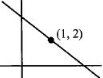
Let $L$ be the line passing through the point $P( 1, 2)$ such that its intercepted segment between the co-ordinate axes is bisected at $P$. If $L_1$ is the line perpendicular to $L$ and passing through the point $(-2 , 1),$ then the point of intersection of $L$ and $L_1$ is
  • $\left( {\frac{4}{5},\frac{{12}}{5}} \right)$
  • B
    $\left( {\frac{3}{5},\frac{{23}}{{10}}} \right)$
  • C
    $\left( {\frac{11}{20},\frac{{29}}{{10}}} \right)$
  • D
    $\left( {\frac{3}{10},\frac{{17}}{{5}}} \right)$
Answer

Correct option: A.
$\left( {\frac{4}{5},\frac{{12}}{5}} \right)$
a
Equation of line $L$

$\frac{x}{2} + \frac{y}{4} = 1$

$2x + y = 4\,\,\,\,\,\,\,\,\,\,.....\left( 1 \right)$

For line 

$x - 2y =  - 4\,\,\,\,\,.......\left( 2 \right)$

solving equation  $(1)$ and $(2)$; we get point of intersection

$\left( {4/5,\frac{{12}}{5}} \right)$

Need a full question paper?

Generate a complete, print-ready paper with questions like this in minutes — across 16+ boards, with answer keys.

Start Generating Free

Similar questions

If $\sin \theta = \frac{{12}}{{13}},(0 < \theta < \frac{\pi }{2})$ and $\cos \phi = - \frac{3}{5},\left( {\pi < \phi < \frac{{3\pi }}{2}} \right)$. Then $\sin (\theta + \phi )$will be
A parabola has the origin as its focus and the line $x = 2$ as the directrix. Then the vertex of the parabola is at
$\frac{{{{( - 1 + i\sqrt 3 )}^{15}}}}{{{{(1 - i)}^{20}}}} + \frac{{{{( - 1 - i\sqrt 3 )}^{15}}}}{{{{(1 + i)}^{20}}}}$ is equal to
The number of onto functions $f$ from $\{1, 2, 3, …, 20\}$ only $\{1, 2, 3, …, 20\}$ such that $f(k)$ is a multiple of $3$, whenever $k$ is a multiple of $4$, is
The product of all positive real values of $x$ satisfying the equation $x^{\left(16\left(\log _5 x\right)^3-68 \log _5 x\right)}=5^{-16}$is. . . . .
If the maximum value of $y =\frac{{7\ +\ 6\tan \,x\ -\ {{\tan }^{2\,}}\,x}}{{\left( {1\ +\ {{\tan }^2}\,x} \right)}}$ is $\lambda $ then the value of ${\log _{\sqrt 2 }}\left( \lambda  \right)$ is
Let $S = 0$ is the locus of centre of a variable circle which intersect the circle $x^2 + y^2 -4x -6y = 0$ orthogonally at $(4, 6)$ . If $P$ is a variable point of $S = 0$ , then least value of $OP$ is (where $O$ is origin)
$\sin 36^\circ \sin 72^\circ \sin 108^\circ \sin 144^\circ = $
If $\left(\frac{3^{6}}{4^{4}}\right) \mathrm{k}$ is the term, independent of $\mathrm{x}$, in the binomial expansion of $\left(\frac{\mathrm{x}}{4}-\frac{12}{\mathrm{x}^{2}}\right)^{12}$, then $\mathrm{k}$ is equal to ...... .
The equation of the circle passing through $(1,0)$ and $(0,1)$ and having smallest possible radius is :-