MCQ
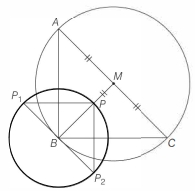
Let $P$ be a point inside a $\triangle A B C$ with $\angle A B C=90^{\circ}$. Let $P_1$ and $P_2$ be the images of $P$ under reflection in $A B$ and $B C$ respectively. The distance between the circumcenters of $\triangle A B C$ and $P_1 P P_2$ is
  • A
    $\frac{A B}{2}$
  • B
    $\frac{A P+B P+C P}{3}$
  • $\frac{A C}{2}$
  • D
    $\frac{A B+B C+A C}{2}$

Answer

Correct option: C.
$\frac{A C}{2}$
c
(c)

$A B C$ is a right angled triangle, $\angle A B C=90^{\circ}$

Circumcentre of $\triangle A B C$ is mid-point of $A C$ i.e. $M$.

Circumcentre of $\Delta P_1 P P_2$ is mid-point of $P_1 P_2$

$A B$ is perpendicular bisector of $P P_1$ and $B C$ is perpendicular bisector of $P P_2$.

Perpendicular bisector of $P P_1$ and $P P_2$ intersect at $B$.

$\therefore B$ is circumcentre of $\Delta P_1 P P_2$.

$\therefore$ Distance between

$B M=A M=M C=\frac{A C}{2}$

Need a full question paper?

Generate a complete, print-ready paper with questions like this in minutes — across 16+ boards, with answer keys.

Start Generating Free

Similar questions

The vector $\vec a = \left( {\alpha ,2,\beta } \right)\;,$ lies in the plane of the vector $\vec b = \left( {1,1,0} \right),$ and $\;\vec c = \left( {0,1,1} \right)$ and bisects the angle between $\vec b$  and $\vec c$ . Then which one of the following gives possible values $\alpha $ and $\beta $ ?
If $f(a) = 2$, $f'(a) = 1$, $g(a) = - 3$, $g'(a) = - 1$, then $\mathop {\lim }\limits_{x \to a} \,\frac{{f(a)\,g(x) - f(x)\,g(a)}}{{x - a}} = $
If magnitudes of vectors $\vec a,\vec b,\,\vec c$ are $3, 4,$ and $5$ respectively $\vec a\,$ and $\,\vec b + \,\vec c,\, \vec b\,$ and $\,\vec c + \,\vec a,$ $\vec c\,$ and $ \,\vec a + \,\vec b,$ perpendicular to each other, then $\left| {\vec a + \vec b + \vec c} \right|=$
If in the equation $a{x^2} + bx + c = 0,$ the sum of roots is equal to sum of square of their reciprocals, then $\frac{c}{a},\frac{a}{b},\frac{b}{c}$ are in
The set of all real values of $\lambda$ for which the quadratic equations, $\left(\lambda^{2}+1\right) x ^{2}-4 \lambda x +2=0$ always have exactly one root in the interval $(0,1)$ is
If the points $P$ and $Q$ are respectively the circumcentre and the orthocentre of a $\triangle ABC$, then $\overrightarrow{ PA }+\overrightarrow{ PB }+\overrightarrow{ PC }$ is equal to
One card is drawn from a pack of $52$ cards. The probability that it is a queen or heart is
The range of the function $f(x) =$$\frac{{{e^x}\,\ln \,x\,\,{5^{({x^2} + 2)}}({x^2} - 7x + 10)}}{{2{x^2}\, - \,11x\, + \,12}}$  is
Let $f: R \rightarrow R$ and $g: R \rightarrow R$ be functions defined by$f(x)=\left\{\begin{array}{cl}x|x| \sin \left(\frac{1}{x}\right), & x \neq 0, \\ 0, & x=0,\end{array}\right.$ and $g(x)=\left\{\begin{array}{cc}1-2 x, & 0 \leq x \leq \frac{1}{2}, \\ 0, & \text { otherwise }\end{array}\right.$
Let $a, b, c, d \in R$. Define the function $h: R \rightarrow R$ by
$h(x)=a f(x)+b\left(g(x)+g\left(\frac{1}{2}-x\right)\right)+c(x-g(x))+d g(x), x \in R$
Match each entry in List $-I$ to the correct entry in List $-II$.
List $-I$ List $-II$
$(P)$ If $a=0, b=1, c=0$ and $d=0,$ then  $(1) \ h$ is one $-$ one
$(Q)$ If $a=1, b=0, c=0$ and $d=0,$ then  $(2) \ h$ is onto.
$(R)$ If $a=0, b=0, c=1$ and $d=0,$ then  $(3) \ h$ is differentiable on $R$.
$(S)$ If $a=0, b=0, c=0$ and $d=1,$ then $(4) $ the range of $h$ is $[0,1]$
  $(5)$ the range of $h$ is $\{0,1\}$
The correct option is
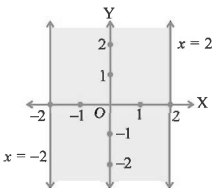
The inequality representing the coloured region in figure is $\ldots \ldots . .$