MCQ
Let $\quad f:(-\infty, \infty)-\{0\} \rightarrow R$ be a differentiable function such that $f^{\prime}(1)=\lim _{a \rightarrow \infty} a^2 f\left(\frac{1}{a}\right)$.

Then $\lim _{a \rightarrow \infty} \frac{a(a+1)}{2} \tan ^{-1}\left(\frac{1}{a}\right)+a^2-2 \log _e a$ is equal to

  • A
     $\frac{3}{2}+\frac{\pi}{4}$
  • B
     $\frac{3}{8}+\frac{\pi}{4}$
  •  $\frac{5}{2}+\frac{\pi}{8}$
  • D
     $\frac{3}{4}+\frac{\pi}{8}$

Answer

Correct option: C.
 $\frac{5}{2}+\frac{\pi}{8}$
c
$ f:(-\infty, \infty)-\{0\} \rightarrow R $

$ f^{\prime}(1)=\lim _{a \rightarrow \infty} a^2 f\left(\frac{1}{a}\right) $

$ \lim _{a \rightarrow \infty} \frac{a(a+1)}{2} \tan ^{-1}\left(\frac{1}{a}\right)+a^2-2 \ln (a) $

$ \lim _{a \rightarrow \infty} a^2\left(\frac{\left(1+\frac{1}{a}\right)}{2} \tan ^{-1}\left(\frac{1}{a}\right)+1-\frac{2}{a^2} \ln (a)\right) $

$ f(x)=\frac{1}{2}(1+x) \tan ^{-1}(x)+1-2 x^2 \ln (x) $

$ f^{\prime}(x)=\frac{1}{2}\left(\frac{1+x}{1+x^2}+\tan ^{-1}(x)+4 x \ln (x)\right)+2 x $

$ f^{\prime}(1)=\frac{1}{2}\left(1+\frac{\pi}{4}\right)+2 $

$ f^{\prime}(1)=\frac{5}{2}+\frac{\pi}{8}$

Ans. ($3$)

Need a full question paper?

Generate a complete, print-ready paper with questions like this in minutes — across 16+ boards, with answer keys.

Start Generating Free

Similar questions

Consider $ \text{x} = 4\tan^{-1}\left (\frac {1}{5}\right ), \text{y} = \tan^{-1} \left (\frac {1}{70}\right ) $ and $ \text{z} = \tan^{-1}\bigg (\frac {1}{99}\bigg)$ .What is $xx$ equal to?
The area (in square units) of the region enclosed by the ellipse $x^2+3 y^2=18$ in the first quadrant below the line $y=x$ is :
If $\triangle_1=\begin{vmatrix}1&1&1\\\text{a}&\text{b}&\text{c}\\\text{a}^2&\text{b}^2&\text{c}^2\end{vmatrix},\triangle_2=\begin{vmatrix}1&\text{bc}&\text{a}\\1&\text{ca}&\text{b}\\1&\text{ab}&\text{c}\end{vmatrix},$ then:
If $f\left( x \right)\, = \,\,\operatorname{sgn} \left( {\left( {{x^2} - kx + 6} \right)\left( {\sin x - \frac{1}{2}} \right)} \right)$ (where $k > 0$ ) has exactly $4$ points of discontinuity in $(0, 6)$ then maximum integral value of $k$ is
If the direction ratios of two lines are given by $3lm - 4\,ln + mn = 0$ and $l + 2m + 3n = 0$, then the angle between the lines is
The normal at the point $(1, 1)$ on the curve $2y + x^2 = 3$ is :
The probability that a certain beginner at golf gets a good shot if he uses the correct club is $\frac{1}{3}$ and the probability of a good shot with an incorrect club is $\frac{1}{4}$. In his bag are $5$ different clubs, only one of which is correct for the shot in question. If he chooses a club at random and takes a stroke, then the probability that he gets a good shot, is
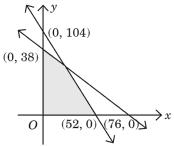
The feasible region of an LPP is given in the following figure
Image
Then, the constraints of the LPP are $x \geq 0, y \geq 0$ and
An ordinary dice is rolled for a certain number of times. If the probability of getting an odd number $2$ times is equal to the probability of getting an even number $3$ times, then the probability of getting an odd number for odd number of times is
If $f(x)=\int_0^x e^{t^2}(t-2)(t-3) d t$ for all $x \in(0, \infty)$, then

$(A)$ $f$ has a local maximum at $x=2$

$(B)$ $f$ is decreasing on $(2,3)$

$(C)$ there exists some $c \in(0, \infty)$ such that $f ^{\prime \prime}( c )=0$

$(D)$ $f$ has a local minimum at $x=3$