Question
Let R be the feasible region (convex polygon) for a linear programming problem and let Z = ax + by be the objective function. When Z has an optimal value (maximum or minimum), where the variables x and y are subject to constraints described by linear inequalities, this optimal value must occur at a corner point (vertex) of the feasible region. Based on the above information, answer the following questions.
- Objective function of a L.P.P. is:
- A constant.
- A function to be optimised.
- A relation between the variables.
- None of these.
- Which of the following statement is correct?
- Every LPP has at least one optimal solution.
- Every LPP has a unique optimal solution.
- If an LPP has two optimal solutions, then it has infinitely many solutions.
- None of these.
- In solving the LPP: "minimize f = 6x + 10y subject to constraints $\text{x}\geq6,\text{ y}\geq2,\text{ 2x}+\text{y}\geq10,\text{ x}\geq0,\text{ y}\geq0"$ redundant constraints are:
- $\text{x}\geq6,\text{ y}\geq2$
- $\text{2x}+\text{y}\geq10,\text{ x}\geq0,\text{ y}\geq0$
- $\text{x}\geq6$
- None of these
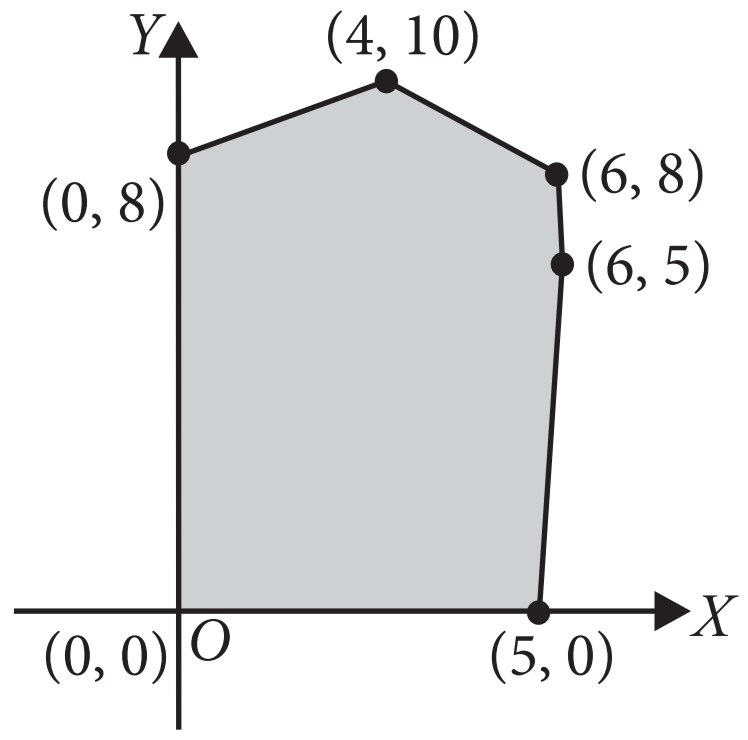
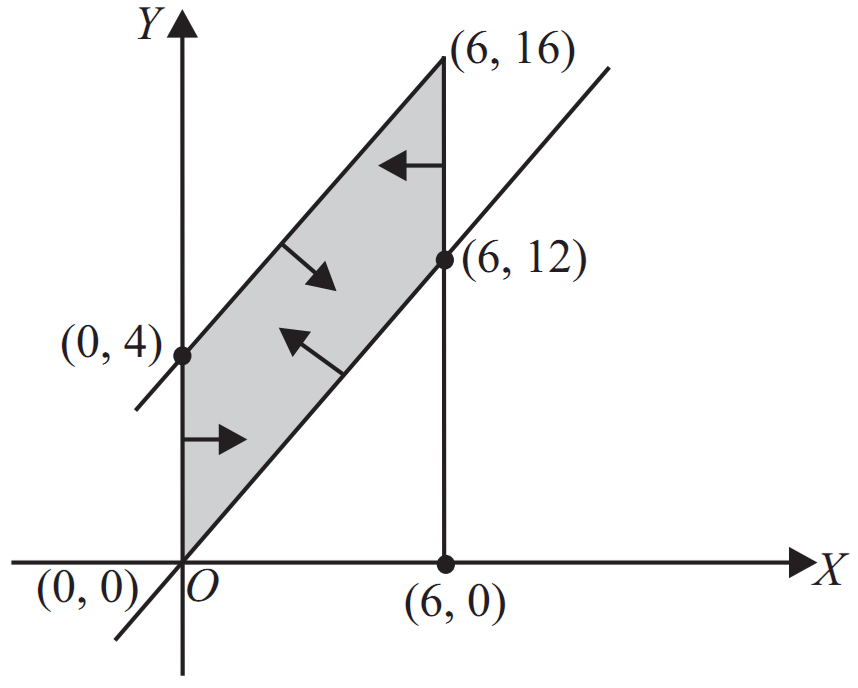
- The feasible region for a LPP is shown shaded in the figure. Let Z = 3x - 4y be the objective function. Minimum of Z occurs at:
- (0, 0)
- (0, 8)
- (5, 0)
- (4, 10)
- The feasible region for a LPP is shown shaded in the figure. Let F = 3x - 4y be the objective function. Maximum value of F is:
- 0
- 8
- 12
- -18





 Based on the above information, answer the following questions.