Question
Let R be the feasible region (convex polygon) for a linear programming problem and let Z = ax + by be the objective function. When Z has an optimal value (maximum or minimum), where the variables x and y are subject to constraints described by linear inequalities, this optimal value must occur at a corner point (vertex) of the feasible region. Based on the above information, answer the following questions.
  1. Objective function of a L.P.P. is:
  1. A constant.
  2. A function to be optimised.
  3. A relation between the variables.
  4. None of these.
  1. Which of the following statement is correct?
  1. Every LPP has at least one optimal solution.
  2. Every LPP has a unique optimal solution.
  3. If an LPP has two optimal solutions, then it has infinitely many solutions.
  4. None of these.
  1. In solving the LPP: "minimize f = 6x + 10y subject to constraints $\text{x}\geq6,\text{ y}\geq2,\text{ 2x}+\text{y}\geq10,\text{ x}\geq0,\text{ y}\geq0"$ redundant constraints are:
  1. $\text{x}\geq6,\text{ y}\geq2$
  2. $\text{2x}+\text{y}\geq10,\text{ x}\geq0,\text{ y}\geq0$
  3. $\text{x}\geq6$
  4. None of these
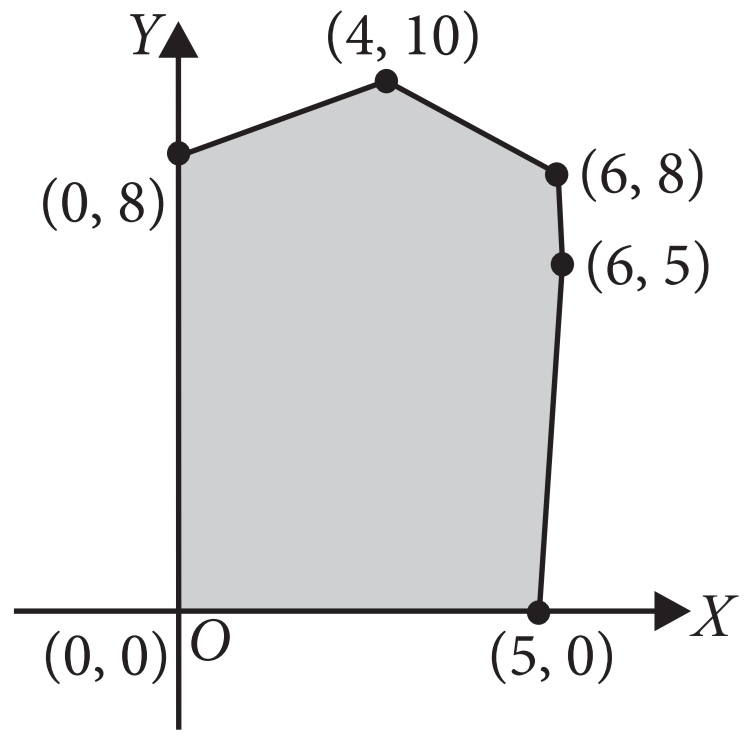
  1. The feasible region for a LPP is shown shaded in the figure. Let Z = 3x - 4y be the objective function. Minimum of Z occurs at:
  1. (0, 0)
  2. (0, 8)
  3. (5, 0)
  4. (4, 10)
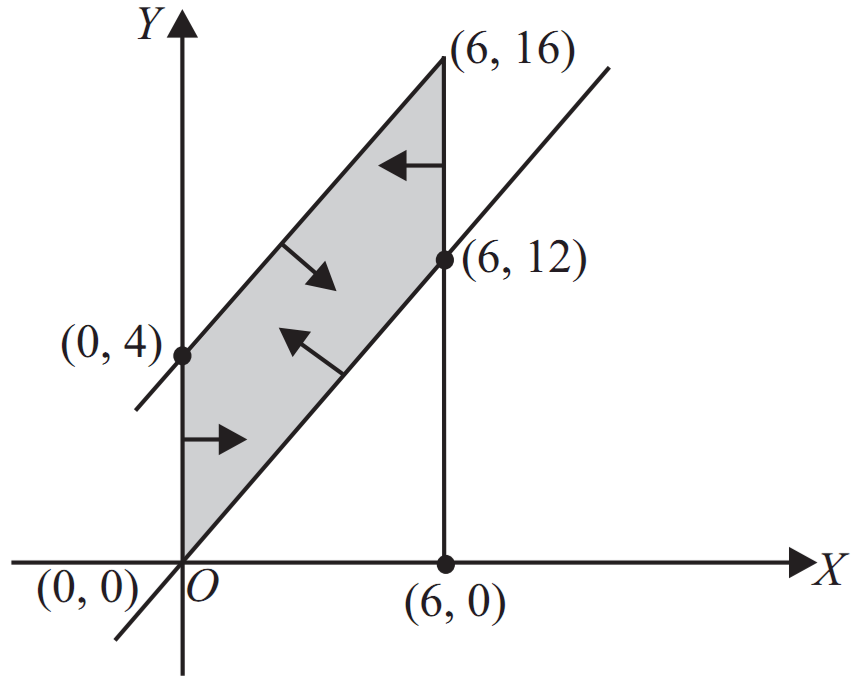
  1. The feasible region for a LPP is shown shaded in the figure. Let F = 3x - 4y be the objective function. Maximum value of F is:
  1. 0
  2. 8
  3. 12
  4. -18

Answer

  1. (b) A function to be optimised.
Solution:

Objective function is a linear function (involve variable) whose maximum or minimum value is to be found.
  1. (c) If an LPP has two optimal solutions, then it has infinitely many solutions.
Solution:

If optimal solution is obtained at two distinct points A and B ( corners of the feasible region), then optimal solution is obtained at every point of segment [AB].
  1. (b) $\text{2x}+\text{y}\geq10,\text{ x}\geq0,\text{ y}\geq0$
​​​​​​​Solution:

When $\text{x}\geq6$ and $\text{y}\geq2,$ then

$\text{2x}+\text{y}\geq2\times6+2,\text{i.e.,}\text{ 2x}+\text{y}\geq14$

Hence, $\text{x}\geq0,\text{ y}\geq0$ and $2\text{x}+\text{y}\geq10$ are automatically satisfied by every point of the region

$\{(\text{x, y}):\text{x}\geq6\}\cap\{(\text{x, y}):\text{y}\geq2\}$
  1. (b) (0, 8)
​​​​​​​​​​​​​​​​​​​​​Solution:

Construct the following table of values of the objective function:
Corner Point
Value of Z = 3x - 4y
(0, 0)
3 × 0 - 4 × 0 = 0
(5, 0)
3 × 5 - 4 × 0 = 15
(6, 5)
3 × 6 - 4 × 5 = -2
(6, 8)
3 × 6 - 4 × 8 = -14
(4, 10)
3 × 4 - 4 × 10 = -28
(0, 8)
$3\times0 - 4\times8 = -32\leftarrow\text{Minimum}$
Minimum of Z = -32 at (0, 8).
  1. (a) 0
​​​​​​​​​​​​​​​​​​​​​​​​​​​​Solution:

Construct the following table of values of the objective function F:
Corner Point
Value of F = 3x - 4y
(0, 0)
$3\times0 - 4\times0 = 0\leftarrow\text{Minimum}$
( 6, 12)
3 × 6 - 4 × 12 = -30
(6, 16)
3 × 6 - 4 × 16 = -46
(0, 4)
3 × 0 - 4 × 4 = -16
Hence, maximum of F = 0.

Need a full question paper?

Generate a complete, print-ready paper with questions like this in minutes — across 16+ boards, with answer keys.

Start Generating Free

Similar questions

Let f : A → B and g : B → C be two functions defined on non-empty sets A, B, C, then gof : A → C be is called the composition of f and g defined as, $\text{gof}(\text{x})=\text{g}\{\text{f(x)}\}\forall\text{ x }\in\text{ A}.$ Consider the functions $\text{f}(\text{x})=\begin{cases}\sin\text{x},&\text{x}\geq0\\1-\cos\text{x},&\text{x}\leq0\end{cases},\text{g}(\text{x})=\text{e}^\text{x}$ and then answer the following questions.
  1. The function gof(x) is defined as:
  1. $\text{gof}(\text{x})=\begin{cases}\text{e}^\text{x}&,\text{x}\geq0\\1-\text{e}^{\cos\text{x}}&,\text{x}\leq0\end{cases}$
  2. $\text{gof}(\text{x})=\begin{cases}\text{e}^{\sin\text{x}}&,\text{x}\leq0\\\text{e}^{1-\cos\text{x}}&,\text{x}\geq0\end{cases}$
  3. $\text{gof}(\text{x})=\begin{cases}\text{e}^{\sin\text{x}}&,\text{x}\leq0\\1-\text{e}^{\cos\text{x}}&,\text{x}\geq0\end{cases}$
  4. $\text{gof}(\text{x})=\begin{cases}\text{e}^{\sin\text{x}}&,\text{x}\geq0\\\text{e}^{1-\cos\text{x}}&,\text{x}\leq0\end{cases}$
  1. $\frac{\text{d}}{\text{dx}}\{\text{gof}(\text{x})\}=$
  1. $[\text{gof}(\text{x})]'=\begin{cases}\cos\text{x}\cdot\text{e}^{\sin\text{x}}&,\text{x}\geq0\\\text{e}^{1-\cos\text{x}}\cdot\sin\text{x}&,\text{x}\leq0\end{cases}$
  2. $[\text{gof}(\text{x})]'=\begin{cases}\cos\text{x}\cdot\text{e}^{\sin\text{x}}&,\text{x}\geq0\\-\sin\text{x}\cdot\text{e}^{1-\cos\text{x}}&,\text{x}\leq0\end{cases}$
  3. $[\text{gof}(\text{x})]'=\begin{cases}\cos\text{x}\cdot\text{e}^{\sin\text{x}}&,\text{x}\geq0\\\sin\text{x}\cdot({1-\cos\text{x}})&,\text{x}\leq0\end{cases}$
  4. $[\text{gof}(\text{x})]'=\begin{cases}\cos\text{x}\cdot\text{e}^{\sin\text{x}}&,\text{x}\geq01-{\sin\text{x}})\cdot\text{e}^{1-\cos\text{x}}&,\text{x}\leq0\end{cases}$
  1. R.H.D. of gof(x) at $x = 0$ is:
  1. $0$
  2. $1$
  3. $-1$
  4. $2$
  1. L.H.D. of gof(x) at $x = 0$ is:
  1. $0$
  2. $1$
  3. $-1$
  4. $2$
  1. The value of f'(x) at $\text{x}=\frac{\pi}{4}$ is:
  1. $\frac{1}{9}$
  2. $\frac{1}{\sqrt2}$
  3. $\frac{1}{2}$
  4. Not defined.
Consider the following equations of curves $\text{y}=\cos\text{x},\text{y}=\text{x}+1$ and y = 0.
On the basis of above information, answer the following questions.
  1. The curves $\text{y}=\cos\text{x}$ and y = x + 1 meet at:
  1. (1, 0)
  2. (0, 1)
  3. (1, 1)
  4. (0, 0)
  1. $\text{y}=\cos\text{x}$ meet the x-axis at:
  1. $\Big(\frac{-\pi}{2},0\Big)$
  2. $\Big(\frac{\pi}{2},0\Big)$
  3. Both (a) and (b).
  4. None of these.
  1. Value of the integral $\int\limits_{-1}^{0}(\text{x}+1)\text{dx}$ is:
  1. $\frac{1}{2}$
  2. $\frac{2}{3}$
  3. $\frac{3}{4}$
  4. $\frac{1}{3}$
  1. Value of the integral $\int\limits_{0}^{\frac{\pi}{2}}\cos\text{x dx}$ is:
  1. 0
  2. -1
  3. 2
  4. 1
  1. Area bounded by the given curves is:
  1. $\frac{1}{2}\text{ sq}.\text{units}$
  2. $\frac{3}{2}\text{ sq}.\text{units}$
  3. $\frac{3}{4}\text{ sq}.\text{units}$
  4. $\frac{1}{4}\text{ sq}.\text{units}$
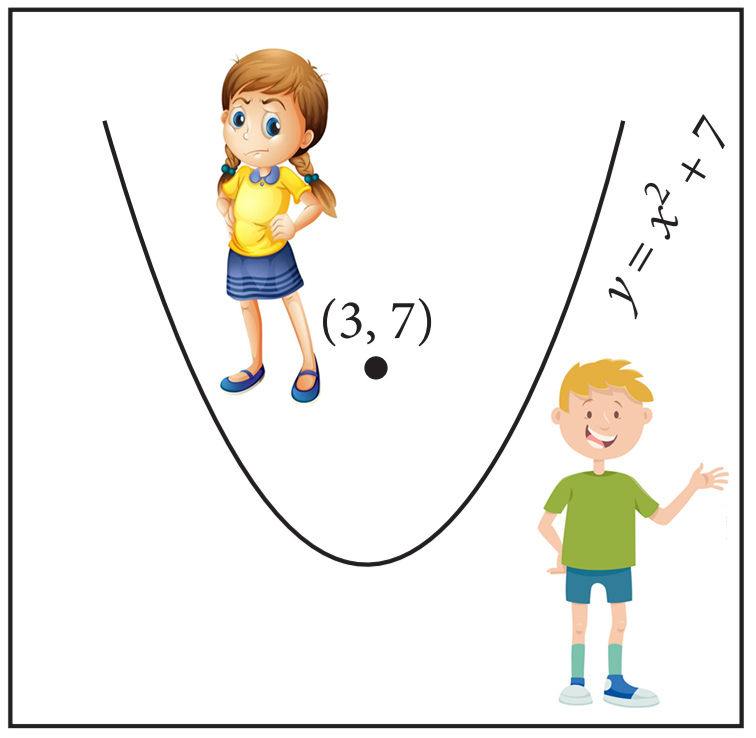
A student Arun is running on a playground along the curve given by $y = x^2 + 7$. Another student Manila standing at point $(3, 7)$ on playground wants to hit Arun by paper ball when Arun is nearest to Manila.

Based on above information, answer the following questions.

  1. Arun's position at any value of x will be.
  1. $(x^2, y - 7)$
  2. $(x^2, y + 7)$
  3. $(x, x^2 + 7)$
  4. $(x^2, x - 7)$
  1. Distance (say D) between Arun and Manila will be.
  1. $(\text{x}-1)(2\text{x}^2+2\text{x}+3)$
  2. $(\text{x}-3)^2+\text{x}^4$
  3. $\sqrt{(\text{x}-3)+\text{x}^4}$
  4. $\sqrt{(\text{x}-1)(2\text{x}^2+2\text{x}+3)}$
  1. For which real value(s) of x, first derivative of $D^2$ w.r.t, x will Vanish?
  1. 1
  2. 2
  3. 3
  4. 4
  1. Find the position of Arun when Manila will hit the paper hall.
  1. (5, 32)
  2. (1, 8)
  3. (3, 7)
  4. (3, 16)
  1. The minimum value of D is.
  1. $3$
  2. $\sqrt{3}$
  3. $5$
  4. $\sqrt{5}$
Read the following text carefully and answer the questions that follow:
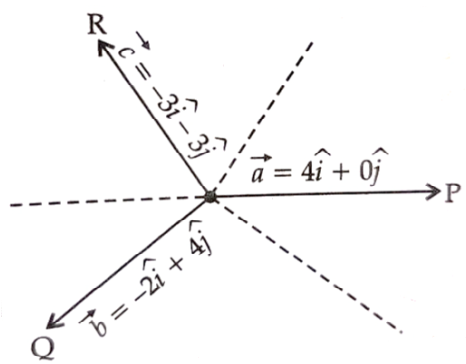
Team $P, Q, R$ went for playing a tug of war game. Teams $P, Q, R$ have attached a rope to a metal ring and is trying to pull the ring into their own areas $($team areas when in the given figure below$)$. Team $P$ pulls with force$F _1=4 \hat{i}+0 \hat{j} KN$
Team $Q$ pull with force $F _2=-2 \hat{i}+4 \hat{j} KN$
Team $R$ pulls with force $F _3=-3 \hat{i}-3 \hat{j} KN$
Image
$i$. What is the magnitude of the teams combined force? $(1)$
$ii$. Find the magnitude of Team $B. (1)$
$iii$. Which team will win the game? $(2)$
OR
Find the probability that she gets grade $A$ in at least one subject. $(2)$
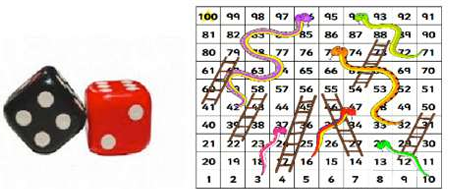
Akshat and his friend Aditya were playing the snake and ladder game. They had their own dice to play the game. Akshat was having red dice whereas Aditya had black dice. In the beginning, they were using their own dice to play the game. But then they decided to make it faster and started playing with two dice together.

Image

Aditya rolled down both black and red die together.

First die is black and second is red.

(i) Find the conditional probability of obtaining a sum greater than 9, given that the black die resulted in a 5 .

(ii) Find the conditional probability of obtaining the sum 8, given that the red die resulted in a number less than 4 .

A differential equation is said to be in the variable separable form if it is expressible in the form $f(x)\ dx = g(y)\ dy.$
The solution of this equation is given by
$\int\text{f(x)dx}=\int\text{g(y)dy}+\text{c},$ where c is the constant of integration.
Based on the above information, answer the following questions.
  1. If the solution of the differential equation $\frac{\text{dy}}{\text{dx}}=\frac{\text{ax+3}}{\text{2y+f}}$ represents a circle, then the value of 'a' is:
  1. $2$
  2. $-2$
  3. $3$
  4. $-4$
  1. The differential equation $\frac{\text{dy}}{\text{dx}}=\frac{\sqrt{1-\text{y}^2}}{\text{y}}$ determines a family of circle with.
  1. Variable radii and fixed centre $(0, 1)$
  2. Variable radii and fixed centre $(0, -1)$
  3. Fixed radius 1 and variable centre on $x-$axis
  4. Fixed radius 1 and variable centre on $y-$axis
  1. If $= y'+ 1, y(0) = 1$, then $y ($In $2) =$
  1. $1$
  2. $2$
  3. $3$
  4. $4$
  1. The solution of the differential equation $\frac{\text{dy}}{\text{dx}}=\text{e}^\text{x-y}+\text{x}^2\text{e}^\text{-y}$ is:
  1. $\text{e}^\text{x}=\frac{\text{y}^3}{3}+\text{e}^\text{y}+\text{c}$
  2. $\text{e}^\text{y}=\frac{\text{x}^2}{3}+\text{e}^\text{x}+\text{c}$
  3. $\text{e}^\text{y}=\frac{\text{x}^3}{3}+\text{e}^\text{x}+\text{c}$
  4. None of these
  1. If $\frac{\text{dy}}{\text{dx}}=\text{y}\sin2\text{x},\ \text{y}(0)=1,$ then its solution is:
  1. $\text{y}=\text{e}^{\sin^2}\text{x}$
  2. $\text{y}={\sin^2}\text{x}$
  3. $\text{y}={\cos^2}\text{x}$
  4. $\text{y}=\text{e}^{\cos^2}\text{x}$
If the equation is of the form $\frac{\text{dy}}{\text{dx}}=\text{py}=\text{Q},$ where P, Q are functions of x, then the solution of the differential equation is given by $\text{ye}^{\int\text{pdx}}=\int\text{Q e}^{\int\text{pdx}}\text{dx}+\text{c},$ where $\text{e}^{\int\text{pdx}}$ is called the integrating factor (I.F.).
Based on the above information, answer the following questions.
  1. The integrating factor of the differential equation $\sin\text{x}\frac{\text{dy}}{\text{dx}}+2\text{y}\cos\text{x}=1$ is $(\sin\text{x})^\lambda,$ where $\lambda=$
  1. 0
  2. 1
  3. 2
  4. 3
  1. Integrating factor of the differential equation $(1-\text{x}^2)\frac{\text{dy}}{\text{dx}}-\text{xy}=1$ is:
  1. $-\text{x}$
  2. $\frac{\text{x}}{1+\text{x}^2}$
  3. $\sqrt{1-\text{x}^2}$
  4. $\frac{1}{2}\log(1-\text{x}^2)$
  1. The solution of $\frac{\text{dy}}{\text{dx}}+\text{y}=\text{e}^{-\text{x}},\text{ y}(0)=0,$ is:
  1. $\text{y}=\text{e}^\text{x}(\text{x}-1)$
  2. $\text{y}=\text{xe}^{-\text{x}}$
  3. $\text{y}=\text{xe}^{-\text{x}}+1$
  4. $\text{y}=(\text{x}+1)\text{e}^{-\text{x}}$
  1. General solution of $\frac{\text{dy}}{\text{dx}}+\text{y}\tan\text{x}=\sec\text{x}$ is:
  1. $\text{y}\sec\text{y}=\tan\text{x}+\text{c}$
  2. $\text{y}\tan\text{x}=\sec\text{x}+\text{c}$
  3. $\tan\text{x}=\text{y}\tan\text{x}+\text{c}$
  4. $\text{x}\sec\text{x}=\tan\text{y}+\text{c}$
  1. The integrating factor of differential equation $\frac{\text{dy}}{\text{dx}}-3\text{y}=\sin2\text{x}$ is:
  1. $\text{e}^{3\text{x}}$
  2. $\text{e}^{-2\text{x}}$
  3. $\text{e}^{-3\text{x}}$
  4. $\text{xe}^{-3\text{x}}$
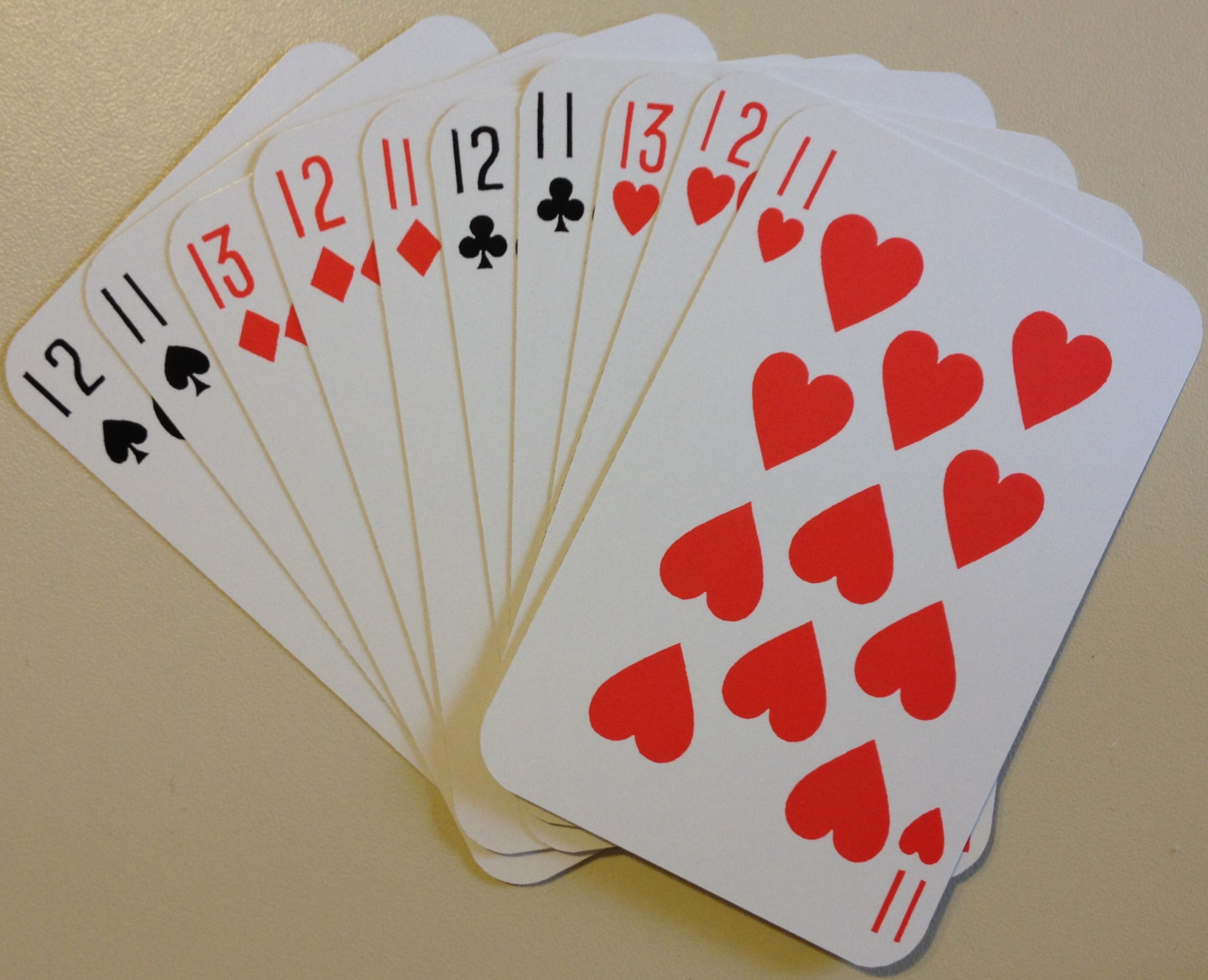
A card is lost from a pack of $52$ cards. From the remaining cards two cards are drawn at random.
Based on the above information, answer the following questions.
  1. The probability of drawing two diamonds, given that a card of diamond is missing, is:
  1. $\frac{21}{425}$
  2. $\frac{22}{425}$
  3. $\frac{23}{425}$
  4. $\frac{1}{425}$
  1. The probability of drawing two diamonds, given that a card of heart is missing, is:
  1. $\frac{26}{425}$
  2. $\frac{22}{425}$
  3. $\frac{19}{425}$
  4. $\frac{23}{425}$
  1. Let A be the event of drawing two diamonds from remaining $51$ cards and $E_1, E_2, E_3$ and $E_4$ be the events that lost card is of diamond, club, spade and heart respectively, then the approximate value of $\displaystyle\sum_{\text{i}=1}^{4}\text{P(A|E}_\text{i})$ is:
  1. $0.17$
  2. $0.24$
  3. $0.25$
  4. $0.18$
  1. AU of a sudden, missing card is found and, then two cards are drawn simultaneously without replacement. Probability that both drawn cards are king is:
  1. $\frac{1}{52}$
  2. $\frac{1}{221}$
  3. $\frac{1}{121}$
  4. $\frac{2}{221}$
  1. If two cards are drawn from a well shuffled pack of $52$ cards, one by one with replacement, then probability of getting not a king in $1^{st}$ and $2^{nd}$ draw is:
  1. $\frac{144}{169}$
  2. $\frac{12}{169}$
  3. $\frac{64}{169}$
  4. None of these
In a family there are four children. All of them have to work in their family business to earn their livelihood at the age of 18. Based on the above information, answer the following questions.
  1. Probability that all children are girls, if it is given that elder child is a boy, is:
  1. $\frac{3}{8}$
  2. $\frac{1}{8}$
  3. $\frac{5}{8}$
  4. None of these.
  1. Probability that all children are boys, if two elder children are boys, is:
  1. $\frac{1}{4}$
  2. $\frac{3}{4}$
  3. $\frac{1}{2}$
  4. None of these.
  1. Find the probability that two middle children are boys, if it is given that eldest child is a girl.
  1. $0$
  2. $\frac{3}{4}$
  3. $\frac{1}{4}$
  4. None of these.
  1. Find the probability that all children are boys, if it is given that at most one of the children is a girl.
  1. $0$
  2. $\frac{1}{5}$
  3. $\frac{2}{5}$
  4. $\frac{4}{5}$
  1. Find the probability that all children are boys, if it is given that at least three of the children are boys.
  1. $\frac{1}{5}$
  2. $\frac{2}{5}$
  3. $\frac{3}{5}$
  4. $\frac{4}{5}$
Megha wants to prepare a handmade gift box for her friend's birthday at home. For making lower part of box, she takes a square piece of cardboard of side $20$cm.

Based on the above information, answer the following questions.
  1. If $x$ cm be the length of each side of the square cardboard which is to be cut off from corners of the square piece of side 20cm, then possible value of $x$ will be given by the interval.
  1. $[0, 20]$
  2. $(0, 10)$
  3. $(0, 3)$
  4. None of these
  1. Volume of the open box formed by folding up the cutting corner can be expressed as.
  1. $\text{V}=\text{x}(20-2\text{x})(20-2\text{x)}$
  2. $\text{V}=\frac{\text{x}}{2}(20+\text{x})(20-\text{x})$
  3. $\text{V}=\frac{\text{x}}{3}(20-\text{x})(20+\text{x})$
  4. $\text{V}=\text{x}(20-2\text{x})(20-\text{x)}$
  1. The values of $x$ for which $\frac{\text{dV}}{\text{dX}}=0$, are.
  1. $3, 4$
  2. $0,\frac{10}{3}$
  3. $0, 10$
  4. $10,\frac{10}{3}$
  1. Megha is interested in maximizing the volume of the box. So, what should be the side of the square to be cut off so that the volume of the box is maximum?
  1. $12$cm
  2. $8$cm
  3. $\frac{10}{3}\text{cm}$
  4. $2$cm
  1. The maximum value of the volume is.
  1. $\frac{17000}{27}\text{cm}^3$
  2. $\frac{11000}{27}\text{cm}^3$
  3. $\frac{8000}{27}\text{cm}^3$
  4. $\frac{16000}{27}\text{cm}^3$