MCQ
Let $S$ be the sample space of all five digit numbers.If $p$ is the probability that a randomly selected number from $S$, is a multiple of $7$ but not divisible by $5$ , then $9\,p$ is equal to.
  • A
    $1.0146$
  • B
    $1.2085$
  • $1.0285$
  • D
    $1.1521$

Answer

Correct option: C.
$1.0285$
c
Sol. $n ( S )=$ all 5 digit nos $=9 \times 10^{4}$

$A :$ no is multiple of $7$ but not divisible by $5$

Smallest $5$ digit divisible by $7$ is $10003$

Largest $5$ digit divisible by $7$ is $99995$

$\therefore 99995=10003+( n -1) 7 \quad n =12857$

Numbers divisible by $35$

$99995=10010+( P -1) 35 \Rightarrow P =2572$

$\therefore$ Numbers divisible by $7$ but not by $35$ are

$12857-2572=10285$

$\therefore P =\frac{10285}{90000}$

$\therefore 9\,P =1.0285$

Need a full question paper?

Generate a complete, print-ready paper with questions like this in minutes — across 16+ boards, with answer keys.

Start Generating Free

Similar questions

The mean of the numbers $a, b, 8,5,10$ is $6$ and their variance is $6.8$. If $M$ is the mean deviation of the numbers about the mean, then $25\; M$ is equal to
Let $S=\{1,2,3, \ldots, 100\}$. Suppose $b$ and $c$ are chosen at random from the set $S$. The probability that $4 x^2+b x+c$ has equal roots is
Consider the hyperbola

$\frac{x^2}{100}-\frac{y^2}{64}=1$

with foci at $S$ and $S_1$, where $S$ lies on the positive $x$-axis. Let $P$ be a point on the hyperbola, in the first quadrant. Let $\angle SPS _1=\alpha$, with $\alpha<\frac{\pi}{2}$. The straight line passing through the point $S$ and having the same slope as that of the tangent at $P$ to the hyperbola, intersects the straight line $S_1 P$ at $P_1$. Let $\delta$ be the distance of $P$ from the straight line $SP _1$, and $\beta= S _1 P$. Then the greatest integer less than or equal to $\frac{\beta \delta}{9} \sin \frac{\alpha}{2}$ is. . . . . . . 
The sum of the integers from $1$ to $100$ which are not divisible by $3$ or $5$ is
If $p + q + r = 0 = a + b + c$, then the value of the determinant $\left| {\,\begin{array}{*{20}{c}}{pa}&{qb}&{rc}\\{qc}&{ra}&{pb}\\{rb}&{pc}&{qa}\end{array}\,} \right|$ is
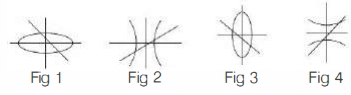
Suppose $a, b$ are real numbers such that $a b \neq 0$. Which of the following four figures represent the curve $(y-a x-b)\left(b x^2+a y^2-a b\right)=0$ ?
If one of the diameters of the circle $x^{2}+y^{2}-2 x-6 y+6=0$ is a chord of another circle $'C'$, whose center is at $(2,1),$ then its radius is..........
Let  $a, b$  and $ c $ be vectors with magnitudes $3, 4$  and $5$  respectively and $a + b + c = 0, $ then the values of $ a.b + b.c + c.a$  is
The integral $\int {\frac{{3{x^{13}}\, + \,\,2{x^{11}}}}{{{{(2{x^4}\, + \,3{x^2}\, + \,1)}^4}}}dx} $ is equal to (where $C$ is a constant of integration)
Let $A =\left[\begin{array}{ll} a & b \\ c & d \end{array}\right]$ and $B =\left[\begin{array}{l}\alpha \\ \beta\end{array}\right] \neq\left[\begin{array}{l}0 \\ 0\end{array}\right]$ such that $AB = B$ and $a + d =2021,$ then the value of $ad - bc$ is equal to $...... .$