MCQ
Let $S$ be the set of all $(\lambda, \mu)$ for which the vectors $\lambda \hat{ i }-\hat{ j }+\hat{ k }, \hat{ i }+2 \hat{ j }+\mu \hat{ k }$ and $3 \hat{ i }-4 \hat{ j }+5 \hat{ k }$, where $\lambda-\mu=5$, are coplanar, then $\sum_{(\lambda, \mu) \in S} 80\left(\lambda^2+\mu^2\right)$ is equal to :
  • A
    $2370$
  • B
    $2130$
  • $2290$
  • D
    $2210$

Answer

Correct option: C.
$2290$
c
$\left|\begin{array}{ccc}\lambda & -1 & 1 \\ 1 & 2 & \mu \\ 3 & -4 & 5\end{array}\right|=0 \quad and\, \lambda-\mu=5$

$\lambda(10+4 \mu)+(5-3 \mu)+(-10)=0$

$(\mu+5)(4 \mu+10)+5-3 \mu-10=0$

$\mu=-15 ; \lambda=5 / 4$

$\mu=-3 ; \lambda=2$

$\text { Hence } \sum_{(\lambda, \mu) \in S} 80\left(\lambda^2+\mu^2\right)$

$=80\left(\frac{250}{16}+13\right)$

$=1250+1040$

$=2290$

Need a full question paper?

Generate a complete, print-ready paper with questions like this in minutes — across 16+ boards, with answer keys.

Start Generating Free

Similar questions

Assume that in a family, each chold is equally likely to be a boy or a girl. A family with tree cgildren is chosen at random. Tere probability that the eldest child is a girl given that the family has at least oe girl.
The perpendicular distance of the point $(2, 4, -1)$ from the line $\frac{{x + 5}}{1} = \frac{{y + 3}}{4} = \frac{{z - 6}}{{ - 9}}$ is
Find the value of $\lambda$ for which the vectors $3 \hat{i}-6 \hat{j}+\hat{k}$ and $2 \hat{i}-4 \hat{j}+\lambda \hat{k}$ are parallel.
Let $f$ is a differentiable function satisfying $f\left( {x + 2y} \right) = 2yf(x) + xf(y) - 3xy + 1\,\,\,\forall \,x,\,y \in \,R$ such that $f'(0) = 1$ , then $f(2)$ is equal to 
The equation of a curve passing through $(1, 0)$ for which the product of the abscissa of a point $P \,\&$ the intercept made by a normal at $P$ on the $x-$ axis equals twice the square of the radius vector of the point $P,$ is
Mark the correct alternative in the following question for the binary operation $*$ on $Z$ defined by $a^ * b = a + b + 1,$ the identity element is:
Let $A =\{2,3,4\}$ and $B =\{8,9,12\}$. Then the number of elements in the relation $R=\left\{\left(\left(a_1, b_1\right),\left(a_2, b_2\right)\right) \in(A \times B, A \times B): a_1\right.$ divides $b_2$ and $a_2$ divides $\left.b_1\right\}$ is:
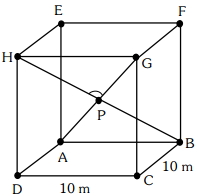
A hall has a square floor of dimension $10\, \mathrm{~m} \times 10\, \mathrm{~m}$ (see the figure) and vertical walls. If the angle $GPH$ between the diagonals $\mathrm{AG}$ and $\mathrm{BH}$ is $\cos ^{-1} \frac{1}{5}$, then the height of the hall (in $meters$) is :
If $ \cos^{-1}\left (\frac {1 - \text{x}^{2}}{1 + \text{x}^{2}}\right ) + \cos^{-1}\left (\frac {1 - \text{y}^{2}}{1 + \text{y}^{2}}\right )=\frac{\pi}{2}$, where $xy < 1,$ then:
The number of arbitrary constants in the particular solution of a differential equation of third order are: