MCQ
Let $[t]$ denote the largest integer less than or equal to $t$. If

$\int_0^3\left(\left[x^2\right]+\left[\frac{x^2}{2}\right]\right) d x=a+b \sqrt{2}-\sqrt{3}-\sqrt{5}+c \sqrt{6}-\sqrt{7},$ where $a, b, c \in z$, then $a+b+c$ is equal to.........

  • A
    $21$
  • B
    $12$
  • C
    $29$
  • $23$

Answer

Correct option: D.
$23$
d
$ \int_0^3\left[x^2\right] d x+\int_0^3\left[\frac{x^2}{2}\right] d x $

$ =\int_0^1 0 d x+\int_1^{12} 1 d x+\int_{\sqrt{2}}^{\sqrt{3}} 2 d x$

$ +\int_{\sqrt{3}}^2 3 \mathrm{dx}+\int_2^{\sqrt{5}} 4 \mathrm{dx}+\int_{\sqrt{5}}^{\sqrt{6}} 5 \mathrm{dx} $

$ +\int_{\sqrt{6}}^{\sqrt{7}} 6 \mathrm{dx}+\int_{\sqrt{7}}^{\sqrt{8}} 7 \mathrm{dx}+\int_{\sqrt{8}}^3 8 \mathrm{dx} $

$ +\int_0^{\sqrt{2}} 0 \mathrm{dx}+\int_{\sqrt{2}}^2 1 \mathrm{dx} $

$ +\int_2^{\sqrt{6}} 2 \mathrm{dx}+\int_{\sqrt{6}}^{\sqrt{8}} 3 \mathrm{dx}+\int_{\sqrt{8}}^3 4 \mathrm{dx}=31-6 \sqrt{2}-\sqrt{3}-\sqrt{5} $

$ -2 \sqrt{6}-\sqrt{7} $

$ \mathrm{a}=31 \quad b=-6 \quad c=-2 $

$ \mathrm{a}+\mathrm{b}+\mathrm{c}=31-6-2=23$
Need a full question paper?

Generate a complete, print-ready paper with questions like this in minutes — across 16+ boards, with answer keys.

Start Generating Free

Similar questions

The solutions of the equation $\left| {\,\begin{array}{*{20}{c}}x&2&{ - 1}\\2&5&x\\{ - 1}&2&x\end{array}\,} \right| = 0$ are
The relation $R$ is defined on the set of natural numbers as $\{(a, b) : a = 2b\}$. Then $\{R^{ - 1}\}$ is given by
The work done by the force $F = 2i - 3j + 2k$ in displacing a particle from the point $(3, 4, 5) $ to the point $(1, 2, 3) $ is ............ $\mathrm{unit}$
The volume of a sphere is increasing at the rate of $4\pi\text{ cm}^{3}/\text{sec}$. The rate of increase of the radius when the volume is $288\pi\text{ cm}^{3}/\text{sec}$ is :
Let $X$ be a discrete random variable. Then the variance of $X$ is:
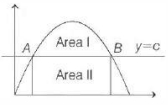
The figure shows a portion of the graph $y=2 x-4 x^3$.The line $y=c$ is such that the areas of the regions marked $I$ and $II$ are equal. If $a, b$ are the $x$-coordinates of $A, B$ respectively, then $a+b$ equals
If direction cosines of two lines are proportional to $(2, 3, -6)$ and $(3, -4, 5)$, then the acute angle between them is
If $\alpha ,\,\,\beta ,\,\gamma $ be the angles which a line makes with the positive direction of co-ordinate axes, then ${\sin ^2}\alpha + {\sin ^2}\beta + {\sin ^2}\gamma = $
The length of perpendicular from the origin to the plane which makes intercepts $\frac{1}{3},\frac{1}{4},\frac{1}{5}$​ respectively on the coordinate axes is:
Let there be three independent events $E _{1}, E _{2}$ and $E _{3}$. The probability that only $E _{1}$ occurs is $\alpha$, only $E _{2}$ occurs is $\beta$ and only $E _{3}$ occurs is $\gamma .$ Let $'p'$ denote the probability of none of events occurs that satisfies the equations $(\alpha-2 \beta) p =\alpha \beta$ and $(\beta-3 \gamma) p =2 \beta \gamma .$ All the given probabilities are assumed to lie in the interval $(0,1)$

Then, $\frac{\text { Probability of occurrence of } E _{1}}{\text { Probability of occurrence of } E _{3}}$ is equal to ..........