Question
Let the angle between two nonzero vectors $\overrightarrow{\text{A}}$ and $\overrightarrow{\text{B}}$ be 120° and its resultant be $\vec{\text{c}}:$
  1. C must be equal to $|\text{A}-\text{B}|$
  2. C must be less than $|\text{A}-\text{B}|$
  3. C must be greater than $|\text{A}-\text{B}|$
  4. C may be equal to $|\text{A}-\text{B}|$
Answer

  1. C must be less than $|\text{A}-\text{B}|$
Explanation:
Here, we have three vector A, B and C.
$\big|\overrightarrow{\text{A}}+\overrightarrow{\text{B}}\big|^2=\big|\overrightarrow{\text{A}}\big|^2+\big|\overrightarrow{\text{B}}\big|^2+2\overrightarrow{\text{A}}.\overrightarrow{\text{B}} \ ...{\text{(i)}}$
$\big|\overrightarrow{\text{A}}-\overrightarrow{\text{B}}\big|^2=\big|\overrightarrow{\text{A}}\big|^2+\big|\overrightarrow{\text{B}}\big|^2-2\overrightarrow{\text{A}}.\overrightarrow{\text{B}} \ ...{\text{(ii)}}$
Subtracting (i) from (ii), we get:
$\big|\overrightarrow{\text{A}}+\overrightarrow{\text{B}}\big|^2-\big|\overrightarrow{\text{A}}-\overrightarrow{\text{B}}\big|^2=4\overrightarrow{\text{A}}.\overrightarrow{\text{B}}$
Using the resultant property $\overrightarrow{\text{C}}=\overrightarrow{\text{A}}+\overrightarrow{\text{B}},$ we get:
$\big|\overrightarrow{\text{C}}\big|^2-\big|\overrightarrow{\text{A}}-\overrightarrow{\text{B}}\big|^2=4\overrightarrow{\text{A}}.\overrightarrow{\text{B}}$
$\Rightarrow\big|\overrightarrow{\text{C}}\big|^2=\big|\overrightarrow{\text{A}}-\overrightarrow{\text{B}}\big|^2+4\overrightarrow{\text{A}}.\overrightarrow{\text{B}}$
$\Rightarrow\big|\overrightarrow{\text{C}}\big|^2=\big|\overrightarrow{\text{A}}-\overrightarrow{\text{B}}\big|^2+4\big|\overrightarrow{\text{A}}\big|.\big|\overrightarrow{\text{B}}\big|\cos120^{\circ}$
Since cosine is negative in the second quadrant, C must be less than $|\text{A}-\text{B}|.$

Need a full question paper?

Generate a complete, print-ready paper with questions like this in minutes — across 16+ boards, with answer keys.

Start Generating Free

Similar questions

$20$ ampere current is flowing in a long straight wire. The intensity of magnetic field at a distance $10 \ cm$ from the wire will be
The work function of aluminium is 4.2 eV. If two photons, each of energy 3.5 eV strike an electron of aluminium, then emission of electrons will be (a) Possible(b) Not possible(c) Data is incomplete(d) Depend upon the density of the surface


Wave nature of light is verified by ___________.
The $\alpha-$particle is the nucleus of an atom of
The energy required to excite an electron from the ground state of hydrogen atom to the first excited state, is
The terminal potential difference of a cell when short-circuited is (E = E.M.F. of the cell)(a) E (b) E/2 (c) Zero  (d) E/3
       
In Young's double slit experiment, if one of the slit is closed fully, then in the interference pattern(a) A bright slit will be observed, no interference pattern will exist(b) The bright fringes will become more bright(c) The bright fringes will become fainter(d) None of the above


In intrinsic semiconductor at room temperature, number of electrons and holes are(a) Equal(b) Zero(c) Unequal(d) Infinite
       
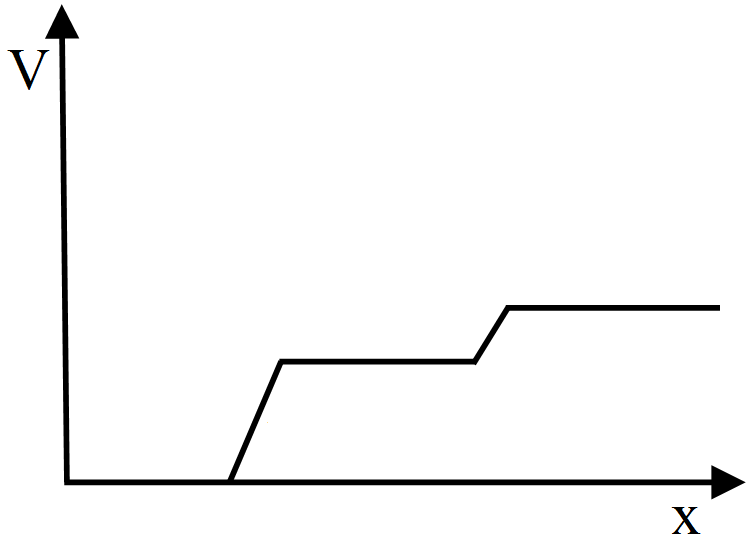
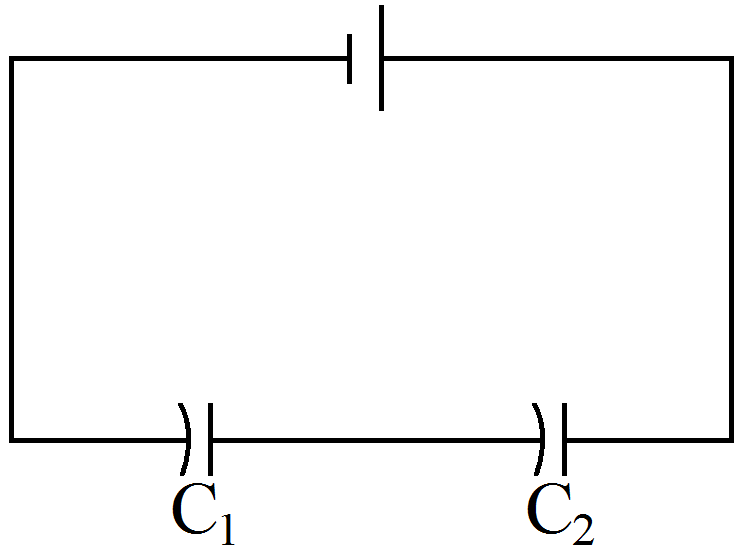
Figure shows two capacitors connected in series and joined to a battery. The graph shows the variation in potential as one moves from left to right on the branch containing the capacitors:

The capacitance of a parallel plate capacitor is 12μF. If the distance between the plates is doubled and area is halved, then new capacitance will be(a) 8μF    (b) 6μF(c) 4μF    (d) 3μF