Question
Let the function $f: R \rightarrow R$ be defined by

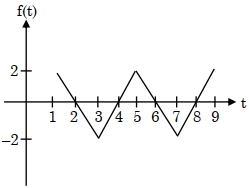
$f(t)=\left\{\begin{array}{cc}(-1)^{n+1} 2, & \text { if } t=2 n-1, n \in N , \\ \frac{(2 n+1-t)}{2} f(2 n-1)+\frac{(t-(2 n-1))}{2} f(2 n+1), & \text { if } 2 n-1 < t < 2 n+1, n \in N \end{array}\right.$

Define $g(x)=\int_1^x f(t) d t, x \in(1, \infty)$. Let $\alpha$ denote the number of solutions of the equation $g(x)=0$ in the interval $(1,8]$ and $\beta=\lim _{x \rightarrow 1+} \frac{g(x)}{x-1}$. Then the value of $\alpha+\beta$ is equal to. . . . . .
Answer

c
$f ( t )=\left\{\begin{array}{ccc}2 & ; & t =1 \\ 4-2 t & ; & 1< t <3 \\ -2 & ; & t =3 \\ -8-2 t & ; & 3< t <5 \\ 2 & ; & t =5 \\ 12-2 t & ; & 5< t <7 \\ -2 & ; & t =7 \\ -16+2 t & ; & 7< t <9\end{array}\right.$

$g(x)=\int_1^x f(t) d t ; g^{\prime}(x)=f(x)$

$\text { for } x \in(1,8]$

$g(x)=0 \Rightarrow x=3,5,7 \therefore \alpha=3$

$\beta=\lim _{x \rightarrow 1^{+}} \frac{g(x)}{x-1}$

$\text { Apply L'pital }$

$=\frac{g^{\prime}\left(1^{+}\right)}{1}=f\left(1^{+}\right)$

$\beta=2$

$\therefore \alpha+\beta=5$

Need a full question paper?

Generate a complete, print-ready paper with questions like this in minutes — across 16+ boards, with answer keys.

Start Generating Free

Similar questions

The distance of the point $(6,-2 \sqrt{2})$ from the common tangent $y = mx + c , m > 0$, of the curves $x =2 y ^2$ and $x =1+ y ^2$ is
In an isosceles triangle $ABC$, the vertex $A$ is $(6,1)$ and the equation of the base $BC$ is $2 x + y =4$. Let the point $B$ lie on the line $x+3 y=7$. If $(\alpha, \beta)$ is the centroid $\triangle A B C$, then $15(\alpha+\beta)$ is equal to
The maximum sum of the series $20 + 19\frac{1}{3} + 18\frac{2}{3} + .........$ is
Words of length $10$ are formed using the letters, $A, B, C, D, E, F, G, H, I, J$. Let $x$ be the number of such words where no letter is repeated ; and let $y$ be the number of such words where exactly one letter is repeated twice and no other letter is repeated. Then, $\frac{y}{9 x}=$
Let the sum of the coefficients of the first three terms in the expansion of $\left(x-\frac{3}{x^2}\right)^n, x \neq 0, n \in N$, be $376$. Then the coefficient of $x^4$ is $......$
The area of the triangle formed by joining the origin to the points of intersection of the line $x\sqrt 5 + 2y = 3\sqrt 5 $ and circle ${x^2} + {y^2} = 10$ is
Minimum number of times a fair coin must be tossed so that the probability of getting at least one head is more than $99\%$ is
Three numbers selected from the set $\{3^1, 3^2, 3^3, .....3^{20}\}$ then, the number of ways that selected numbers form a increasing $G.P.$ :-
Let $A = \,\left[ {\begin{array}{*{20}{c}}
1&0&0\\
1&1&0\\
1&1&1
\end{array}} \right]$ and $B = A^{20}$ . Then the sum of the elements of the first column of $B$ is?
The value of ${81^{(1/{{\log }_5}3)}} + {27^{{{\log }_{_9}}36}} + {3^{4/{{\log }_{_7}}9}}$ is equal to