Question
Let the function,$
f(x)=\left\{\begin{array}{ll}
-3 a x^2-2, & x<1 \\
a^2+b x, & x \geq 1
\end{array}\right.
$
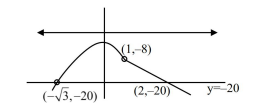
Be differentiable for all $x \in R$, where $a >1, b \in R$. If the area of the region enclosed by $y=f(x)$ and the line $y=-20$ is $\alpha+\beta \sqrt{3}, \alpha, \beta, \in Z$, then the value of $\alpha+\beta$ is $\qquad$
Answer

34
Sol. $f(x)$ is continuous and differentiable<br>$
\begin{array}{l}
\text { at } x=1 ; \quad LHL=RHL, LHD=RHD \\
-3 a-2=a^2+b,-6 a=b \\
a=2,1 ; b=-12 \\
f(x)=\left\{\begin{array}{cc}
-6 x^2-2 & ; 
4<1 \\
4-12 x & ; x \geq 1
\end{array}\right.
\end{array}
$
Image

$\begin{array}{l}\text { Area }=\int_{-\sqrt{3}}^1\left(-6 x^2-2+20\right) d x+\int_1^2(4-12 x+20) d x \\ 16+12 \sqrt{3}+6=22+12 \sqrt{3}\end{array}$

Need a full question paper?

Generate a complete, print-ready paper with questions like this in minutes — across 16+ boards, with answer keys.

Start Generating Free

Similar questions

If $a _{1}(>0), a _{2}, a _{3}, a _{4}, a _{5}$ are in a G.P., $a _{2}+ a _{4}=2 a _{3}+1$ and $3 a _{2}+ a _{3}=2 a _{4}$, then $a _{2}+ a _{4}+2 a _{5}$ is equal to
Let $f : R \rightarrow R$ be a differentiable function such that $f \left(\frac{\pi}{4}\right)=\sqrt{2}, f \left(\frac{\pi}{2}\right)=0$ and $f ^{\prime}\left(\frac{\pi}{2}\right)=1$ and let $g(x)=\int\limits_{x}^{\pi / 4}\left(f^{\prime}(t) \sec t+\tan t \operatorname{sectf}(t)\right) d t$ for $x \in\left[\frac{\pi}{4}, \frac{\pi}{2}\right)$. Then $\lim\limits _{ x \rightarrow\left(\frac{\pi}{2}\right)^{-}} g ( x )$ is equal to
If $z, iz$ and $z + iz$ are the vertices of a triangle whose area is $2$ units, then the value of $|z|$ is
Number of solution(s) satisfying the equation, $3x^2 - 2x^3 = log_2 (x^2 + 1) -log_2 x$ is
If for the matrix, $A =\left[\begin{array}{cc}1 & -\alpha \\ \alpha & \beta\end{array}\right], AA ^{ T }= I _{2},$ then the value of $\alpha^{4}+\beta^{4}$ is ....... .
Let $\mathrm{f}:(0, \infty) \rightarrow \mathrm{R}$ be a twice differentiable function. If for some $a \neq 0, \int_{0}^{1} \mathrm{f}(\lambda \mathrm{x}) \mathrm{d} \lambda=\operatorname{af}(\mathrm{x})$, $f(1)=1$ and $f(16)=\frac{1}{8}$, then $16-f^{\prime}\left(\frac{1}{16}\right)$ is equal to __________ .
If the vectors $4i+11j+mk,\,7i+2j+6k$  and $i+5j+4k$  are coplanar, then $m$ is
The value of $\int_{1/e}^{\tan x} {\frac{{t\,dt}}{{1 + {t^2}}}} + \int_{1/e}^{\cot x} {\frac{{dt}}{{t(1 + {t^2})}}} = $
The number of distinct real roots of the equation $|\mathrm{x}+1||\mathrm{x}+3|-4|\mathrm{x}+2|+5=0$, is ...........
Let the point $B$ be the reflection of the point $A(2,3)$ with respect to the line $8 x-6 y-23=0$. Let $\Gamma_A$ and $\Gamma_B$ be circles of radii $2$ and $1$ with centres $A$ and $B$ respectively. Let $T$ be a common tangent to the circles $\Gamma_A$ and $\Gamma_B$ such that both the circles are on the same side of $T$. If $C$ is the point of intersection of $T$ and the line passing through $A$ and $B$, then the length of the line segment $AC$ is. . . . . .