MCQ
Let the shortest distance between the lines $L : \frac{ x -5}{-2}=\frac{ y -\lambda}{0}=\frac{ z +\lambda}{1}, \lambda \geq 0$ and $L _1: x +1= y -$ $1=4-z$ be $2 \sqrt{6}$. If $(\alpha, \beta, \gamma)$ lies on $L$, then which of the following is NOT possible?
  • A
    $\alpha+2 \gamma=24$
  • B
    $2 \alpha+\gamma=7$
  • C
    $2 \alpha-\gamma=9$
  • D
    $\alpha-2 \gamma=19$

Answer

Need a full question paper?

Generate a complete, print-ready paper with questions like this in minutes — across 16+ boards, with answer keys.

Start Generating Free

Similar questions

If $x, y, z$ are nonzero real numbers, then the inverse of matrix $\mathrm{A}=\left[\begin{array}{lll}x & 0 & 0 \\ 0 & y & 0 \\ 0 & 0 & z\end{array}\right]$ is
Choose the correct answer from the given four options.

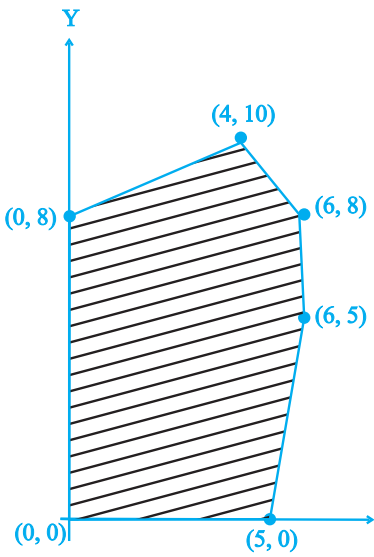
The feasible solution for a LPP shown in Fig. 12.12. Let z = 3x - 4y be objective functio. (Maximum value of Z + Minimum value of Z) is equal to:
  1. 13.
  2. 1.
  3. -13.
  4. -17.
The length of the perpendicular from point $(1, 2, 3)$ to the line $\frac{{x - 6}}{3} = \frac{{y - 7}}{2} = \frac{{z - 7}}{{ - 2}}$ is
If $\tan^{-1}3+\tan^{-1}\text{x}=\tan^{-1}8,$ then x =
  1. $5$
  2. $\frac{1}{5}$
  3. $\frac{5}{14}$
  4. $\frac{14}{5}$
In a $\triangle\text{ABC},$ if C is a right angle, then

$\tan^{-1}\Big(\frac{\text{a}}{\text{b}+\text{c}}\Big)+\tan^{-1}\Big(\frac{\text{b}}{\text{c}+\text{b}}\Big)=$

  1. $\frac{\pi}{3}$

  2. $\frac{\pi}{4}$

  3. $\frac{5\pi}{2}$

  4. $\frac{\pi}{6}$

If $f$ is continuous function, then
Let $a = 2i + j + k,\,\,b = i + 2j - k$and $a$  unit vector $ c$ be coplanar. If $ c $is perpendicular to $ a$ , then $ c $=
The area bounded by the curve $4 y^{2}=x^{2}(4-x)(x-2)$ is equal to ...... .
The corner points of the feasible region determined by the following system of linear inequalities:
$2\text{x}+\text{y}\le10,\ \text{x}+3\text{y}\le15,\ \text{x},\ \text{y}\ge0$ are (0, 0), (5, 0), (3, 4) and (0, 5). Let Z = px + qy, where p, q > 0. Condition on p and q so that the maximum of Z occurs at both (3, 4) and (0, 5) is:
    $\int\frac{\text{xdx}}{(\text{x-1)}(\text{x-2})}$ equals:
    1. $\log\begin{vmatrix}\frac{(\text{x}-1)^2}{\text{x}-2}\end{vmatrix}+\text{c}$
    2. $\log\begin{vmatrix}\frac{(\text{x}-2)^2}{\text{x}-2}\end{vmatrix}+\text{c}$
    3. $\log\begin{vmatrix}\Big(\frac{\text{x}-1}{\text{x}-2}\Big)^2\end{vmatrix}+\text{c}$
    4. $\log|(\text{x}-1)(\text{x}-2)+\text{c}$