MCQ
Let there be a spherically symmetric charge distribution with charge density varying as $\rho (r)=\;\rho _0\left( {\frac{5}{4} - \frac{r}{R}} \right)$, upto $r = R$ ,and $\rho (r) = 0$ for $r > R$ , where $r$ is the distance from the origin. The electric field at a distance $r(r < R)$ from the origin is given by
  • A
    $\frac{{{\rho _o}r}}{{3{\varepsilon _0}}}\;\left( {\frac{5}{4} - \frac{r}{R}} \right)\;\;\;\;\;\;$
  • B
    $\frac{{4\pi {\rho _0r}}}{{3{\varepsilon _0}}}\;\left( {\frac{5}{3} - \frac{r}{R}} \right)$
  • $\frac{{{\rho _o}r}}{{4{\varepsilon _0}}}\;\left( {\frac{5}{3} - \frac{r}{R}} \right)$
  • D
    $\frac{{4\pi {\rho _0r}}}{{3{\varepsilon _0}}}\;\left( {\frac{5}{4} - \frac{r}{R}} \right)$
Answer

Correct option: C.
$\frac{{{\rho _o}r}}{{4{\varepsilon _0}}}\;\left( {\frac{5}{3} - \frac{r}{R}} \right)$
c
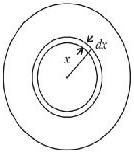
Let us consider a spherical shell of radius $x$ and thickness $dx$

Charge on this shell

$d q=\rho \cdot 4 \pi x^{2} d x=\rho_{0}\left(\frac{5}{4}-\frac{x}{R}\right) .4 \pi x^{2} d x$

$\therefore$ Total charge in the spherical region from centre to $r$ $(r < R)$ is

$q=\int d q=4 \pi \rho_{0} \int_{0}^{r}\left(\frac{5}{4}-\frac{x}{R}\right) x^{2} d x$

$=4 \pi \rho_{0}\left[\frac{5}{4} \cdot \frac{r^{3}}{3}-\frac{1}{R} \cdot \frac{r^{4}}{4}\right]=\pi \rho_{0} r^{3}\left(\frac{5}{3}-\frac{r}{R}\right)$

Electric field at $r, E=\frac{1}{4 \pi \epsilon_{0}} \cdot \frac{q}{r^{2}}$

$=\frac{1}{4 \pi \epsilon_{0}} \cdot \frac{\pi \rho_{0} r^{3}}{r^{2}}\left(\frac{5}{3}-\frac{r}{R}\right)=\frac{\rho_{0} r}{4 \epsilon_{0}}\left(\frac{5}{3}-\frac{r}{R}\right)$

Need a full question paper?

Generate a complete, print-ready paper with questions like this in minutes — across 16+ boards, with answer keys.

Start Generating Free

Similar questions

If $\lambda_{ m }$ denotes the wavelength at which the radioactive emission from a black body at a temperature $T \;K$ is maximum, then
A particle of charge $q$ and mass $m$ is moving along the $x$ -axis with a velocity $v$ and enters a region of electric field $E$ and magnetic field $B$ as shown in figure below for which figure the net force on the charge may be zero
When $100\, V\, DC$ is applied across a solenoid a current of $1\, A$ flows in it. When $100\, V\, AC$ is applied across the same coil, the current drops to $0.5\, A$. If the frequency of the $AC$ source is $50\,Hz$, the impedance and inductance of the solenoid are:
Two concentric circular coils with radii $1\,cm$ and $1000\,cm$, and number of turns $10$ and $200$ respectively are placed coaxially with centers coinciding. The mutual inductance of this arrangement will be $.........\times 10^{-8}\,H$(Take, $\pi^2=10$)
In an isothermal process $2$ water drops of radius $1 \,mm$ are combined to form a bigger drop. Find the energy (in $\mu J$) change in this process if $T =0.1\, N / m$ 
The refractive index of a converging lens is $1.4.$ What will be the focal length of this lens if it is placed in a medium of same refractive index ? (Assume the radii of curvature of the faces of lens are $R _{1}$ and $R _{2}$ respectively)
Assertion : If a compass needle be kept at magnetic north pole of the earth the compass needle may stay in any direction.

Reason : Dip needle will stay vertical at the north pole of earth

Indium impurity in germanium makes
Which of the following quantities do not change when a resistor connected to a battery is heated due to the current?
In a $U-$ tube, the liquid level stands at same level when it is at rest. When $U-$ tube is accelerated towards right, as shown in figure, the difference $h$  between level of two arms will be