MCQ
Let $V$ and $E$ are potential and electric field intensity at a point then
  • A
    if $V = 0$ then $E$ must be zero
  • B
    if $V  \ne  0$ then $E$ can not be zero
  • C
    if $E \ne 0$ then $V$ can not be zero
  • if $V = 0$ then $E$ may be zero

Answer

Correct option: D.
if $V = 0$ then $E$ may be zero
d
if $v = 0\, E$ may or may not be zero
if $E = 0\, v$ may or may not be zero

Need a full question paper?

Generate a complete, print-ready paper with questions like this in minutes — across 16+ boards, with answer keys.
Start Generating Free

Similar questions

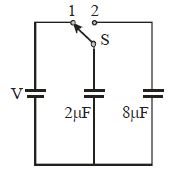
A $2\,\mu F$ Capacitor is charged as shown in the figure. The percentage of its store energy dissipated after the switch $S$ is turned to position $2$, is.....$\%$
At which temperature the $\text{r.m.s}$. velocity of a hydrogen molecule equal to that of an oxygenmolecule at $47^{\circ}$?
The angle of incidence for a ray of light at a refracting surface of a prism is $45^o  $. The angle of prism is $60^o $ . If the ray suffers minimum deviation through the prism, the angle of minimum deviation and refractive index of the material of the prism respectively, are 
Field inside a solenoid is
Steam at $100\,^oC$ is passed into $20\, g$ of water at $10\,^oC$. When water acquires a temperature of $80\,^oC$, the mass of water present will be ........ $g$

[Take specific heat of water $= 1\, cal\, g^{-1}\,^oC^{-1}$ and latent heat of steam $= 540\, cal\, g^{-1}$]

The potential difference between $A$ and $B$ in the Figure is ................... $\mathrm{V}$
A rocket is launched straight up from the surface of the earth. When its altitude is one fourth of the radius of the earth, its fuel runs out and therefore it coasts. The minimum velocity which the rocket must have when it starts to coast if it is to escape from the gravitational pull of the earth is ...... $km/s$   [escape velocity on surface of earth is $11.2\,km/s$]
The period of oscillation of a simple pendulum of constant length at earth surface is $T$. Its period inside a mine is
Two vectors $\dot{A}$ and $\dot{B}$ are defined as $\dot{A}=a \hat{i}$ and $\overrightarrow{\mathrm{B}}=\mathrm{a}(\cos \omega t \hat{\mathrm{i}}+\sin \omega t \hat{j}$ ), where a is a constant and $\omega=\pi / 6 \mathrm{rad} \mathrm{s}^{-1}$. If $|\overrightarrow{\mathrm{A}}+\overrightarrow{\mathrm{B}}|=\sqrt{3}|\overrightarrow{\mathrm{A}}-\overrightarrow{\mathrm{B}}|$ at time $t=\tau$ for the first time, the value of $\tau$, in, seconds, is. . . . . .
This question has a paragraph followed by two statements, Statement $- 1$ and Statement $- 2$. Of the given four alternatives after the statements, choose the one that describes the statements.
A thin air film is formed by putting the convex surface of a plane-convex lens over a plane glass plate. With monochromatic light, this film gives an interference pattern due to light reflected from the top ( convex) surface and the bottom (glass plate) surface of the film.
Statement $- 1$ : When light reflects from the air-glass plate interface, the reflected wave suffers a phase change of $\pi$.
Statement $- 2$ : The centre of the interference pattern is dark.