MCQ
Let $\vec{a}$ be a unit vector and $\vec{b}$ is a nonzero vector not parallel to $\vec{a}$ . The angles of the triangle, two of whose sides are represented by $\sqrt 3 (\vec{a} \times \vec{b} )$ and $\vec{b} - (\vec{a} . \vec{b}) \vec{a}$ are
  • A
    $\frac{\pi }{4}$ , $\frac{\pi }{4}$ , $\frac{\pi }{2}$
  • B
    $\frac{\pi }{4}$ , $\frac{\pi }{3}$ , $\frac{5\pi }{12}$
  • $\frac{\pi }{6}$ , $\frac{\pi }{3}$ , $\frac{\pi }{2}$
  • D
    $\frac{\pi }{3}$ , $\frac{\pi }{3}$ , $\frac{\pi }{3}$
Answer

Correct option: C.
$\frac{\pi }{6}$ , $\frac{\pi }{3}$ , $\frac{\pi }{2}$
c
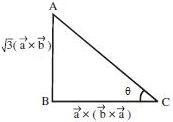
$\vec b - (\vec a \cdot \vec b)\vec a = (\vec a \cdot \vec a)\vec b - (\vec a \cdot \vec b)\vec a = \vec a \times (\vec b \times \vec a)$

here $\vec a \times \vec b \bot \vec a \times (\vec b \times \vec a)$

$\angle \mathrm{ABC}=90^{\circ}$

$\tan \theta  = \frac{{\sqrt 3 |\vec a \times \vec b|}}{{|\vec a||\vec b \times \vec a|}} = \sqrt 3 $

$\theta=\pi / 3$

$\angle \mathrm{ABC}=\pi / 2: \angle \mathrm{BAC}=\pi / 6$

$\angle \mathrm{ACB}=\pi / 3$

Need a full question paper?

Generate a complete, print-ready paper with questions like this in minutes — across 16+ boards, with answer keys.

Start Generating Free

Similar questions

$\mathop {Lim}\limits_{n\, \to \infty } \,\,\frac{\pi }{{6n}}\left[ {{{\sec }^2}\left( {\frac{\pi }{{6n}}} \right) + {{\sec }^2}\left( {2\,\cdot\,\frac{\pi }{{6n}}} \right) + ..... + {{\sec }^2}(n - 1)\frac{\pi }{{6n}} + \frac{4}{3}} \right]$ has the value equal to
If $\vec a = 2\sin \theta \hat i - \hat j + 2\hat k$ , $\vec b = 2\hat i + 2\sin \theta \hat j - \hat k$ and $\vec c = 4\hat i + \hat j + 4\,\,{\cos ^2}\theta \hat k$ are coplanar. Then $\theta $ can be equal to
Choose the correct answer from the given four options.

If $\text{P}(\text{A})=\frac{2}{5},\text{P}(\text{B})=\frac{3}{5}$ and $\text{P}(\text{A}\cap\text{B})=\frac{1}{5},$ then $\text{P}\Big(\frac{\text{A}'}{\text{B}'}\Big)\cdot\text{P}\Big(\frac{\text{B}'}{\text{A}'}\Big)$ is equas:

  1. $\frac{5}{6}$

  2. $\frac{5}{7}$

  3. $\frac{25}{42}$

  4. $1$

Let $[t]$ denote the greatest integer function. If $\int \limits_0^{2.4}\left[x^2\right] d x=\alpha+\beta \sqrt{2}+\gamma \sqrt{3}+\delta \sqrt{5}$, then $\alpha+\beta+\gamma+$ $\delta$ is equal to $..............$.
The product of the d.cs of the line which makesequal angles with ox, oy, oz is:
  1. $1$
  2. $\sqrt{3}$
  3. $\frac{1}{3\sqrt{3}}$
  4. $\frac{1}{\sqrt{3}}$
The lines $\frac{\text{x}}{1}=\frac{\text{y}}{2}=\frac{\text{z}}{3}$ and $\frac{\text{x}-1}{-2}=\frac{\text{y}-2}{-4}=\frac{\text{z}-3}{-6}$ are:
  1. Parallel.
  2. Intersecting.
  3. Skew.
  4. Coincident.
The area of a triangle with vertices $(-3,0)$, $(3,0)$ and $(0, k)$ is 9 sq. units. The value of $k$ will be
What is the value of $\int_{-1}^{1}\sin^3\text{x}\cos^2\text{xdx}?$
  1. $0$
  2. $1$
  3. $\frac{1}{2}$
  4. $2$
Let $\text{f(x)}=\text{x}+\text{b}|\text{x}|+\text{c}|\text{x}|^4,$ where a, b, and c are real constants. Then, f (x) is differentiable at x = 0, if:
  1. a = 0
  2. b = 0
  3. c = 0
  4. None of these.
$\int\limits^{\frac{\pi}{3}}_{\frac{\pi}{6}}\frac{1}{1+\sqrt{\cot\text{x}}}\text{ dx}$ is:

  1. $\frac{\pi}{3}$

  2. $\frac{\pi}{6}$

  3. $\frac{\pi}{12}$

  4. $\frac{\pi}{2}$