Question
Let $\vec{\text{a}}=2\vec{\text{i}}+3\vec{\text{j}}+4\vec{\text{k}}$ and $\vec{\text{b}}=3\vec{\text{i}}+4\vec{\text{j}}+5\vec{\text{k}}.$ Find the angle between them.

Answer

$\Rightarrow\vec{\text{a}}=2\vec{\text{i}}+3\vec{\text{j}}+4\vec{\text{k}};\vec{\text{b}}=3\vec{\text{i}}+4\vec{\text{j}}+5\vec{\text{k}}$$\Rightarrow\vec{\text{a}}.\vec{\text{b}}=\text{ ab}\cos\theta\Rightarrow\theta=\cos^{-1}\frac{\vec{\text{a}}.\vec{\text{b}}}{\text{ab}}$
$\Rightarrow\cos^{-1}\frac{2\times3+3\times4+4\times5}{\sqrt{2^2+3^3+4^4}\sqrt{3^2+4^2+5^2}}=\cos^{-1}\Big(\frac{38}{\sqrt{1450}}\Big)$

Need a full question paper?

Generate a complete, print-ready paper with questions like this in minutes — across 16+ boards, with answer keys.
Start Generating Free

Similar questions

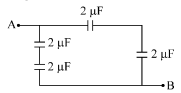
Find the equivalence between A and B in the given circuit diagram.
Image
An $\alpha$-particle and a proton are accelerated through the same potential difference. Find the ratio of their de Broglie wavelength.
Electric potential at a point $P , V (x, y, z)=$ $6 x-8 x y^2-8 y+6 y z-4 z^2$. Find the electric force on a 4 coulomb point charge located at the origin.
Write the limitations of Bohr model.
Draw the energy band diagram of (i) n-type, and (ii) p-type semiconductors at temperature T > 0 K. In the case of n-type Si-semiconductor, the donor energy level is slightly below the bottom of conduction band whereas in p-type semiconductor, the acceptor energy level is slightly above the top of valence band. Explain, giving examples, what role do these energy levels play in conduction and valence bands.
What is the meaning of binding energy per nucleon? The binding energy per nucleon of neutron $\left({ }_1 H ^2\right)$ and $\alpha$-particle $\left({ }_2 He ^4\right)$ is 1.25 and 7.2 MeV per nucleon respectively. Which nucleus is more stable?
The peak power consumed by a resistive coil, when connected to an AC source, is 80W. Find the energy consumed by the coil in 100 seconds, which is many times larger than the time period of the source.
At what rate should the earth rotate so that the apparent g at the equator becomes zero? What will be the length of the day in this situation?
Define the term ‘Half$-$life’ of a radioactive substance. Two different radioactive substances have half$-$lives $T_1$ and $T_2$ and number of undecayed atoms at an instant $N_1$ and $N_2,$ respectively. Find the ratio of their activities at that instant.
Draw a labelled ray diagram to show the image formation in a refracting type astronomical telescope. Why should the diameter of the objective of a telescope be large?