Question
Let $\vec{\text{A}}=3\vec{\text{i}}+4\vec{\text{j}}.$ Write four vector $\overrightarrow{\text{B}}$ such that $\overrightarrow{\text{A}}\neq\overrightarrow{\text{B}}$ but A = B.

Answer

This vector A has a magnitude = 5
so take a vector $\overrightarrow{\text{B}}=5\cos\theta\hat{\text{i}}+5\sin\theta\hat{\text{j}}$
Start putting different values of $\theta$ in the above vector you can get as many vector as you want satisfying the condition $\text{A}\neq\text{B}$ but A = B.

Need a full question paper?

Generate a complete, print-ready paper with questions like this in minutes — across 16+ boards, with answer keys.
Start Generating Free

Similar questions

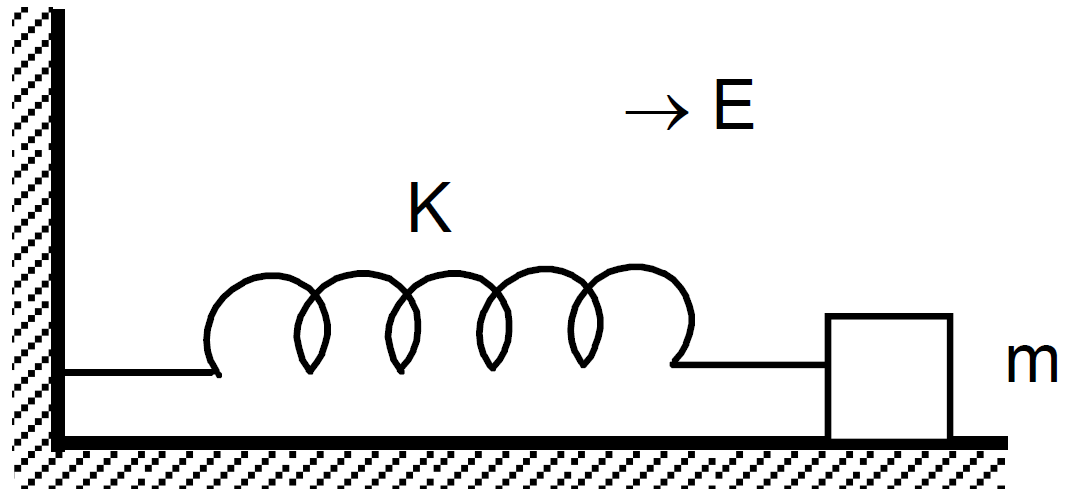
A block of mass m having a charge q is placed on a smooth horizontal table and is connected to a wall through an unstressed spring of spring constant k as shown in figure. A horizontal electric field E parallel to the spring is switched on. Find the amplitude of the resulting SHM of the block.
A glass contains some water at room temperature 20°C. Refrigerated water is added to it slowly. When the temperature of the glass reaches 10°C, small droplets condense on the outer surface. Calculate the relative humidity in the room. The boiling point of water at a pressure of 17.5mm of mercury is 20°C and at 8.9mm of mercury it is 10°c.
In a factory it is desired to lift 2000kg of metal through a distance of 12m in 1 minute. Find the minimum horsepower of the engine to be used.
The instantaneous voltage from an ac source is given by $\text{E}=300\sin314\text{t};$ what is the rms voltage of the source.
Protons with kinetic energy K emerge from an accelerator as a narrow beam. The beam is bent by a perpendicular magnetic field, so that it just misses a plane target kept at a distance l in front of the accelerator. Find the magnetic field.
An electric dipole of length 2 cm, when placed with its axis making an angle of $60^\circ$with a uniform electric field, experiences a torque of $8\sqrt{3}$ Nm. Calculate the potential energy of the dipole, if it has a charge of $\pm4\text{nC}.$
  1. How are infrared waves produced? Write their one important use.
  2. The thin Ozone layer on top of the stratosphere is crucial for human survival. Why?
The selling rate of a radioactive isotope is decided by its activity. What will be the second$-$hand rate of a one month old $\text{ }^{32}\text{P}\big(\text{t}_{\frac{1}{2}}=14.3\text{days}\big)$ source if it was originally purchased for $800$ rupees?
Write and explain the law of conservation of electric charge.
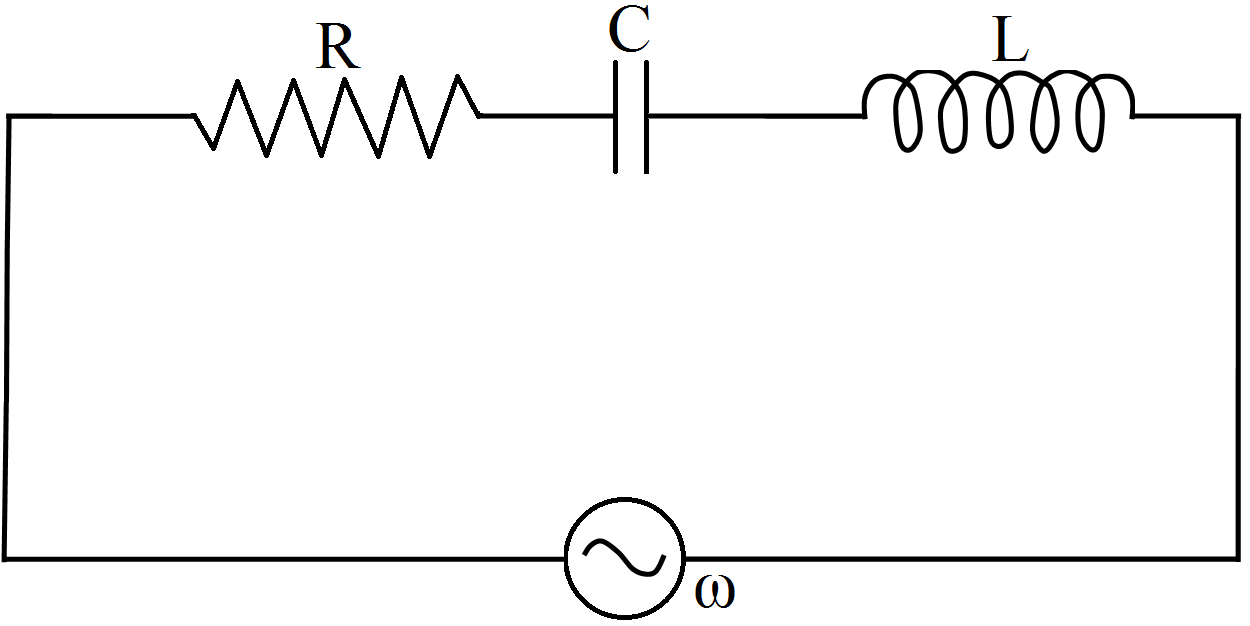
In the circuit shown below R represents an electric bulb. If the frequency $\text{v}=\Big(\frac{\omega}{2\pi}\Big)$ of the supply is doubled, how should the values of C and L be changed, so that the glow of bulb remains unchanged?