Question
Let $\vec{\text{A}}=3\vec{\text{i}}+4\vec{\text{j}}.$ Write four vector $\overrightarrow{\text{B}}$ such that $\overrightarrow{\text{A}}\neq\overrightarrow{\text{B}}$ but A = B.

Answer

This vector A has a magnitude = 5
so take a vector $\overrightarrow{\text{B}}=5\cos\theta\hat{\text{i}}+5\sin\theta\hat{\text{j}}$
Start putting different values of $\theta$ in the above vector you can get as many vector as you want satisfying the condition $\text{A}\neq\text{B}$ but A = B.

Need a full question paper?

Generate a complete, print-ready paper with questions like this in minutes — across 16+ boards, with answer keys.
Start Generating Free

Similar questions

X-ray and visible light travel at the same speed in vacuum. Do they travel at the same speed in glass?
Derive/obtain the instantaneous power and average power for an AC circuit having purely inductive component.
A parallel-plate capacitor is filled with a dielectric material of resistivity ρ and dielectric constant K. The capacitor is charged and disconnected from the charging source. The capacitor is slowly discharged through the dielectric. Show that the time constant of the discharge is independent of all geometrical parameters like the plate area or separation between the plates. Find this time constant.
Write any four properties of electric field lines.
Why do stable nuclei never have more protons than neutrons?
What is stationary interference? How can we get, the resultant intensity of super position of waves emanated from the incoherent sources?
Explain the refraction by two transparent spherically curved surface.
An electroplating unit plates 3.0g of silver on a brass plate in 3.0 minutes. Find the current used by the unit. The electrochemical equivalent of silver is 1.12 × 10-6 kg C-1.
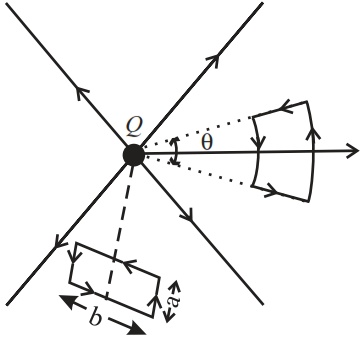
A test charge q is made to move in the electric field of a point charge Q along two different closed paths Fig. First path has sections along and perpendicular to lines of electric field. Second path is a rectangular loop of the same area as the first loop. How does the work done compare in the two cases?

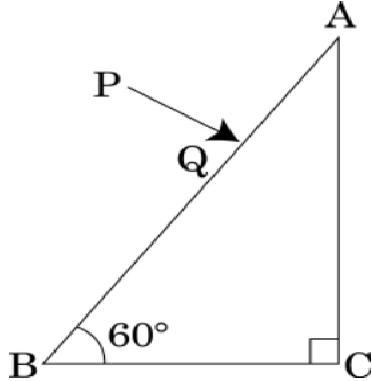
A ray PQ incident normally on the refracting face BA is refracting in the prism BAC made of material of refractive index1.5. Complete the path of ray through the prism. From which face will the ray emerge? Justify your answer.