MCQ
Let $\vec{a}=\hat{i}+\alpha \hat{j}+\beta \hat{k}, \alpha, \beta \in R$. Let a vector $\vec{b}$ be such that the angle between $\vec{a}$ and $\vec{b}$ is $\frac{\pi}{4}$ and $|\vec{b}|^2=6$, If $\vec{a} \cdot \vec{b}=3 \sqrt{2}$, then the value of $\left(\alpha^2+\beta^2\right)|\vec{a} \times \vec{b}|^2$ is equal to
  • A
    90
  • B
    75
  • C
    95
  • D
    85

Answer

$|\overrightarrow{b}|^2=6 ;|\overrightarrow{a}||\overrightarrow{b}| \cos \theta=3 \sqrt{2}$
$|\overrightarrow{a}|^2|\overrightarrow{b}|^2 \cos ^2 \theta=18$
$|\overrightarrow{a}|^2=6$
Also $1+\alpha^2+\beta^2=6$
$\alpha^2+\beta^2=5$
to find $\left(\alpha^2+\beta^2\right)|\vec{a}|^2|\vec{b}|^2 \sin ^2 \theta$
$=(5)(6)(6)\left(\frac{1}{2}\right)$
$=90$

Need a full question paper?

Generate a complete, print-ready paper with questions like this in minutes — across 16+ boards, with answer keys.

Start Generating Free

Similar questions

Let $f(x) = \frac{{1 - \tan x}}{{4x - \pi }},\;x \ne \frac{\pi }{4},\;\;x \in \left[ {0,\frac{\pi }{2}} \right]$, If $f(x)$ is continuous in $\left[ {0,\frac{\pi }{2}} \right]$, then $f\left( {\frac{\pi }{4}} \right)$ is
Four distinct numbers are randomly selected out of the set of first $20$ natural numbers. Probability that no two of them are consecutive is -
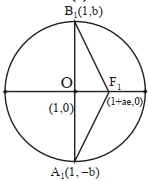
Let an ellipse with centre $(1,0)$ and latus rectum of length $\frac{1}{2}$ have its major axis along $x$-axis. If its minor axis subtends an angle $60^{\circ}$ at the foci, then the square of the sum of the lengths of its minor and major axes is equal to $...........$.
The volume of the largest possible right circular cylinder that can be inscribed in a sphere of radius $ = \sqrt 3 $ is
The area of triangle formed by the lines $x + y - 3 = 0 , x - 3y + 9 = 0$ and $3x - 2y + 1= 0$
Let $S$ be a set containing n elements and we select $2$ subsets $A$ and $B$ of $S$ at random then the probability that $A \cup B = S$ and $A \cap B = \phi $ is
If $|k|\, = 5$ and ${0^o} \le \theta \le {360^o}$, then the number of different solutions of $3\cos \theta + 4\sin \theta = k$ is
If $PQ$ is a double ordinate of the hyperbola $\frac{{{x^2}}}{{{a^2}}} - \frac{{{y^2}}}{{{b^2}}} = 1$ such that $OPQ$ is an equilateral triangle, $O$ being the center of the hyperbola. then the $'e'$ eccentricity of the hyperbola, satisfies
If $f\,(x)\, = \,\int {\frac{{5{x^8}\, + \,7{x^6}}}{{{{({x^2} + 1 + 2{x^7})}^2}}}dx\,,(x\, \ge \,0\,)} $ and $f\,(0)\,=\,0,$ then the value of $f (1)$ is
The equation of the tangent to the hyperbola $2{x^2} - 3{y^2} = 6$ which is parallel to the line $y = 3x + 4$, is