Question
Let $\vec{\text{a}}=4\vec{\text{i}}+3\vec{\text{j}}$ and $\vec{\text{b}}=3\vec{\text{i}}+4\vec{\text{j}}. (a)$ Find the magnitudes of:
  1. $\vec{\text{a}}$
  2. $\vec{\text{b}}$
  3. $\vec{\text{a}}+\vec{\text{b}}$
  4. $\vec{\text{a}}-\vec{\text{b}}$

Answer

$\vec{\text{a}}=4\vec{\text{i}}+3\vec{\text{j}},\vec{\text{b}}=3\vec{\text{i}}+4\vec{\text{j}}$
  1. $|\vec{\text{a}}|=\sqrt{4^2+3^3}=5$
  2. $|\vec{\text{b}}|=\sqrt{9+16}=5$
  3. $|\vec{\text{a}}+\vec{\text{b}}|=|7\vec{\text{i}}+7\vec{\text{j}}|=7\sqrt{2}$
  4. $\vec{\text{a}}-\vec{\text{b}}=(-3+4)\hat{\text{i}}+(-4+3)\hat{\text{j}}=\hat{\text{i}}-\hat{\text{j}}$
$|\vec{\text{a}}-\vec{\text{b}}|=\sqrt{1^2+(-1)^2}=\sqrt{2}.$

Need a full question paper?

Generate a complete, print-ready paper with questions like this in minutes — across 16+ boards, with answer keys.

Start Generating Free

Similar questions

An object of 2 kg falls into the sand from a height of 10 m . If the object moves 2 cm in the sand before coming to rest, what will be the average resistance force? $\left(g=10 m / s ^2\right)$
Just as precise measurements are necessary in science, it is equally important to be able to make rough estimates of quantities using rudimentary ideas and common observations. Think of ways by which you can estimate the following (where an estimate is difficult to obtain, try to get an upper bound on the quantity): The wind speed during a storm.
A cyclist comes to a skidding stop in 10 m. During this process, the force on the cycle due to the road is 200 N and is directly opposed to the motion. (a) How much work does the road do on the cycle ? (b) How much work does the cycle do on the road ?
An electric field $\vec{\text{E}}=\vec{\text{i}}\text{Ax}$ exists in the space, where $A= 10Vm^{-2}$. Take the potential at $(10m, 20m)$ to be zero. Find the potential at the origin.
The minimum deviations suffered by red, yellow and violet beams passing through an equilateral transparent prism are 38.4°, 38.7° and 39.2° respectively. Calculate the dispersive power of the medium.
A particle executes simple harmonic motion. If you are told that its velocity at this instant is zero, can you say what is its displacement? If you are told that its velocity at this instant is maximum, can you say what is its displacement?
A girl is swining in a sitting position. If it becomes vertical, how will the period of the swing change?
A positive charge q is placed in front of a conducting solid cube at a distance d from its centre. Find the electric field at the centre of the cube due to the charges appearing on its surface.
Why do we call physics an exact science?
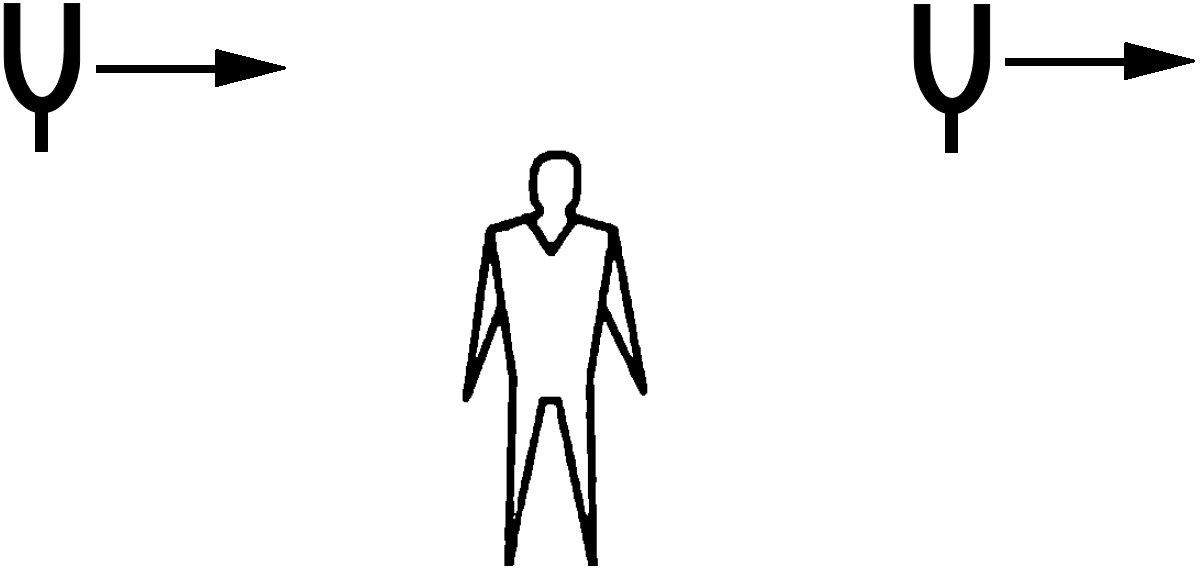
Figure, shows a person standing somewhere in between two identical tuning forks, each vibrating at 512Hz. If both the tuning fbrks move towards right at a speed of 5.5m/s, find the number of beats heard by the listener. Speed of sound in air = 330m/s.