- ✓$\frac{5+4 \sqrt{2}}{3}$
- B$\frac{8+4 \sqrt{2}}{3}$
- C$\frac{1+5 \sqrt{2}}{3}$
- D$\frac{4+5 \sqrt{2}}{3}$
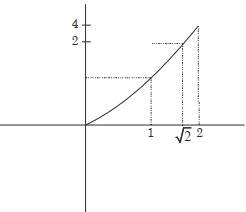
$=1+2 \sqrt{2}-2+\frac{8}{3}-\frac{2 \sqrt{2}}{3}$
$=\frac{5}{3}+\frac{4 \sqrt{2}}{3}$
Generate a complete, print-ready paper with questions like this in minutes — across 16+ boards, with answer keys.
| Column $I$ | Column $II$ |
|
$(A)$ Root$(s)$ of the equation $2 \sin ^2 \theta+\sin ^2 2 \theta=2$ |
$(p)$ $\frac{\pi}{6}$ |
|
$(B)$ Points of discontinuity of the function $f(x)=\left[\frac{6 x}{\pi}\right] \cos \left[\frac{3 x}{\pi}\right],$ where $[y]$ denotes the largest integer less than or equal to $y$ |
$(q)$ $\frac{\pi}{4}$ |
|
$(C)$ Volume of the parallelopiped with its edges represented by the vectors $\hat{i}+\hat{j}, \quad \hat{i}+2 \hat{j} \text { and } \hat{i}+\hat{j}+\pi \hat{k}$ |
$(r)$ $\frac{\pi}{3}$ |
|
$(D)$ Angle between vectors $\vec{a}$ and $\vec{b}$ where $\vec{a}, \vec{b}$ and $\vec{c}$ are unit vectors satisfying $\vec{a}+\vec{b}+\sqrt{3} \vec{c}=\overrightarrow{0}$ |
$(s)$ $\frac{\pi}{2}$ |
| $(t)$ $\pi$ |
$(A)$ $y(-4)=0$
$(B)$ $y(-2)=0$
$(C)$ $y(x)$ has a critical point in the interval $(-1,0)$
$(D)$ $y(x)$ has no critical point in the interval $(-1,0)$