Question
Let x = f(t) and y = g(t) be parametric forms with t as a parameter, then
$\frac{\text{dy}}{\text{dx}}=\frac{\text{dy}}{\text{dt}}\times\frac{\text{dt}}{\text{dx}}=\frac{\text{g}'(\text{t})}{\text{f}'(\text{t})},$ where $\text{f}'(\text{t})\neq0.$
On the basis of above information, answer the following questions.
  1. The derivative of $\text{f}(\tan\text{x})\text{w.r.t.}\text{ g}(\sec\text{x})\text{ at}\text{ x}=\frac{\pi}{4},$ where f'(1) = 2 and $\text{g}'(\sqrt{2})=4,$ is:
  1. $\frac{1}{\sqrt{2}}$
  2. ${\sqrt{2}}$
  3. 1
  4. 0
  1. The derivative of $\sin^{-1}\Big(\frac{2\text{x}}{1+\text{x}^2}\Big)$ with respect to $\cos^{-1}\Big(\frac{1-\text{x}^2}{1+\text{x}^2}\Big)$ is:
  1. -1
  2. 1
  3. 2
  4. 4
  1. The derivative of $\text{e}^{\text{x}^3}$ with respect to log x is:
  1. $\text{e}^{\text{x}^3}$
  2. $3\text{x}^22\text{e}^{\text{x}^3}$
  3. $3\text{x}^3\text{e}^{\text{x}^3}$
  4. $3\text{x}^2\text{e}^{\text{x}^3}+3\text{x}$
  1. The derivative of $\cos^{-1}(2\text{x}^2-1)\text{w.r.t.}\cos^{-1}\text{x}$ is:
  1. $2$
  2. $\frac{-1}{2\sqrt{1-\text{x}^2}}$
  3. $\frac{2}{\text{x}}$
  4. $1-\text{x}^2$
  1. If $\text{y}=\frac{1}{4}\mu^4$ and $\mu=\frac{2}{3}\text{x}^3+5,$ then $\frac{\text{dy}}{\text{dx}}=$
  1. $\frac{2}{27}\text{x}^2(2\text{x}^3+15)^3$
  2. $\frac{2}{7}\text{x}^2(2\text{x}^3+15)^3$
  3. $\frac{2}{27}\text{x}(2\text{x}^3+5)^3$
  4. $\frac{2}{7}(2\text{x}^3+15)^3$

Answer

  1. (a) $\frac{1}{\sqrt{2}}$
Solution:
Now, $\frac{\text{df}(\tan\text{x})}{\text{dg}(\sec\text{x})}=\frac{\text{f}'(\tan \text{x})\sec^2\text{x}}{\text{g}'(\sec\text{x})\sec\text{x}\tan \text{x}}$
$=\frac{\text{f}'(\tan \text{x})\sec\text{x}}{\text{g}'(\sec\text{x})\tan \text{x}}$
$\therefore\Big[\frac{\text{df}(\tan\text{x})}{\text{dg}(\sec\text{x})}\Big]_{\text{x}=\frac{\pi}{4}}=\frac{\text{f}'(1)\sqrt{2}}{\text{g}'(\sqrt{2})\cdot1}=\frac{2\sqrt{2}}{4\cdot1}=\frac{1}{\sqrt{2}}$
  1. (b) 1
  1. (c) $3\text{x}^3\text{e}^{\text{x}^3}$
Solution:
Let $\text{y}=\text{e}^{\text{x}^3},\text{z}=\log\text{x}$
Differentiating w.r.t. x, we get
$\frac{\text{dy}}{\text{dx}}=\text{e}^{\text{x}^3}(3\text{x}^2)=3\text{x}^2\text{e}^{\text{x}^3}$ and $\therefore\frac{\text{dy}}{\text{dz}}=\frac{\frac{\text{dy}}{\text{dx}}}{\frac{\text{dz}}{\text{dx}}}=\frac{3\text{x}^2\text{e}^{\text{x}^3}}{\Big(\frac{1}{\text{x}}\Big)}=3\text{x}^3\text{e}^{\text{x}^3}$
  1. (a) $2$
Solution:
Let $\text{y}=\cos^{-1}(2\text{x}^2-1)=2\cos^{-1}\text{x}$
Differentiating w.r.t. $\cos^{-1}\text{x},$ we get
$\frac{\text{dy}}{\text{d}(\cos^{-1}\text{x})}=\frac{2\text{d}(\cos^{-1}\text{x})}{\text{d}(\cos^{-1}\text{x})}=2$
  1. (a) $\frac{2}{27}\text{x}^2(2\text{x}^3+15)^3$
Solution:
We have, $\text{y}=\frac{1}{4}\text{u}^4\Rightarrow\frac{\text{dy}}{\text{du}}=\frac{1}{4}\cdot4\text{u}^3=\text{u}^3$
and $\text{u}=\frac{2}{3}\text{x}^3+5\Rightarrow\frac{\text{du}}{\text{dx}}=\frac{2}{3}\cdot3\text{x}^2=2\text{x}^2$
$\therefore\frac{\text{dy}}{\text{dx}}=\frac{\text{dy}}{\text{du}}\cdot\frac{\text{du}}{\text{dx}}=\text{u}^3\cdot2\text{x}^2=\Big(\frac{2}{3}\text{x}^3+5\Big)^3(2\text{x})^2$
$=\frac{2}{27}\text{x}^2(2\text{x}^3+15)^3$

Need a full question paper?

Generate a complete, print-ready paper with questions like this in minutes — across 16+ boards, with answer keys.

Start Generating Free

Similar questions

A rumour on whatsapp spreads in a population of 5000 people at a rate proportional to the product of the number of people who have heard it and the number of people who have not. Also, it is given that 100 people initiate the rumour and a total of 500 people know the rumour after 2 days.

Based on the above information, answer the following questions.

  1. If y(t) denote the number of people who know the rumour at an instant t, then maximum value of y(t) is:
  1. 500
  2. 100
  3. 5000
  4. None of these
  1. $\frac{\text{dn}}{\text{dt}}$ is proportional to:
  1. (y - 5000)
  2. y(y - 500)
  3. y(500 - y)
  4. y(5000 - y)
  1. The value of y(0) is:
  1. 100
  2. 500
  3. 600
  4. 200
  1. The value of y(2) is:
  1. 100
  2. 500
  3. 600
  4. 200
  1. The value of y at any time t is given by:
  1. $\text{y}=\frac{5000}{_\text{e}-5000\text{kt}_{+1}}$
  2. $\text{y}=\frac{5000}{_\text{1+e}-5000\text{kt}}$
  3. $\text{y}=\frac{5000}{_\text{49e}-5000\text{kt}_{+1}}$
  4. $\text{y}=\frac{5000}{_\text{49}{(_\text{1+e}}-5000\text{kt})}$
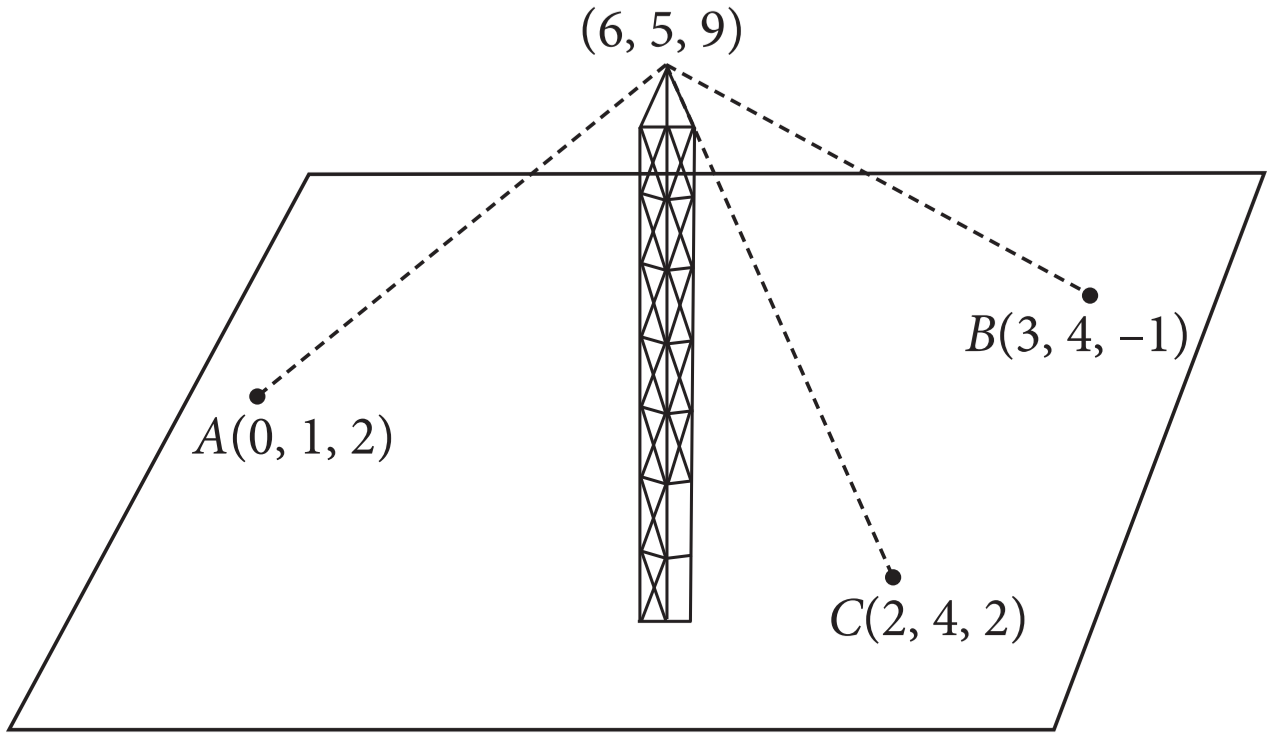
A mobile tower stands at the top of a hill. Consider the surface on which tower stand as a plane having points A(0, 1, 2), B(3, 4, -1), and C(2, 4, 2) on it. The mobile tower is tied with 3 cables from the point A, Band C such that it stand vertically on the ground. The peak of the tower is at the point ( 6, 5, 9), as shown in the figure. Based on the above information, answer the following questions.
  1. The equation of plane passing through the points A, Band C is:
  1. 3x - 4y + z = 0
  2. 3x - 2y + z = 0
  3. 3x - 2y + z = 0
  4. 4x - 3y + 3z = 0
  1. The height of the tower from the ground is:
  1. 6 units
  2. 5 units
  3. $\frac{17}{\sqrt{14}}\text{units}$
  4. $\frac{5}{\sqrt{14}}\text{units}$
  1. The equation of line of perpendicular drawn from the peak of tower to the ground is:
  1. $\frac{\text{x}-6}{3}=\frac{\text{y}-4}{-2}=\frac{\text{z}-9}{1}$
  2. $\frac{\text{x}-6}{3}=\frac{\text{y}-5}{-2}=\frac{\text{z}-9}{1}$
  3. $\frac{\text{x}-6}{3}=\frac{\text{y}-4}{2}=\frac{\text{z}-9}{1}$
  4. $\frac{\text{x}-6}{3}=\frac{\text{y}-5}{2}=\frac{\text{z}-9}{1}$
  1. The coordinates of foot of perpendicular drawn from the peak of tower to the ground are:
  1. $\Big(\frac{33}{14},\frac{104}{14},\frac{109}{14}\Big)$
  2. $\Big(\frac{33}{14},\frac{109}{14},\frac{104}{14}\Big)$
  3. $\Big(\frac{33}{14},\frac{105}{14},\frac{109}{14}\Big)$
  4. None of these
  1. The area of $\triangle\text{ABC}$ is:
  1. $\frac{1}{2}\sqrt{14}\text{sq}.\text{units}$
  2. $\frac{3}{2}\sqrt{14}\text{sq}.\text{units}$
  3. $\sqrt{14}\text{sq}.\text{units}$
  4. $2\sqrt{14}\text{sq}.\text{units}$
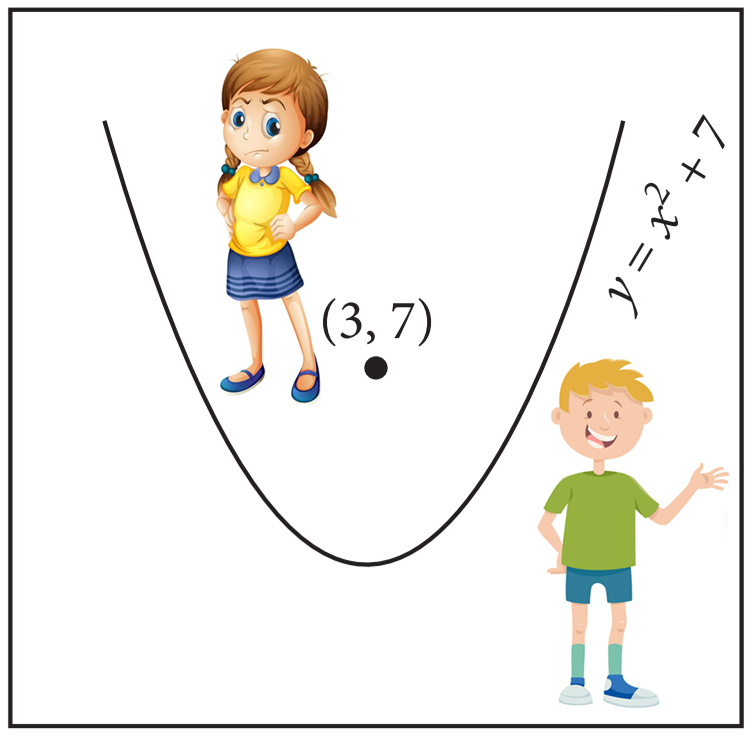
A student Arun is running on a playground along the curve given by $y = x^2 + 7.$ Another student Manila standing at point $(3, 7)$ on playground wants to hit Arun by paper ball when Arun is nearest to Manila.

Based on above information, answer the following questions.
  1. Arun's position at any value of $x$ will be.
  1. $(x^2, y - 7)$
  2. $(x^2, y + 7)$
  3. $(x, x^2 + 7)$
  4. $(x^2, x - 7)$
  1. Distance $($say $D)$ between Arun and Manila will be.
  1. $(\text{x}-1)(2\text{x}^2+2\text{x}+3)$
  2. $(\text{x}-3)^2+\text{x}^4$
  3. $\sqrt{(\text{x}-3)+\text{x}^4}$
  4. $\sqrt{(\text{x}-1)(2\text{x}^2+2\text{x}+3)}$
  1. For which real value$(s)$ of $x,$ first derivative of $D^2 w.r.t, x$ will Vanish?
  1. $1$
  2. $2$
  3. $3$
  4. $4$
  1. Find the position of Arun when Manila will hit the paper hall.
  1. $(5, 32)$
  2. $(1, 8)$
  3. $(3, 7)$
  4. $(3, 16)$
  1. The minimum value of $D$ is.
  1. $3$
  2. $\sqrt{3}$
  3. $5$
  4. $\sqrt{5}$
Three car dealers, say A, B and C, deals in three types of cars, namely Hatchback cars, Sedan cars, SUV cars. The sales figure of 2019 and 2020 showed that dealer A sold 120 Hatchback, 50 Sedan, 10 SUV cars in 2019 and 300 Hatchback, 150 Sedan, 20 SUV cars in 2020; dealer B sold 100 Hatchback, 30 Sedan, 5 SUV cars in 2019 and 200 Hatchback, 50 Sedan, 6 SUV cars in 2020; dealer C sold 90 Hatchback, 40 Sedan, 2 SUV cars in 2019 and 100 Hatchback, 60 Sedan, 5 SUV cars in 2020.

Image

(i) Write the matrix summarizing sales data of 2019 and 2020.

(ii) Find the matrix summarizing sales data of 2020.

(iii) Find the total number of cars sold in two given years, by each dealer?

OR

If each dealer receives a profit of ₹ 50000 on sale of a Hatchback, ₹100000 on sale of a Sedan and ₹200000 on sale of an SUV, then find the amount of profit received in the year 2020 by each dealer.

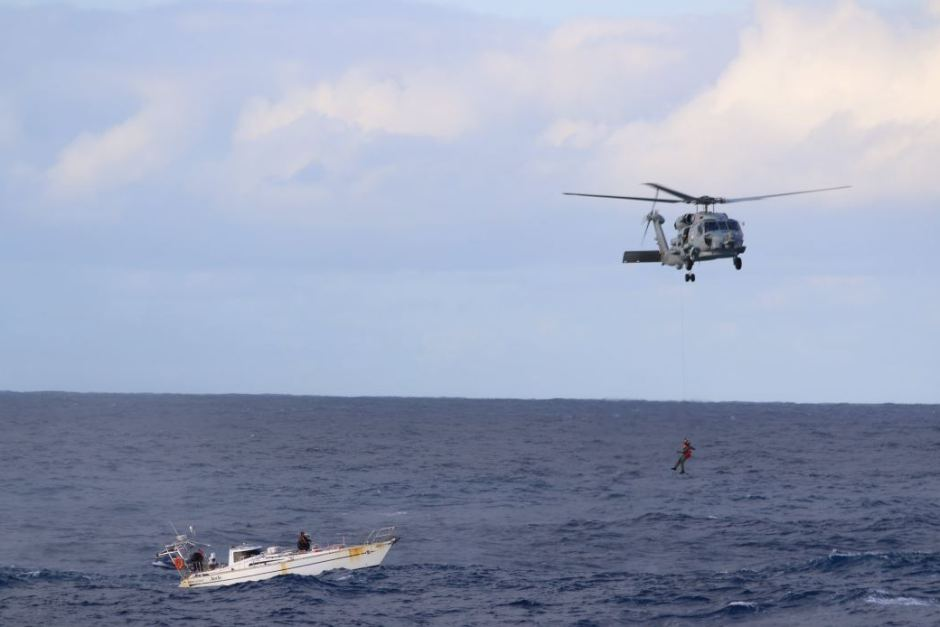
The Indian Coast Guard (ICG) while patrolling, saw a suspicious boat with four men. They were nowhere looking like fishermen. The soldiers were closely observing the movement of the boat for an opportunity to seize the boat. They observe that the boat is moving along a planar surface. At an instant of time, the coordinates of the position of coast guard helicopter and boat are (2, 3, 5) and (1, 4, 2) respectively. Based on the above information, answer the following questions.
  1. If the line joining the positions of the helicopter and boat is perpendicular to the plane in which boat moves, then equation of plane is:
  1. x - y + 3z = 2
  2. x + y  + 3z = 2
  3. x - y + 3z = 3
  4. x + y + 3z = 3
  1. If the soldier decides to shoot the boat at given instant of time, where the distance measured in metres then what is the distance that bullet has to travel?
  1. $\sqrt{5}\text{m}$
  2. $\sqrt{8}\text{m}$
  3. $\sqrt{10}\text{m}$
  4. $\sqrt{11}\text{m}$
  1. If the speed of bullet is 30m/ sec, then how much time will the bullet take to hit the boat after the shot is fired?
  1. 30 seconds
  2. 1 second
  3. $\frac{1}{2}\text{second}$
  4. $\frac{\sqrt{11}}{30}\text{seconds}$
  1. At the given instant of time, the equation of line passing through the positions of helicopter and boat is:
  1. $\frac{\text{x}}{1}=\frac{\text{y}}{-1}=\frac{\text{z}}{3}$
  2. $\frac{\text{x}-1}{1}=\frac{\text{y}-4}{-1}=\frac{\text{z}-2}{3}$
  3. $\frac{\text{x}}{1}=\frac{\text{y}}{1}=\frac{\text{z}}{-3}$
  4. $\frac{\text{x}-1}{1}=\frac{\text{y}-4}{1}=\frac{\text{z}-2}{-3}$
  1. At a different instant of time, the boat moves to a different position along the planar surface. What should be the coordinates of the location of the boat for the bullet to hit the boat if soldier shoots the bullet along the line whose equation is $\frac{\text{x}-1}{1}=\frac{\text{y}-1}{-2}=\frac{\text{z}-2}{3}?$
  1. $\Big(\frac{1}{2},\frac{1}{2},\frac{1}{2}\Big)$
  2. $\Big(\frac{3}{4},\frac{3}{2},\frac{5}{4}\Big)$
  3. $\Big(\frac{1}{3},\frac{1}{4},\frac{1}{5}\Big)$
  4. None of these
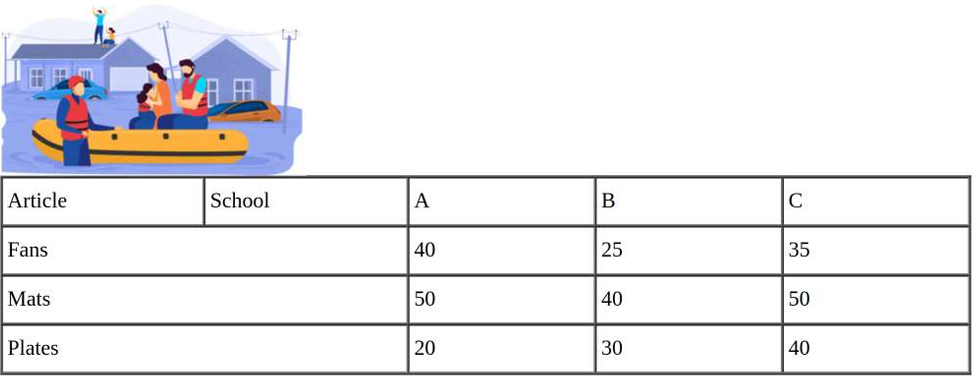
Three schools A, B and C organized a mela for collecting funds for helping the rehabilitation of flood victims. They sold handmade fans, mats, and plates from recycled material at a cost of ₹ 25 , ₹ 100 and ₹ 50 each. The number of articles sold by school A, B, C are given below.

Image

(i) Represent the sale of handmade fans, mats and plates by three schools A, B and C and the sale prices (in ₹) of given products per unit, in matrix form.

(ii) Find the funds collected by school A, B and C by selling the given articles.

(iii) If they increase the cost price of each unit by $20 \%$, then write the matrix representing new price.

OR

Find the total funds collected for the required purpose after $20 \%$ hike in price.

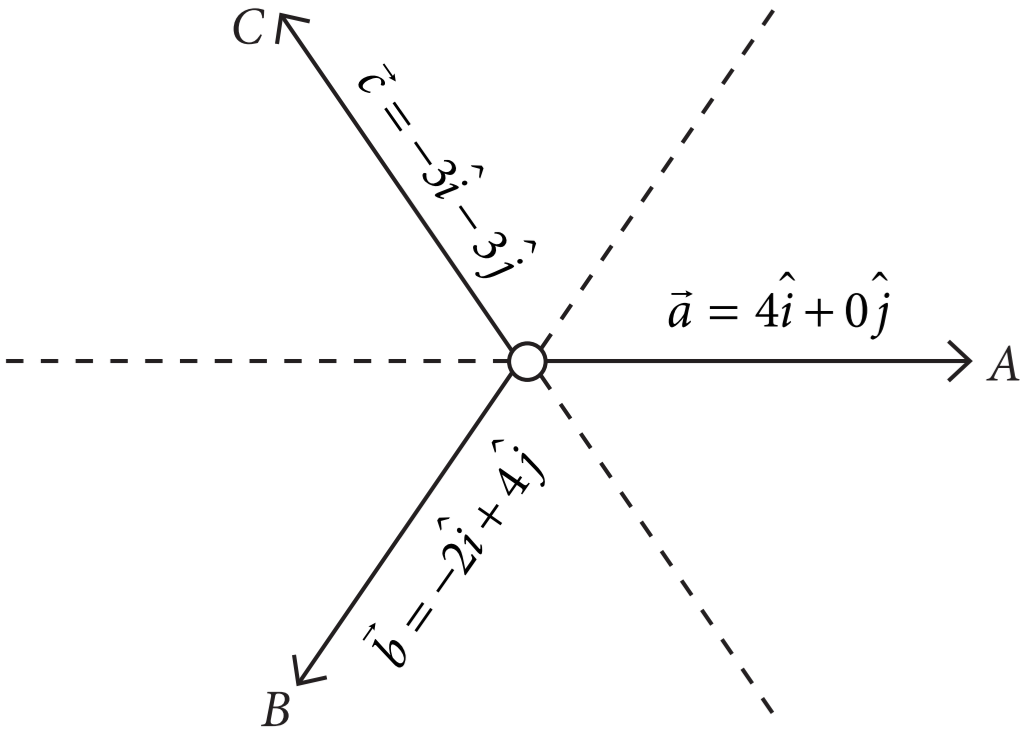
Teams A, B, Cwent for playing a tug of war game. Teams A, B, C have attached a rope to a metal ring and is trying to pull the ring into their own area ( team areas shown below).
Team A pulls with force $\text{F}_1=4\hat{\text{i}}+0\hat{\text{j}}\text{KN}$
Team $\text{B}\rightarrow\text{F}_2=-2\hat{\text{i}}+4\hat{\text{j}}\text{KN}$
Team $\text{C}\rightarrow\text{F}_3=-3\hat{\text{i}}+3\hat{\text{j}}\text{KN}$

Based on the above information, answer the following questions.
  1. Which team will win the game?
  1. Team B
  2. Team A
  3. Team C
  4. No one
  1. What is the magnitude of the teams combined force?
  1. 7KN
  2. 1.4KN
  3. 1.5KN
  4. 2KN
  1. In what direction is the ring getting pulled?
  1. 2.0 radian
  2. 2.5 radian
  3. 2.4 radian
  4. 3 radian
  1. What is the magnitude of the force of Team B?
  1. $2\sqrt{5}\text{KN}$
  2. 6 KN
  3. 2 KN
  4. $\sqrt{6}\text{KN}$
  1. How many KN force is applied by Team A?
  1. 5KN
  2. 4KN
  3. 2KN
  4. 16KN
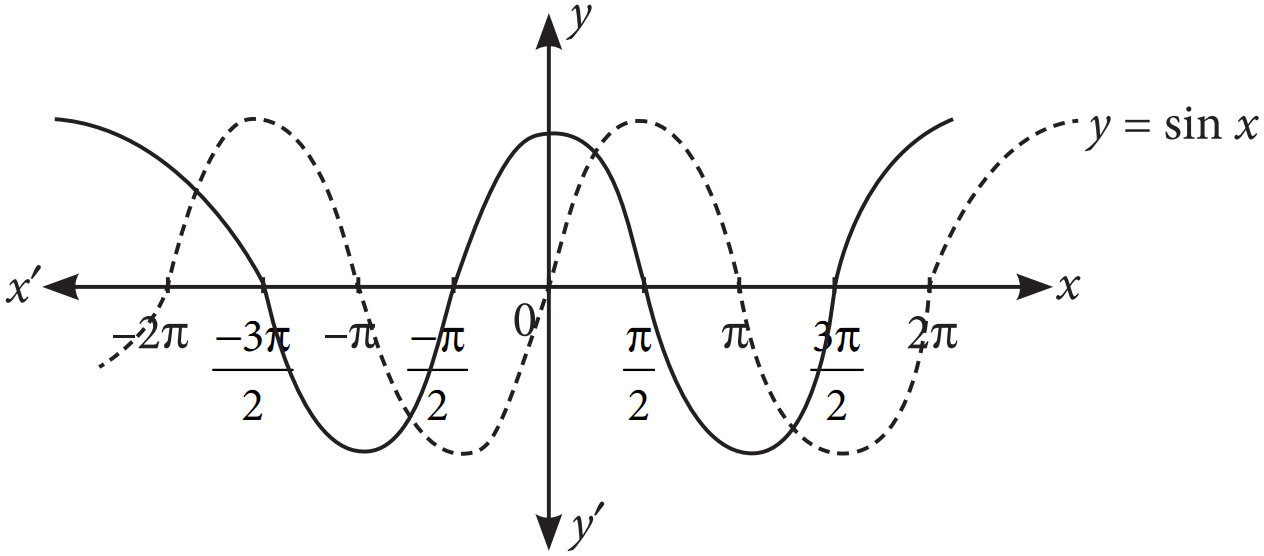
In a classroom, teacher explains the properties of a particular curve by saying that this particular curve has beautiful up and downs. It starts at 1 and heads down until $\pi$ radian, and then heads up again and closely related to sine function and both follow each other, exactly $\frac{\pi}{2}$ radians apart as shown in figure.

Based on the above information, answer the following questions.
  1. Name the curve, about which teacher explained in the classroom.
  1. Cosine
  2. Sine
  3. Tangent
  4. Cotangent
  1. Area of curve explained in the passage from 0 to $\frac{\pi}{2}$ is.
  1. $\frac{1}{3}\text{ sq.unit}$
  2. $\frac{1}{2}\text{ sq.unit}$
  3. ${1}\text{ sq.unit}$
  4. ${2}\text{ sq.units}$
  1. Area of curve discussed in classroom from $\frac{\pi}{2}$ to $\frac{3\pi}{2}$ is.
  1. -2 sq. units
  2. 2 sq. units
  3. 3 sq. units
  4. -3 sq. units
  1. Area of curve discussed in classroom from $\frac{3\pi}{2}$ to $2\pi$ is.
  1. 1 sq. unit
  2. 2 sq. units
  3. 3 sq. units
  4. 4 sq. units
  1. Area of explained curve from 0 to $2\pi$ is.
  1. 1 sq. unit
  2. 2 sq. units
  3. 3 sq. units
  4. 4 sq. units
In pre-board examination of class XII, commerce stream with Economics and Mathematics of a particular school, $50 \%$ of the students failed in Economics, 35\% failed in Mathematics and 25\% failed in both Economics and Mathematics. A student is selected at random from the class.

Image

(i) Find the probability that the selected student has failed in Economics, if it is known that he has failed in Mathematics?

(ii) Find the probability that the selected student has failed in Mathematics, if it is known that he has failed in Economics?

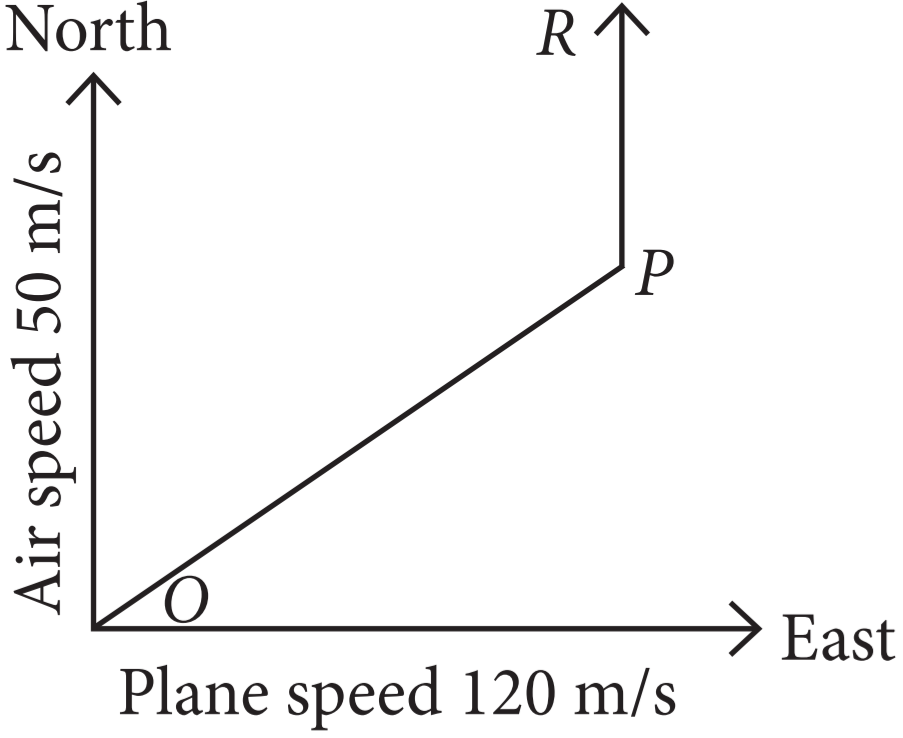
A plane started from airport situated at O with a velocity of 120m/s towards east. Air is blowing at a velocity of 50m/ s towards the north as shown in the figure.
The plane travelled 1hr in OP direction with the resultant velocity. From P to R the plane travelled 1hr keeping velocity of 120m/s and finally landed at R.

Based on the above information, answer the following questions.
  1. What is the resultant velocity from O to P?
  1. 100m/ s
  2. 130m/ s
  3. 126m/ s
  4. 180m/ s
  1. What is the direction of travel of plane from O to P with East?
  1. $\tan^{-1}\Big(\frac{5}{12}\Big)$
  2. $\tan^{-1}\Big(\frac{12}{3}\Big)$
  3. 50
  4. 80
  1. What is the displacement from O to P?
  1. 600km
  2. 468km
  3. 532km
  4. 500km
  1. What is the resultant velocity from P to R?
  1. 120m/ s
  2. 70m/ s
  3. 170m/ s
  4. 200m/ s
  1. What is the displacement from P to R?
  1. 450km
  2. 532km
  3. 610km
  4. 612km